

This is Part 1 of a two-part article.
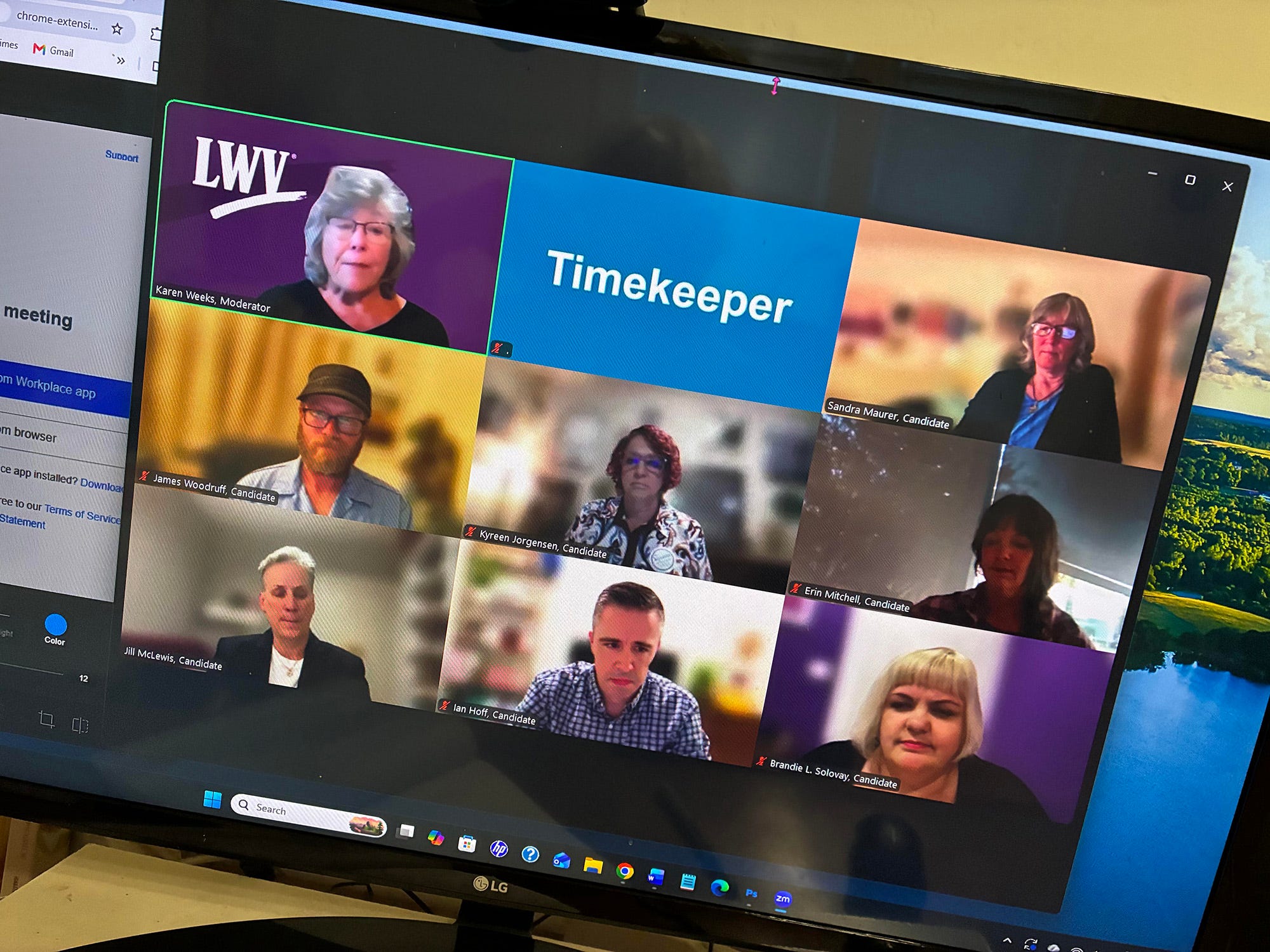
All seven candidates for the Sebastopol City Council were present last Thursday night at the online forum hosted by the League of Women Voters. Questions included several hot-button topics. In this article, we’ll look at their answers to questions about Grocery Outlet, graffiti/racism behind Safeway, and Flock cameras. Part 2 will cover their responses to questions about the Sebastopol Commons, traffic and what they think the job of a councilperson is really all about.
Candidates include:
Kyreen Jorgenson has lived in Sebastopol for 8 years. She has been a deputy clerk for the Board of Supervisors and is currently board clerk for the Smart Train.
James Woodruff is a third-generation Sebastopol resident. A welder who wants to represent working people, he has state certifications in water supply and wastewater treatment.
Ian Hoff has lived in Sebastopol for 8 years. He’s a structural engineer and former Sebastopol volunteer firefighter.
Jill McLewis is a councilmember and current mayor. She has lived in Sebastopol for 12 years. She is the director of a regional food and beverage trade organization and owns a small business, Eye Candy, in Sebastopol.
Brandie Solavay has lived in Sebastopol since 2023. She is a practicing attorney with experience in family, discrimination, disability, immigration and criminal defense law, as well as nonprofit leadership.
Erin Mitchell is a mother and an environmental planning student in her last year at SSU. She was born and raised in Sebastopol. She worked for the state of California for six years in facilities and maintenance.
Sandra Maurer is a councilmember and vice mayor. Before joining the council, she was a non-profit director and environmental activist who helped win the right for utility customers to opt out of smart meters. She has lived in Sebastopol for 38 years.
During the candidate forum, there was a fair amount of equivocation (or, more kindly, nuance) in several of the candidates’ answers to the questions posed to them by moderator Karen Weeks, who is a member of the League’s Voter Service Committee. The city council incumbents—McLewis and Maurer—were at a particular disadvantage because they’re not allowed to state their position on items that will be coming before the city council.
The candidate’s answers below have been edited for length and clarity (i.e., removing all the uhs, you knows, and false starts on sentences).
How should the city balance the desire for more affordable grocery options, aka Grocery Outlet, with concerns about impacts on local businesses?
James Woodruff acknowledged that “Affordability in general is a big issue, and we have a general plan that I would want to respect that keeps these kind of chain stores out of our downtown … We have open spots all around the city, and just as long as they're not in the downtown, where we want to keep things unique and keep that small town character—I definitely value that.”
Ian Hoff expressed his support for having Grocery Outlet move into the old Rite Aid site. Noting that the six grocery stores in Sebastopol draw people from all over West County, he said, “There will be people that will use an affordable grocery store option if we provide it, and that will bring that business to this town. I support this.”
Jill McLewis, careful not to give a yes or no answer, said, “In the past I've been noted as expressing a concern [that] we might possibly consider not having chains at all in the city of Sebastopol.” She also said, “I do believe that we need affordability. I do have a variety of concerns that I am hoping can be addressed when it does come to the council.”
Brandie Solavay summarized the arguments on both sides of the issue, then settled for, “So I think the key here is just really to listen and understand the full issue and explain my vote to the community once I make my vote.”
Erin Mitchell reminisced about the small town pleasures of shopping with her mom in Sebastopol. “I don't think that right smack downtown is a very good location [for Grocery Outlet],” she said. “We do need to maintain the small town charm of Sebastopol, and that would change things aesthetically.” She also admitted that she does drive out of town to Trader Joe’s for lower prices. “I’m a single mom…I have to,” she said.
Sandra Maurer said she has “concerns about the downtown location” and then summarized the arguments on both sides. She’d also been doing some research: “In 2013, Community Market was opposed because we already had too many grocery stores, and I was told that I think it might have been Lucky's was also opposed because we had too many grocery stores then.” Ultimately, she said, “I don't think a Grocery Outlet will replace the local grocery stores.” She did not state her position, but said, “In my research, the first thing I was really surprised to learn was that many people love Grocery Outlet because they serve people who need more affordable food.”
Kyreen Jorgensen admitted that “I’m one of those people that loves Grocery Outlet. I’ve shopped there.” She said she also noticed that the store doesn’t always have what she needs so she shops at other stores as well. Regarding the claim that Sebastopol has too many grocery stores already, she said, “If that was truly the case, then one of these grocery stores would not still be in business. But they are in business, right? Because they are being patronized. I look at it as the Bonnie Bagels versus Grateful Bagel kind of competition thing,” which she described as a kind of friendly competition.
The graffiti behind Safeway is a visible issue. What would you propose to ensure graffiti is removed promptly and that the problem is addressed rather than being repeatedly cleaned up?
Ian Hoff noted that this is a tricky problem because of the multiple parties involved (police, school, city) and the fact that it’s happening on private property, which limits what the city can do. “There could be some incentives to encourage businesses to remove graffiti that might be deemed more offensive than just casual artistic graffiti. This does kind of skirt a little line between just people's free speech. There's been some very colorful, some very artistic graffiti in town too. So I'm not sure how we could make a policy that would say this type is okay, this type is bad.” He also noted that it was good news that the perpetrators of the racist graffiti behind Safeway were arrested and dealt with.
Jill McLewis noted that this issue was coming before the council on Tuesday, and referenced the complications introduced by the number of agencies and entities involved, but said, “It's going to take a large discussion at the council and listening to everyone and hearing all the different opinions, I think, before any kind of solution can be achieved. But I am of the thought that the more we listen to people and the more we get people to talk in person, is where we can actually come and find solutions.”
Brandie Solavay suggested that the community come up with ideas for deterrence. “From what I understand, there are weekly meetings with our current mayor and Safeway and the police to try to figure this out. I think those meetings should continue … Maybe instead of trying to figure out how to just clean it up—which is important, we should do that—also maybe the community or folks could come up with ideas of how to prevent it from happening, such as ‘Let's do painting on canvases in the parking lot of Safeway’ or something instead of behind Safeway … to deter people from actually doing it in the first place.”
Erin Mitchell recalled that during her years working for the state, “Painting over graffiti was a regular occurrence … My suggestion would be to do a mural … And you know, we have an artistic town. I'm all about solutions and figuring out, especially keeping it peaceful.”
Sandra Maurer thought the question itself was a little off-base. “I think the bigger issue here is the racism,” she said. “It was graffiti that was racist.” She noted that graffiti has been a problem for a long time, and the city had volunteers who paint over it, but in this case, she said, “The issue is racism that we as a city can deal with—or make an attempt to deal with—because that's a very, very big problem. I think offensive graffiti should be removed immediately.” She noted that the council would be talking about the creation of an ad hoc committee on racism this coming Tuesday.
Kyreen Jorgensen agreed with Maurer. “I think that we really do need to address the core issue, which is racism. It is prevalent in this town and in this country. I'm not sure how to address it, but I love the idea that the council is thinking of an ad hoc.” She suggested reaching out to other communities who’ve dealt with this problem, as well as reaching out to the Sebastopol community at large. “Again, I go back to going out to the community. There's some great ideas out there. Every time I talk to people, I'm in awe of some of the things that people say. So I agree. It's not the graffiti itself. It's this ideology that we need to hamper.”
James Woodruff said, “As far as the graffiti goes, I believe that it is the responsibility of the individual businesses to remove it as soon as they possibly can.” He said he was grateful for the graffiti removal volunteers, but he agreed with the previous speakers that, “The main issue was definitely the racist nature of the graffiti. In general, I'm a big believer in restorative justice, rather than immediately criminalizing children,” by which he meant the teens responsible for the graffiti behind Safeway. “At the same time, we also need to talk to the residents who are immediately affected by this … We should be hearing from what they want, and how we should respond should definitely reflect that. Anything we do should be a broad-based community response, whether it's restorative justice, better teaching, or some murals. I do like the idea of having murals if possible because graffiti artists rarely cover up murals.”
Would you support Sebastopol using Flock or other ALPR cameras? Why or why not, and what limits would you put on how the data is collected, retained, and shared?
Jill McLewis told listeners that this issue has come up a lot recently with the current council. She partially explained the current rule — namely that any expansion of the number of simple surveillance cameras on city property—or any coordination with other agencies, such as the sheriff’s department—needs to be approved by the council. “It’s always a conundrum with technology because technology is always progressing, and then we have to figure out how to use it responsibly … I hear law enforcement say that Flock cameras are important because they help reduce crime, and I hear a lot of concern about Big Brother watching, but at the same time, the greater concern that I hear from many electives and people in the community is how that data is being utilized. So I think that it’s a broader discussion than I can say here … There are a lot of different options out there and discussions, and I think it’s going to be an ongoing thing that we’re going to have to figure out.”
Brandie Solavay said a Flock camera had just been installed in front of her property (not by her presumably). (Editor’s note: While Flock cameras can’t be installed on city property in Sebastopol, there are no rules on what businesses or residents can install on private property.) “As an attorney that has practiced immigration law for many years, I used to tell my DACA clients, ‘I don't know what's going to happen with this data. I don't know who is going to be shared with, and so I really, really, really worry about not having control or losing control of the data and what data is going to be kept. I don't think there's a guarantee … that this data won't be shared with other people for maybe reasons that aren’t legitimate or good reasons ... I understand that folks may want them for safety, but also I think they also make the city unsafe for some of our residents.”
Erin Mitchell didn’t beat around the bush. “I'll be very bold and honest in saying that this surveillance is too much. Like people need to feel like they have autonomy and privacy. I mean, we have satellites flying around the globe every day that can see the color of our socks. Are these cameras really making it easier to catch crimes or is it a data collection scheme?” She said she thought people should be able to choose to put up a camera on their front porch, but she worried about neighbors feeling like something was watching them “constantly all the time. This is a very big concern for me.”
Sandra Maurer agreed that the city already had a pretty tight surveillance ordinance, then she took her answer in a whole different direction. “If you're concerned about a Flock camera, what about the cell phone? Everyone has a cell phone in their pocket. These are surveillance tools, and the other tool is the smart meter. Almost every home has a smart meter on it, and these are surveillance devices. They collect detailed energy usage data, which can reveal patterns of behavior—whether you're at home, whether you're or not, when you cook, when you watch TV … if you have guests, what your patterns are—and they are really a search without a warrant. Smart meter data is very valuable, and California utility companies admitted they are providing smart meter data to the government and law enforcement and third parties. And this is on every home.” She added that “Anybody can opt out of a smart meter if they don't want to be surveilled that way too.”
Kyreen Jorgensen said she was also grateful for Sebastopol's existing surveillance ordinance. She also said that “Technology can be used nefariously, and I also think that technology could be used for the greater good.” But she didn’t think it was necessary in a small town like Sebastopol. She took this occasion to praise the Sebastopol police: “I think that our police department is doing a fabulous job of getting out there, being more present and interacting with our citizens. I see them more often getting out of their cars and walking around the Barlow and down Main Street.”
James Woodruff is clearly passionate about this issue. “Flock cameras are AI-powered. They’re not secure. It’s been shown that they are easily hacked. So people—even people who are not authorities and are supposed to have access to this data—can access it. Besides which, I don’t think that we should be having mass surveillance, even for the authorities. AI cameras can create profiles. They have so much data and they keep it for longer … and it just makes everyone unsafe. Data storage, data sharing—we don’t know who this information is going to. It does not stay on our servers. It is actually owned by Flock, and so we don’t really have any control over it. And so I don’t think we need Flock cameras in Sebastopol.” He noted that “Even dumb cameras are somewhat invasive of people’s privacy, but at least with those, we have to make positive efforts in order to share that information … People cannot reach in from outside and just grab it.”
Ian Hoff doesn’t think ALPRs cameras are all bad. “This is kind of the nature of our technology these days, whether it's our cell phones, our word processing or spreadsheet software, if you drive an electric car, if you have a doorbell, if you use a video conferencing site online—we're getting these things for free because they are collecting and mining our data. This is one of the tricky things with new technology.” Although Hoff said he was glad there weren’t Flock cameras in Sebastopol, he told a personal story regarding ALPRs that made him rethink their value: “I witnessed a drug deal once and called 911. When I was talking to a police officer, they said they have license plate readers on cars where they can pinpoint potential vehicles of interest that are young criminals, drug dealers, and gang members. This seems useful. Now, again, you know, having a private company manage that data—that's risky. But for Amber Alerts, stolen vehicles, something can ping and identify these vehicles—this is a good thing. But yeah, there should be safety and privacy concerns.”
Part 2 of this article will be posted tomorrow morning.
You can watch the entire Sebastopol City Council Candidate Forum on the League of Women Voters’ YouTube page.
As usual, marvelous coverage, Laura.
With regard to Grocery Outlet, wouldn't it be a locally owned franchise? If so, that should lessen concerns about it being another chain store in Sebastopol. I shop from Andy's to Fircrest, hitting a few stores in between, probably 5 days a week. I'm happy to buy local, but kind of resent all the flyers posted at each store checkout stand talking about Sebastopol already having too many stores for a town of 7,400. Along with probably 50,000 other people, I live outside city limits and rely on Sebastopol's store for most of my daily needs, so let's not pretend that the store-to-shopper ratio here is anything close to what Andy's, Pacific Market, or Fircrest say it is. (I especially have a bone to pick with Fircrest whose prices have gone up on several items I used to regularly purchase there over the years - even Oliver's sells the same or comparable items for less!) Any store that can offer lower prices on a few goods for those of us not making 6-figure salaries is welcome in my book.