


This is Part Two of a city council recap of the May 5th meeting of the Sebastopol City Council. You can find Part 1 here.
Most of the items at the end of last week’s council meeting were either dispensed with quickly—as in the council’s approval of 3% raises for upper management and the police—or covered extensively in two previous articles from last week. (See “Mary Gourley is (finally!) the official city manager of Sebastopol” and “How much does a city manager cost these days?”) That leaves just one long and complicated item left to go: the city’s cost allocation plan.
The Cost Allocation Conundrum
The city council’s Budget Committee is putting together its budget for the next fiscal year, which starts in July 2026. As a part of this process, the council needed to make a decision about the city’s Cost Allocation Plan, which, in the case of Sebastopol, primarily determines how much the city’s Water and Sewer funds owe the City’s General Fund for the city services they use.
The City’s Water Fund and Sewer Funds are not independent agencies. They rely on services that are budgeted through the City’s General Fund, such as billing, payroll processing, human resources, legal support, information technology, and executive oversight.
Figuring out how much the Water and Sewer funds owe the city’s General Fund for those services is what the Cost Allocation Plan is for.
The city’s current cost allocation consultant, Clear Source, first developed a cost allocation plan for the city in 2024. One of their findings was that the city had been consistently overcharging Water and Sewer, based on both an old Cost Allocation Plan that hadn’t been updated since 2001 and a flawed 2019 plan.
Cost Allocation Plans are built to capture both direct and indirect costs. As the staff report noted, “It’s important to note that the City’s Cost Allocation Plan was developed through a structured and established process. The current methodology was informed by interviews with City staff, reflects operational responsibilities, and was based on widely recognized industry standards for municipal cost allocation. The Cost Allocation Plan, consistent with standard practice, incorporates reasonable estimates and defined assumptions and is developed through a systematic approach to ensure appropriate allocation of shared costs across funds.”
Clear Source updated the city’s cost allocation plan in 2025, but because of public and council concerns that the plan was still overcharging Water and Sewer, the council set up an Enterprise Funds Oversight Committee and directed that the next iteration of the Cost Allocation Plan be developed in coordination with that committee and the council’s Budget Committee.
The two items that worried the council most were the extravagant charges for legal work (almost $650,000) and the city council (roughly $200,000). In the first case, councilmembers wondered why the city was charging Water and Sewer for legal work, when there were very few legal costs associated with those funds in recent years. (The city itself did indeed have giant legal bills, but those were related to a lawsuit from the ACLU and other personnel issues.) Councilmembers also wondered why Water and Sewer was being charged for City Council time when councilmembers serve almost for free—they get a $300 a month stipend, plus optional health insurance).
In reference to a comment that the only cost of the council is their $10 a day stipend, Councilmember Phill Carter argued that this was an over-simplification. “It’s more than that,” he said. “We are not just us. We are taking up this building. We’re taking up the electricity right now. We’re taking up staff time.” The point of a Cost Allocation Plan, he said, is to account for all those hidden (or indirect) costs.
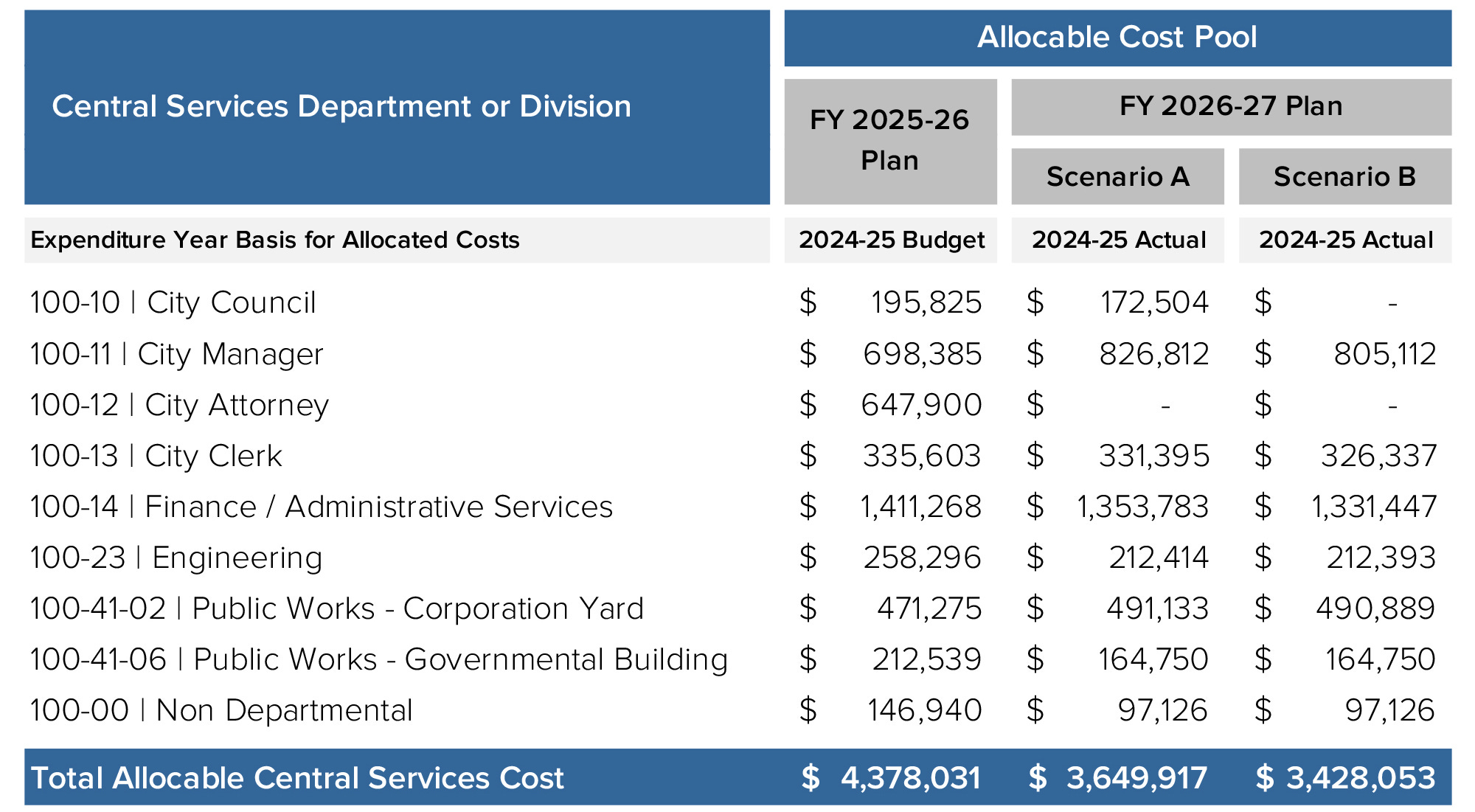
In the chart below, you can see what the city’s Cost Allocation Plan looked like for this current year, 2025-26 (the first column). The next two columns represent two of the options the council considered for the next fiscal year—minus the cost for the city attorney in Scenario A and minus the costs for both the city attorney and city council in Scenario B.
In reaction to the council’s concerns, Clear Source, the city’s Enterprise Funds Oversight Committee and the Budget Committee went to work and tried to come up with a more accurate cost allocation. Scenarios A and B weren’t the only options that they came up with. Here is the full list of choices they presented to the council. (Not sure why the “options” were numbered 0 to 3, while the “scenarios” were designated by letters.)
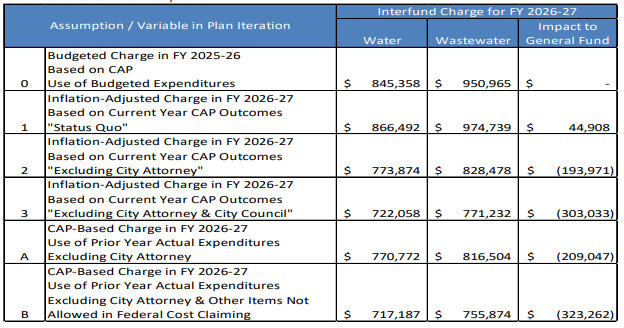
In the end, on a vote of 4 to 1 (McLewis dissenting), the council approved Scenario A. This choice uses Cost Allocation Plan charges based on last year’s actual expenditures and excludes city attorney costs. The council added a 2.5% adjustment for inflation. This means that the impact of Scenario A on the General Fund will be a loss of roughly $193,000.
In making this choice, the council was following the recommendation of the city staff, the Budget Committee, and a majority of the Enterprise Fund Oversight Committee, but Mayor McLewis wasn’t buying it. She argued that more careful accounting was necessary to win back the confidence of the public.
“In my mind, in feedback that we’ve received over the years, it’s my opinion that we’ve lost the confidence of the public because of past practices where this wasn’t assessed for so long or addressed,” she said.
McLewis wanted both city council and city attorney charges removed from the Cost Allocation Plan. Rather than estimates based on interviews with city employees and standard industry algorithms, McLewis wanted to see the city attorney, council members, and city employees keep careful track of the amount of time they spent on water and sewer issues so that those could be charged directly.
“I understand the challenges of that. I run an organization, I have staff, but we’ve lost the confidence of the community, and in my mind, the best way to [remedy] that is to put forth a good faith effort to show that what we’re doing is actually what needs to be done.”
These thoughts are very much in line with the sole dissenting member of the Enterprise Fund Oversight Committee, Kate Haug. You can see Haug’s very detailed argument in the public comment she submitted to the council. Along these same lines, Lee Mathias’s comment is also worth reading.
We reached out to Haug for comment on this story. She wrote back, “The EFOC [Enterprise Fund Oversight Committee] will be presenting to Council on June 2, 2026. Our formal recommendations will be presented then. As I’m working on a committee and in conjunction with other volunteer colleagues, I’d prefer to respond after our formal presentation.”
Councilmember Phill Carter, a member of the Enterprise Funds Oversight Committee, said Scenario A, while not perfect, was a good start.
“I think the Enterprise Committee will do more for the following year,” he said. “I think this year, initially, we need to take baby steps. This is one way to initiate that process. Doing something dramatic, going to time and materials—more like Cloverdale does—initially would be traumatic to staff and to the budget. It’s responsible to do things methodically and with pace and clearly. Our consultant can prove and has the methodology…to understand exactly how we are allocating money.” He repeated again, “These are baby steps, and that’s why Scenario A is important just to get to where we need to be eventually. The Oversight Committee is diligently working hard to figure out what that appropriate way is.”
Watch a recording of the May 5 Sebastopol City Council Meeting here. See the agenda and documentation of the meeting here.
The costs allocation plan is very complicated. Probably by design, so Water rate payers don't realize they are paying up to 1/2 of city expenses like City Council and City Manager and Administration. Imagine that the water and wastewater rate payers decided to form a separate district and part ways with the city. Do you think the city would be able to cut administrative expenses by 1/2 because there would be so much less work to do? The city can do this because it is complicated and really no one is paying much attention.
The May 5 discussion is important, but it should not be viewed as the beginning of this issue. This has been unfolding for years, across at least three City Manager administrations: Larry McLaughlin, Don Schwartz, and newly appointed City Manager Mary Gourley.
The key public moment I keep coming back to is the October 3, 2023 City Council meeting. At that meeting, during the water and sewer rate discussion, the Council asked how the General & Administrative allocation to the enterprise funds was being determined. Staff stated that the allocation was based on the 2001/2002 cost allocation study. In other words, ratepayers were being asked to consider major rate increases while a major component of the charges to Water and Wastewater was still based on a roughly 21-year-old methodology. The minutes also show that the current utility rate study itself had been initiated later than anticipated because of workload, even though existing rates were already insufficient for infrastructure and capital needs.
That matters because ratepayers were already paying the bills. They were paying under old assumptions, old formulas, and unclear documentation. When this was finally questioned publicly, the answer was essentially: yes, the allocation study is old, and yes, a new one is coming. But coming later. First quarter of 2024 was the expectation. That was during Larry McLaughlin’s time as City Manager/City Attorney. Don Schwartz would not begin as City Manager until January 2024.
So this is not a sudden technical disagreement that appeared in 2026. The problem was visible by at least October 2023, and the underlying methodology went back more than two decades.
https://www.cityofsebastopol.gov/wp-content/uploads/2022/12/APPROVED-October-3-2023-FINAL-City-Council-Meeting-Minutes.pdf