

Last Sunday, Feb. 22, the Western Sonoma County Historical Society hosted a special event at the Sebastopol Center for the Arts. Though it was cold and rainy outside, inside the building, the conversation was bright and chipper. Sebastopol community members gathered on this day to discuss one thing: trains. But not just any train. They’d gathered to hear about Sebastopol’s much-admired “Train down Main.”
Presenting at the event was Fred Codoni, who had worked for the Petaluma and Santa Rosa Railroad (P&SR), which ran through Sebastopol, as well as other nearby railroad companies starting in the late 1950s. Codoni spent the next hour describing the colorful history of the railroad in Sebastopol, showing the audience countless images of the trains and how they changed over time.
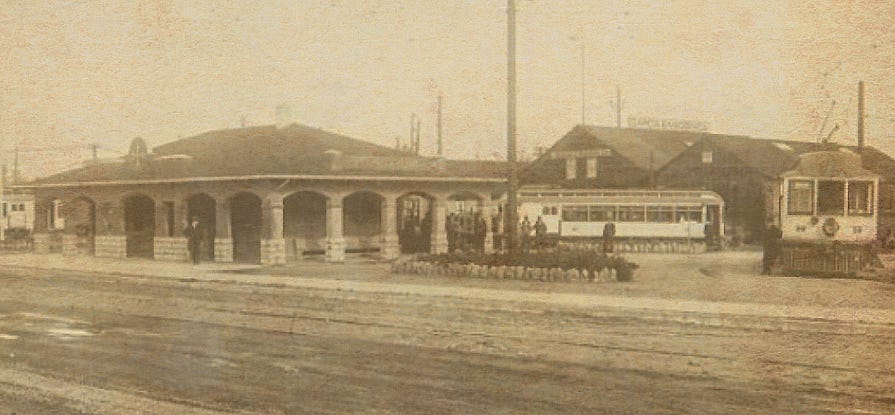
Codoni started by describing the “Interurban Era,” a time when trains created a vital connection between rural communities and their urban centers. Interurban electric trains would give service to places where the larger, steam-powered, mainline trains couldn’t. While large mainline trains required a dedicated crew, electric trains were cheaper and only required a few people to run. Sebastopol got its first glimpse of the interurban era on April 5, 1904, when the first trains started arriving to replace horse-drawn carts. These passenger trains ran down Main Street, right where automobiles would drive in the coming years.
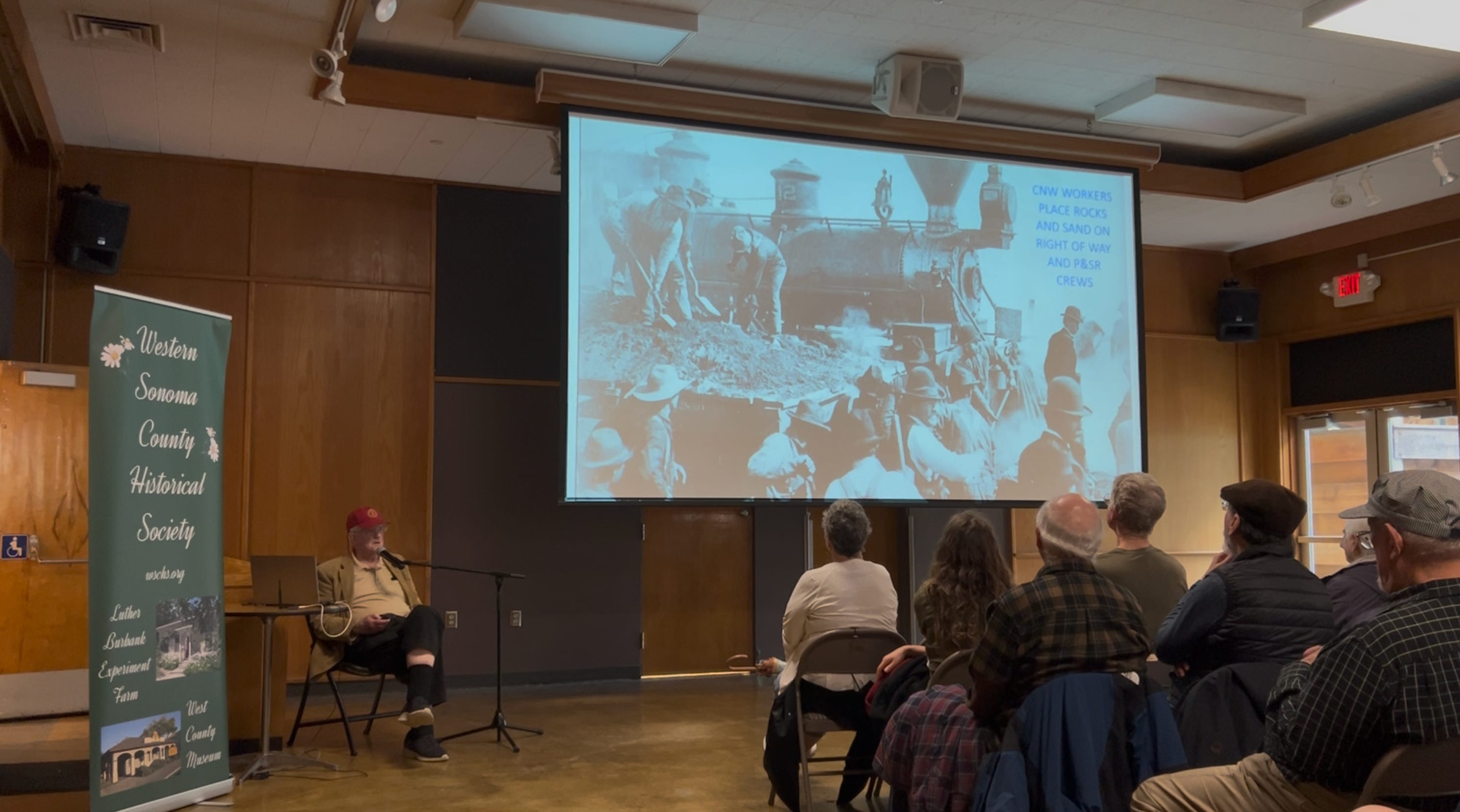
Around this time, multiple competing train companies had lines running through Sebastopol. Codoni told the story of a historical skirmish, known as the Battle of Sebastopol Avenue. The P&SR wanted to expand its tracks, and in order to do so, the company had to cross the tracks of one of its competitors, the California Northwestern line, which didn’t want to allow the crossing. Codoni explained how crowds of people came out to protest California Northwestern. To disperse the protest, Cal Northwestern had workers shovel dirt and debris onto onlookers. They also blocked the tracks with a train engine and, at one point, opened a steam line to scald the protesters. Ultimately, a judge ruled that P&SR could install a track crossing, and in 1905, the first P&SR passenger car crossed the California Northwestern tracks.
The P&SR had ambitious plans to expand south toward San Rafael and north toward Healdsburg. In 1906, the earthquake changed these plans. On one hand, it was beneficial to the train company as it provided a lot of business moving rubble. Shortly after the earthquake, PS&R introduced its first locomotive, which was particularly useful in transporting large amounts of cleared debris. However, the earthquake also wiped out much of the company’s passenger business. This and the advent of the automobile dealt a big blow to PS&R.
Codoni said, “It was the beginning of the end for the Petaluma and Santa Rosa Railroad, though they didn’t know it at the time.” Shortly after the earthquake, PS&R started to suffer great financial losses.
In 1927, Edward Maggard, a fabled train director, found a struggling train system in the PS&R. As Codoni explained, “He was going to save the passenger routes and the freight service.” Maggard promoted the trains through various advertising campaigns. However, despite his best efforts, passenger counts drastically declined during this period, due to the increasing prevalence of automobile travel. In 1932, the last passenger train passed through Sebastopol. In the years after, most of the wooden passenger trains were burned so their metal parts could be salvaged.
But that wasn’t it for the PS&R railroad. Although the passenger service had ended, freight transportation was still a lucrative business. In 1946, PS&R bought two diesel engines, which were easier to run, given that the electrical wires that powered previous passenger trains were in constant disrepair. These engines took freight, especially from Sebastopol’s many canneries, all across the PS&R lines and to connecting lines. This was the height of the “Train Down Main” era, when the PS&R diesel engines would often stop or slow the same automobile traffic that had killed passenger service. In 1958, PS&R bought two more engines, completing their set of diesel engines: #1, #2, #3, and #4. The new engines, #3 and #4, could be connected and conducted by one man, which was more cost-effective.
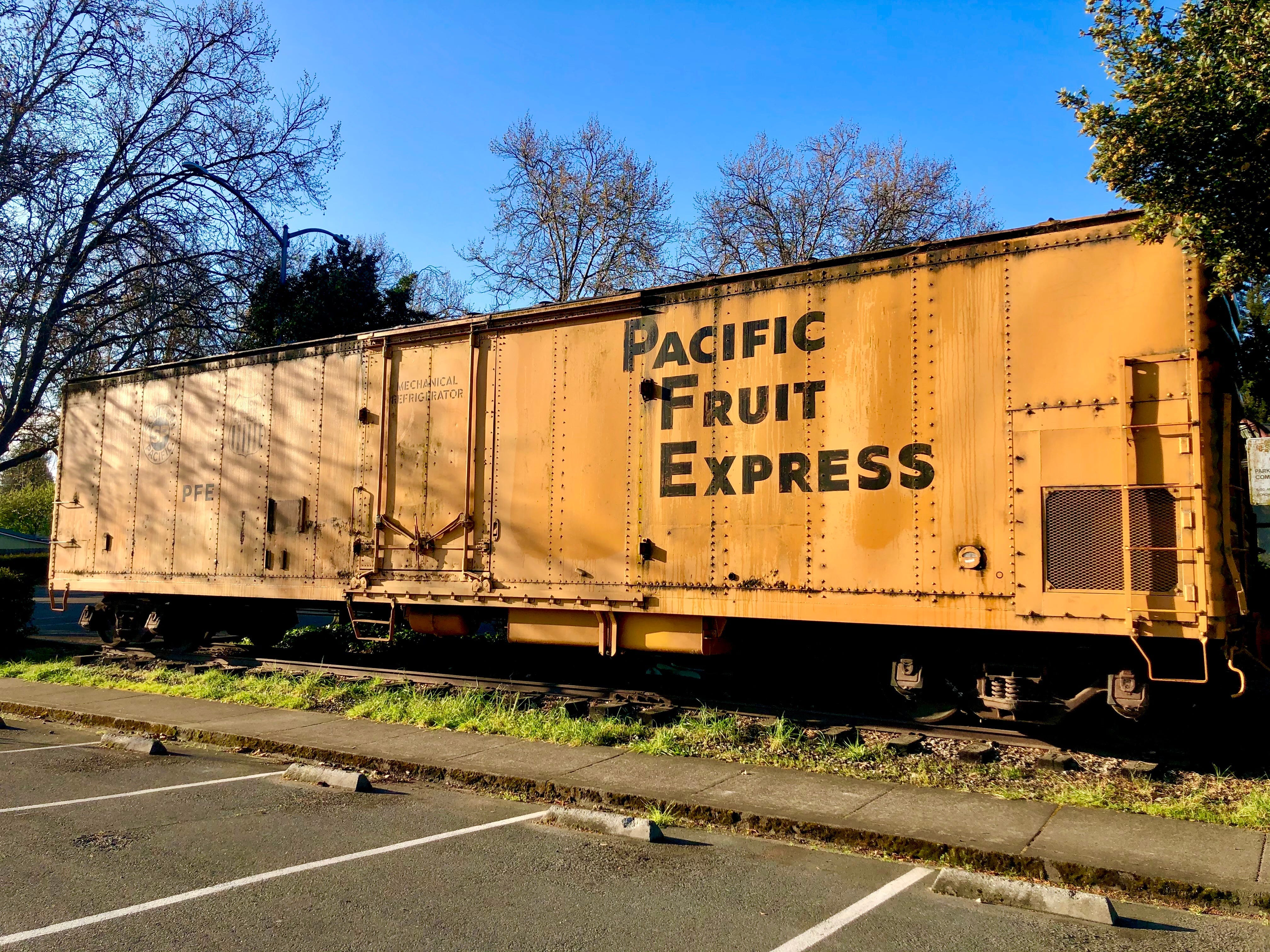
Ultimately, however, the PS&R couldn’t last forever. As the diesel engines started to feel the effects of wear and tear, PS&R started to lease engines and cars from their competitors, Southern Pacific Railroad and the Northwestern Pacific Railroad. The boxcar that today sits in downtown Sebastopol near Hopmonk Tavern was owned by the Southern Pacific railroad and was likely used during this time. (The boxcar is now used to store the archives of the West County Museum.)
Slowly, the PS&R lost its identity as Sebastopol’s railroad. It wasn’t long until the rail industry in Sebastopol ended. The PS&R was abandoned in 1984, and shortly after, the tracks were removed.
Some of the PS&R passenger cars still exist today, restored by various Sonoma County historical societies and railway museums. Though the railroad is gone, it will continue to live on in the stories of Sebastopol’s fabled “Train Down Main.”
The Western Sonoma County Historical Society runs both the West County Museum in downtown Sebastopol and the Luther Burbank Experiment Farm, off Bodega Avenue. Find out more about their events and presentations on their website.
The long road back for P&SR Passenger Car 63
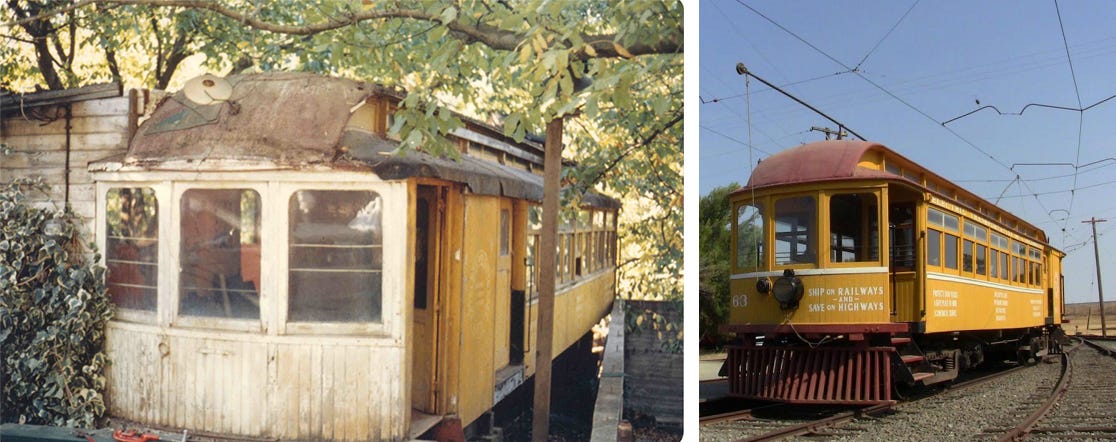
Photo and text from the Western Railway Museum in Suisun City
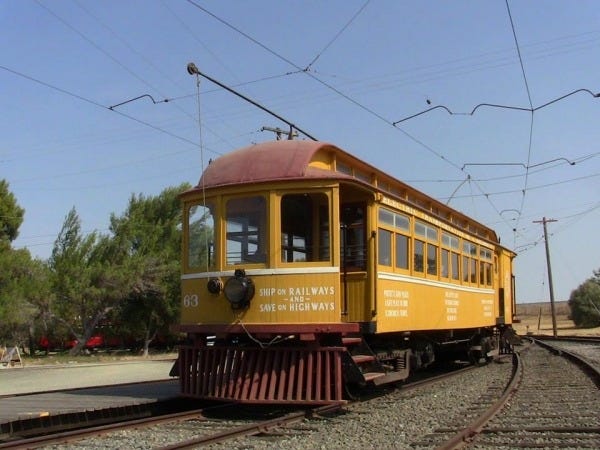
This little wooden interurban car, P&SR 63, is a wooden combination baggage and interurban car with clerestory roof. It is a double-end, double-truck car, built in San Francisco by the Holman Car Company in 1904. It ran between Petaluma, Sebastopol, and Santa Rosa with a branch to Forestville. Passenger service on the P&SR ended in 1932, and this car was dismantled. The car body was used as part of a house in the hills west of Fairfield until it was acquired by the Western Railway Association in August 1967 and moved to the museum on Nov. 27, 1967. Members of the association tore down the house to get the car body out of it. The car was restored to operating condition at the museum, with parts salvaged from a car from Yakima Valley, Washington.
Dates
1904-1932: P&SR 63.
1932: P&SR discontinues passenger service.
1932: car 63 dismantled, body sold.
1932?-1967: used as a house in rural Solano County, California.
1967: acquired by Bay Area Electric Railroad Association and moved to Rio Vista Junction.
1967-1973: car restored to operation by the Western Railway Museum shop, using trucks and motors from Yakima Valley box motor 301.
Lawson Gaylord is an Analy student and publisher of the West County World, Analy’s student newspaper.

Lawson is an awesome reporter. Guessing at his age, I'm left wondering where he learned about trains. But then again, we still teach about dinosaurs and good manners, too, am I right?
I was on Main Street the day they tore out the rails for the "train down Main."
Bravo to Lawson Gaylord on reporting this important piece of local history and his pursuit as a journalist.