


There’s a new turn in the fight over AT&T’s plan to shut off its old copper phone lines.
On July 15, four groups asked a federal judge in San Diego to let them join AT&T’s lawsuit and fight on California’s side. The four are a group that speaks for the state’s rural counties, a consumer group called TURN, another that speaks for all of California’s counties, and the union for phone workers. Sonoma County is one of the 40 counties the rural group represents.
The same day, the judge, Linda Lopez, let the groups hand the court a brief with their views. AT&T had tried to block even that. Now the groups want more: the right to make their own arguments and to appeal if they lose, instead of leaving the defense to state officials. The judge hasn’t said yes or no yet.
The rest of the fight hasn’t changed. AT&T still needs California to back down before it can cut copper service, and that hasn’t happened.
In 2025, a Forestville nonprofit got $17 million to bring broadband to Forestville and the Sonoma Coast. On July 16th, it was awarded another $32 million from the California Public Utilities Commission to expand that network and add Graton.
Broadband cable runs up Highway 116 toward downtown Guerneville. It crosses a pasture where a grazing co-op keeps goats and sheep next to a small water-system well. The people who live under those wires still can’t buy service.
That’s how internet service works out here. The wires are there. The service is not. There’s also fiber running through West County — thin strands of glass that carry the fastest internet you can buy. Republic Services, the county’s trash hauler, paid to run business fiber to the taxpayer-owned transfer station. No homes along the way can use it. More fiber sits unused in the ground next to Highway 116.
A Forestville nonprofit called WiConduit is trying to build fiber to homes that have no internet. The project was supposed to be wrapped up in June, but it’s running about 18 months late.
Meanwhile, AT&T just got federal permission to shut down its old copper phone lines across much of California — including parts of Sonoma County.
More money for local fiber
WiConduit won its $17 million from the California Public Utilities Commission in January 2025. The money pays for two builds:
Forestville Connect got $7.8 million to hook up 295 locations with no service (that’s about $26,000 per location).
Sonoma Coast Connect got $9.2 million to hook up 507 more, at about $18,000 each, in Timber Cove, Walsh Landing, Fort Ross, Jenner and Seaview.
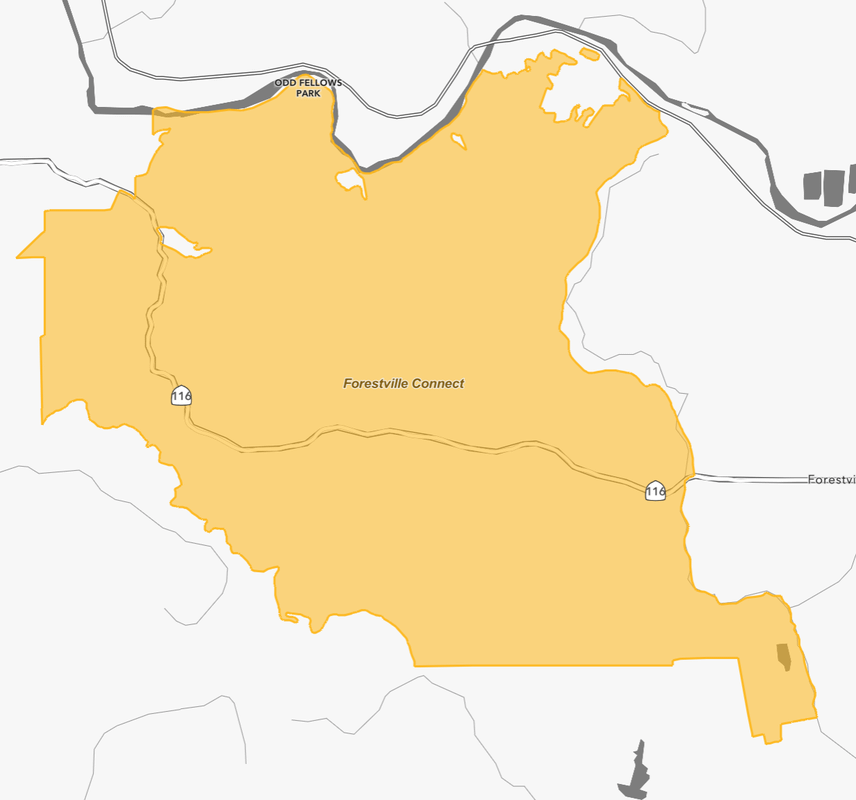
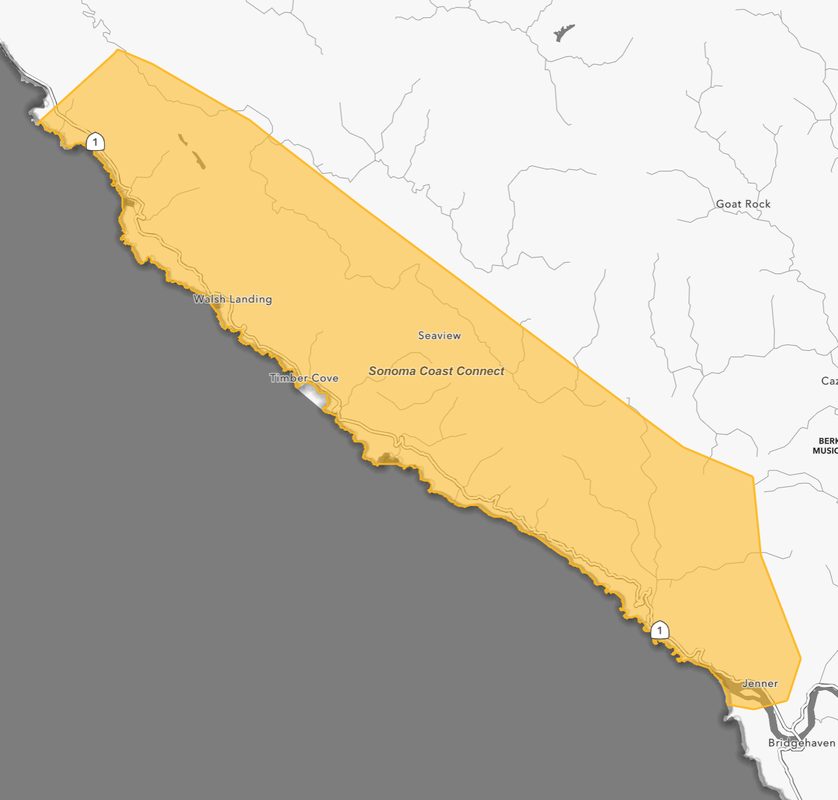
The plan was to bury every foot of cable, safe from fires and falling trees, but that cost too much. “Budgets were higher than expected on all fronts,” said Calvin Sandeen, WiConduit’s founder and executive director. The new design hangs about 80% of the cable on utility poles instead, along roughly the same routes PG&E’s power lines follow. The finish date slipped from June 2026 to December 2027. A change like that doesn’t take a public vote. State grant rules say WiConduit must report the delay to the commission’s staff and explain when it will finish — and the staff report on the new money treats the first projects as moving ahead.
“There’s a reason this place is unserved,” Sandeen said in May. “It is very difficult.”
The utilities commission voted on July 16 to approve a new grant of up to $32.4 million for WiConduit and its partner, the internet provider GigabitNow. The grants would pay for extensions of the Forestville and Sonoma Coast projects, plus a new one, Graton Connect. WiConduit — a nonprofit that ran on $200,000 a year before the first grant landed — will be managing nearly $50 million in broadband money.
Even that only dents the problem. More than 12,000 locations in Sonoma County are counted as unserved or underserved on the state’s broadband map as of the county’s April 2025 count.
Why the fiber that’s already there can’t reach you
Sandeen has four answers.
It’s passing through, not stopping. A fiber line running past a house usually carries traffic between cities. It doesn’t serve homes. Hooking up a neighborhood costs extra, and in the countryside there aren’t enough customers to pay for it.
The poles are full — or falling apart. Big companies hold space on utility poles they aren’t using, which blocks newcomers. Many poles are also in bad shape. Sonic.net told state regulators it slashed a San Francisco project after inspectors found poles “in terrible shape,” said Regina Costa of The Utility Reform Network, a consumer group known as TURN. Costa is the group’s telecommunications policy director.
Some lines serve one customer. The Comcast fiber on Fort Ross Road was paid for by a federal school subsidy to connect Fort Ross Elementary — one of the most expensive school builds, Sandeen says. It serves no homes along the route.
Paper competition. When a group or company applies for a grant to supply fiber, other companies can object by claiming they already serve the area. Forestville Connect proposed 323 locations. A single objection claimed 618 were already served. State staff could confirm only 131, and the project was cut to 295. Costa identified the objector as Comcast.
The copper shutdown is no longer a request
The bigger fight is over AT&T’s old copper phone lines. On May 20, the company asked the Federal Communications Commission to let it stop selling old-style phone service in parts of 360 of its California service areas — about 184,000 home customers and 15,000 business customers — starting as early as June 1, 2027. It also asked the FCC to block California’s “carrier of last resort” rules, which require AT&T to offer basic phone service to anyone who asks. And it sued state regulators in federal court.
The same day, AT&T promised to spend $19 billion in California through 2030, including fiber to more than 4 million more locations.
On June 29, AT&T got the first thing it asked for. Under the FCC’s streamlined rules, the shutdown applications were granted automatically — no hearing, no written decision — when the agency let a 31-day deadline pass without stepping in. It let the deadline pass even though TURN and the Rural County Representatives of California had asked the FCC to pull the applications off the fast track, arguing that customers who should have received notices never did. AT&T now holds federal permission to end copper phone service in those areas as soon as June 1, 2027.
What still stands in the way are California State rules that require AT&T to keep offering basic phone service, and the FCC hasn’t ruled on the company’s petition to override them.
A month ago, nobody outside the company knew exactly which towns would lose copper. Now the list is public, posted on the state commission’s website. Portions of Geyserville, Rohnert Park, Valley Ford and Windsor service areas are on it, according to AT&T’s own list. Forestville is not. That fits the company’s stated logic: keep copper where people have no other way to get phone service and pull it where they do. Customers around the state have been opening letters saying their landline could end as soon as June 2027, the Press Democrat and other outlets have reported.
California is pushing back on every front. On June 15, the utilities commission told the FCC to reject AT&T’s petitions and keep California’s rule that basic phone service stay available to anyone who asks. Two days later, it filed its opposition to AT&T’s lawsuit in federal court. And on June 22, it asked the 9th U.S. Circuit Court of Appeals to throw out the FCC’s March order that loosened the copper-retirement rules — the legal ground AT&T’s whole plan stands on. TURN, the rural counties group and the Communications Workers of America union filed their own 9th Circuit challenge four days before that.
AT&T’s replacement for copper is a home phone unit called AT&T Phone-Advanced that runs on its wireless network. Company officials say the switch will take years; technicians will visit customers; nobody will lose 911 service; and the unit is free for the first three months in affected areas.
TURN’s Costa, who lives in Hacienda along the lower Russian River, isn’t convinced. In high fire-risk zones, California requires phone networks to run 72 hours on backup power — the only rule of its kind in the country, according to TURN. Phone-Advanced ships with a 24-hour battery, she said, and AT&T doesn’t say what keeps the network behind it running when the power goes out. A one-day battery, she said, doesn’t cover a real outage.
“If you have it at your house and the network dies, that is not gonna do you a heck of a lot of good,” said Costa. “We were out for two weeks last year. They’re not gonna last two weeks.”
There’s a puzzle in AT&T’s own paperwork, too. In a sworn statement filed May 29 with state regulators, AT&T California president Susan Santana said the company had only about 5,600 home landline customers on fiber statewide as of Oct. 31, 2025, and that AT&T “does not provide basic service over a wireless network.” At the same time, the company is telling federal regulators that a wireless product can replace copper.
What to watch
The San Diego court fight: AT&T has asked a federal judge to block California’s rules while its lawsuit plays out. Both sides have filed their briefs. There’s no ruling yet.
California’s $1.86 billion federal broadband plan is still waiting on Washington. Federal officials have signed off on every other state’s plan — California and Illinois are the last two in line — and Sonoma County’s preliminary awards aren’t final until that clears.
June 1, 2027: the earliest date AT&T’s federal permission lets it shut off copper.

What a morass with no solution in sight. Thanks for the thorough explanation
It’s my belief that all that money, millions and millions of dollars could have been better spent purchasing Starlink equipment, scaled subsidizes for folks to cover monthly costs while getting folks connected fast and easy. It solves both problems because the system is not dependent on cell towers and it works in most spots. Yea, I know: “I live in the deep woods and there is not sky available”. It is simply a system that works.