

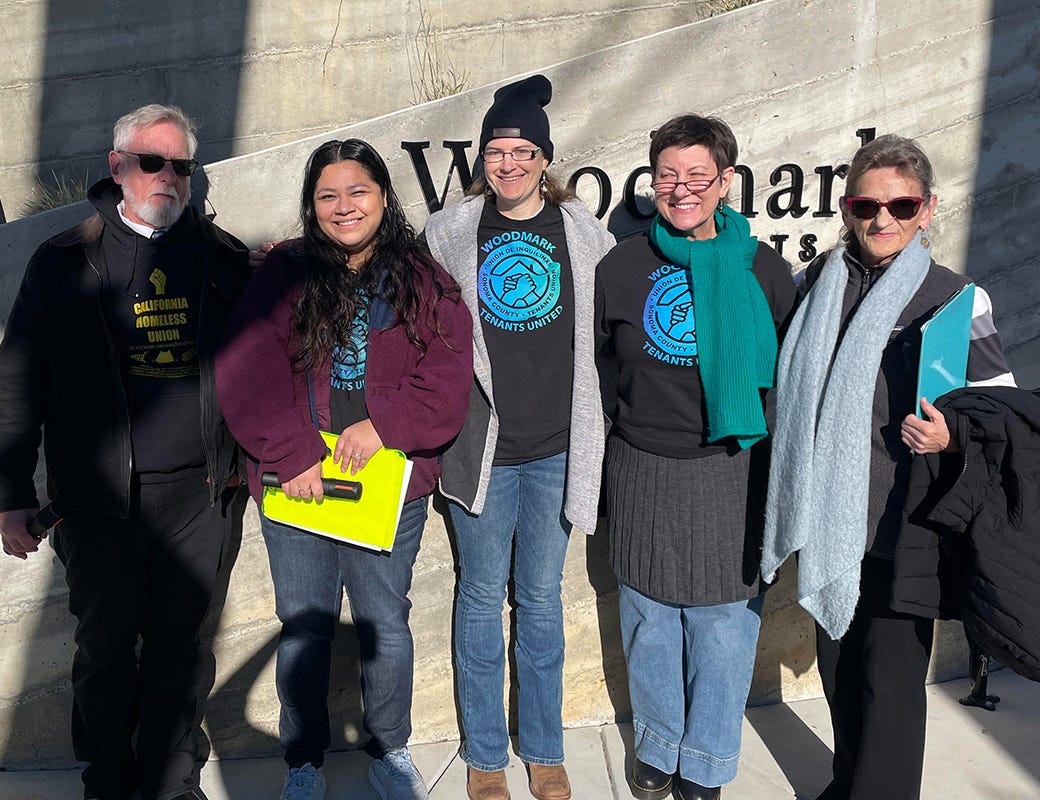
Yesterday morning, Woodmark Tenants United, representing 14 remaining families at Woodmark Apartments, held a protest and press conference in front of the complex on Bodega Avenue. The action was meant to reaffirm that the group is still fighting to stay in their homes at Woodmark and to announce that they have retained Berkeley-based attorney, Anthony Prince, to represent them. Although Prince works with the California Homeless Union, he said his office is taking this case on privately.
A small group of Woodmark’s tenants have been fighting to stay in their homes ever since they were informed in September 2025 that they had to move out to make room for the farmworkers the project was originally built to house. In December 2024, the property’s developers and property management company filled the complex with low-income non-farmworkers, claiming that they couldn’t find enough eligible farmworkers. The developers applied for a waiver to the USDA’s farmworker housing program, which had given them a $1 million loan, but that waiver was denied. The developer and the USDA agreed on a Corrective Action Plan that involved moving the existing tenants out and farmworkers in. As a result, tenants were told they’d have to move out by the end of the year.
The developer offered tenants $10,000 to move out by the end of October or $5,000 by the end of November—and sweetened the deal by offering some units at a low-income housing complex in Santa Rosa. Most of the complex’s tenants took them up on that offer and moved out.
Out of 46 units in the complex, 14 families—mostly single mothers with children, the disabled and seniors—decided to stay.
“We are not going away,” said Woodmark resident Beth Gallock at yesterday’s rally. “We tenants at Woodmark have formed a tenants’ union, and we’re fighting TPC and Aperto’s efforts to force us out. We have worked to get a just-cause eviction ordinance passed by the Sebastopol City Council. We now have secured legal counsel and we are demanding justice to be allowed to remain in our homes.”
“The thing to remember is we did nothing wrong,” Sandie Russell, a retired nurse, said firmly.
On January 8, their attorney sent demand letters to Woodmark co-owners, The Pacific Companies (TPC) and the Central Valley Coalition for Affordable Housing, and to Woodmark’s property management company, Aperto. Prince’s formal demand letter requested the following: 1. Immediate cessation of displacement actions; 2. Extension of existing leases; 3. Good-faith negotiation to avoid litigation.
Thus far, he hasn’t heard any response from the companies. That puts him in good company. Back in November, when the Sebastopol City Council passed a just-cause eviction ordinance, the council instructed then-Mayor Zollman to reach out to the owners of Woodmark, asking them not to evict the remaining tenants until some sort of compromise could be reached. He sent the letter but said he never heard anything back.
“We’re not about to let the misconduct of TPC add to the ranks of the homeless,” Prince said. “They were supposed to, in good faith, participate in a good program prioritizing housing for historically marginalized populations, populations that have been pushed to the bottom. We support those things. The agricultural workers in this country ought to be prioritized for housing, but not at the expense of pushing others into poverty and homelessness.”
“They [TPC] are trying to set this thing up as a fight between farm workers, who were supposed to be prioritized and were not, and tenants who were never told and never misrepresented themselves as farmworkers, but nevertheless were provided with units in this complex. TPC knew all along that they weren’t farmworkers, and that they [TPC] were violating the terms of an agreement they had with the federal government.”
“Two wrongs don’t make a right,” Prince continued. “It’s wrong for the owners and managers of this property to have entered into an agreement with the federal government with certain obligations and then disregard those obligations at the expense of the intended beneficiaries of that program, Sonoma County’s agricultural workers. That was wrong. It is equally wrong to have people sit in the rental office and be told, ‘Don’t worry about that requirement.” It was wrong to misrepresent, to fail to make these tenants aware of the fact that TPC had applied for a waiver from that requirement (if they actually ever did apply).”
Prince argued the current tenants were fraudulently induced to move into the apartments.
“Who’s going to rent an apartment if they’re told, ‘Oh, by the way, it’s possible that within a few months—we don’t know when—but if the government denies our application for a waiver from the farmworker requirement, you’ll have to get out of here.’” he said. “Who would have rented an apartment under those conditions? Nobody.”
Woodmark resident Trinell Meyer said that all of their leases expired in December, but that the company accepted their January rent. They were presented with new leases to sign by January 14 that had an addendum attesting to the fact that they were farmworkers. They obviously can’t sign this new lease because they’re not farmworkers.
According to Prince, “The only alternative they [the developers] have if they want to physically displace these tenants is to initiate an unlawful detainer, which is the name for the actual lawsuit to remove a tenant. They do that, though, then we bring all these affirmative defenses that the lease itself was induced by fraud and therefore is either void or the judgment is for the tenants.”
Neither Prince nor the tenants have reached out to the USDA itself, though Woodmark resident Gallock said Congressman Jared Huffman, Assemblymember Chris Rogers, and 5th District Supervisor Lynda Hopkins have done so. According to Gallock, they’ve not reported hearing anything back yet.
“From a legal standpoint, we take the position that it is entirely possible and necessary for TPC to adhere to the requirements of the program of the United States Department of Agriculture, and at the same time, that they can permit these residents to remain as legal tenants,” Prince said. “We believe the law will require harmonizing these respective interests.”


Thank you Sebastopol Times for keeping us informed about this important issue.
Great reporting, as always! I would suggest that there is another alternative. The developer and NGO who appear to have defrauded the federal government by their actions could be forced to pay back the loan plus fair market interest as well as any other financial benefit that they received based on their stated commitment of building farm worker housing. Potentially, they could also have to pay penalties for misrepresenting their intentions to the USDA, the community and the county. If they make good on the reimbursement to the federal government the current tenants should be allowed to stay.