


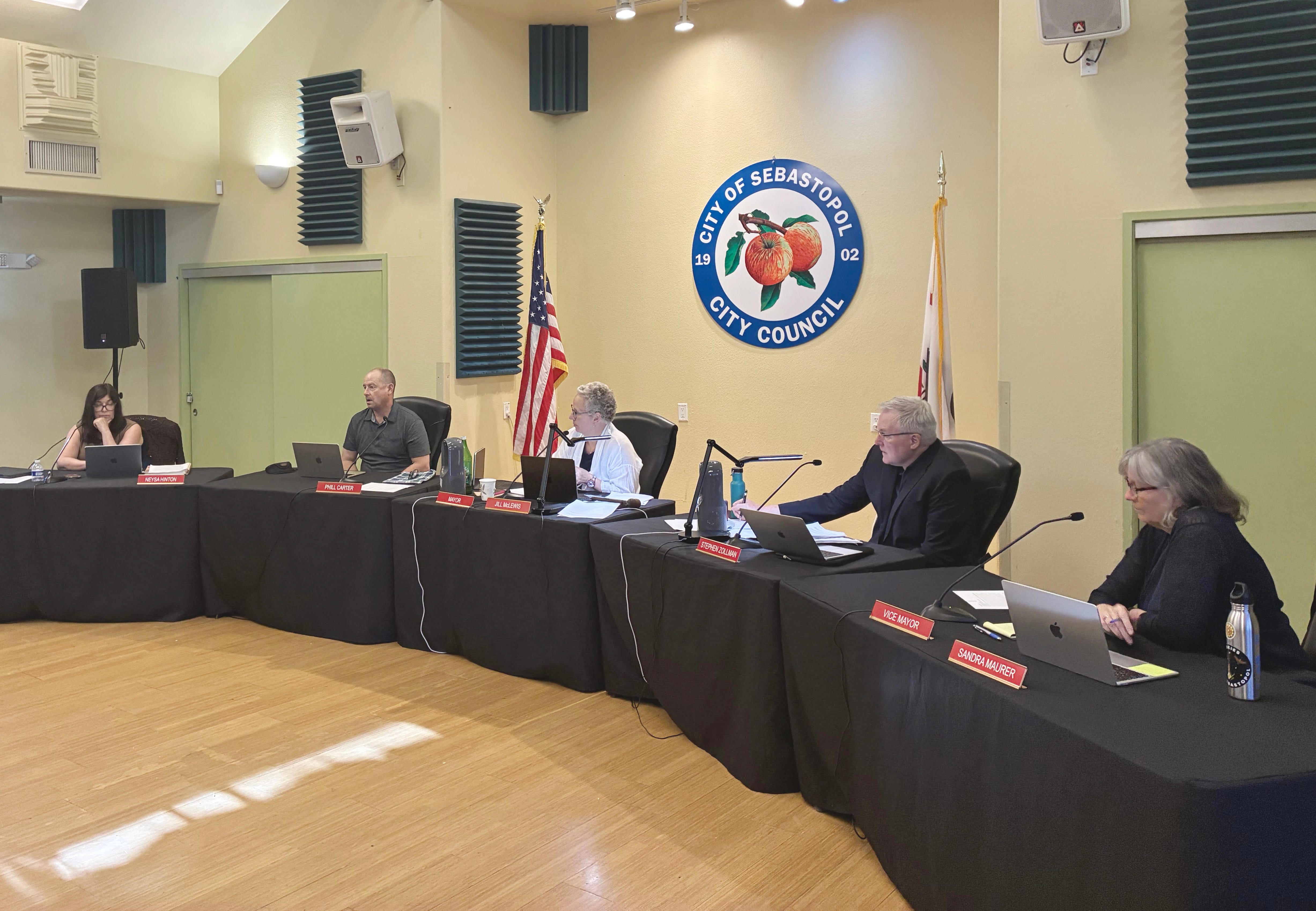
The council faced a packed agenda at its July 21 meeting. Sebastopol Police Chief Sean McDonagh presented the annual Police Audit update and gave a second report on local crime statistics. The council unanimously endorsed giving a 50% rebate on the TOT tax for ten years to the Barlow Hotel. It also voted unanimously to cancel its request for the repayment of a loan to the city’s Wastewater Fund. This decision was made in light of a Grand Jury Report in June that found that the city’s General Fund owed roughly $5.5 million to its Water and Wastewater Funds, after years of overcharging those funds for city services. In a related move, city staff presented a draft of its response to the Grand Jury regarding the above claims, and the council approved it unanimously.
Consent Calendar
The consent calendar consists of items that are routine in nature or don’t require additional discussion, often because they’ve been discussed extensively at a previous council meeting.
In addition to the approval of meeting minutes, the council unanimously approved the following:
● Approved the adoption of an ordinance to increase City Councilmember compensation from $300 a month to $950 a month, raising the cost for compensation for the council as a whole from $18,000 annually to $57,000, taking effect in January 2027.
● Approved the completion of work on the Burbank Farm ADA path and public restroom facility.
● Approved the updated City’s IPS (Investment Policy Statement). (See explanation here.)
● Approved the contract award, not to exceed $321,369, for the Morris Street Sewer Pump Station Wet Well Repairs Project to the Valentine Corporation, and passed an amendment to the budget for this project, which increased from $300,000 to $400,000.
The final item on the consent calendar involved a request for approval of several consultant salaries. Some members of the council were unhappy with the level of detail in the staff report on this item and so moved it to the regular agenda for discussion.

Councilmember Hinton expressed frustration that the council hadn’t been apprised of these contracts earlier, and Councilmember Zollman said he’d like to see the reasoning behind these choices—including a list of competitors and pros and cons for why that particular company was chosen for the contract. Hinton said that although the budget committee had given this list the nod, she felt contracts of this size deserved to come before the full council. In the end, however, the council voted 3 to 2 to approve payment for these contracts, Hinton and Zollman dissenting.
Information Presentations
Update on the implementation of the Jerry Threet Sebastopol Police Department Audit
In 2021, the city received the Independent Civilian Review of the Sebastopol Police Department prepared by Jerry Threet, a former director of IOLERO, the Independent Office of Law Enforcement Review and Outreach, which was created to provide citizen oversight over the Sonoma County Sheriff's Office. Threet evaluated the Sebastopol Police Department's policies, practices, training, leadership, organizational culture, accountability systems, and community engagement, and made 146 recommendations for improvement.
Between 2021 and 2024, successive police chiefs provided periodic updates to the City Council about the implementation of these recommendations. In December 2024, Police Chief Ron Nelson advised the council that 95% of the recommendations had been implemented, and that the remaining seven recommendations were either not feasible or counterproductive. (See our coverage on his report in a city council recap from that period.) He also said he felt further updates were unnecessary, but council requested a review of this document in light of the recent Callaghan verdict, regarding police misconduct in 2024.
Police Chief Sean McDonagh had prepared a kind of qualitative description of what he’d been doing in the department—recruitment, staff development, stable leadership— but Councilmember Stephen Zollman said he had hoped for an item-by-item update on the full list of recommendations.
McDonagh said he was currently almost finished with a review of all Sebastopol Police policies, and Zollman asked that that be agendized for a council meeting in September.
Sebastopol Crime Statistics
After saying, I’ll try not to bore you with statistics, but unfortunately, that’s what this particular item is,” Chief McDonagh gave his second presentation of the evening. “Like I said, there were 19,000+ calls for service. We did nearly 7,000 business security checks, 830 criminal case investigations, 318 arrests, over 1,000 traffic stops, nearly 1,200 citations, and nearly 650 parking citations were issued.
Property crimes were the largest reported category, making up almost half of all arrests: “Theft, fraud, stolen property represented 144 of the 318 cases that we had,” McDonagh said.
Here is a breakdown of crimes by category:
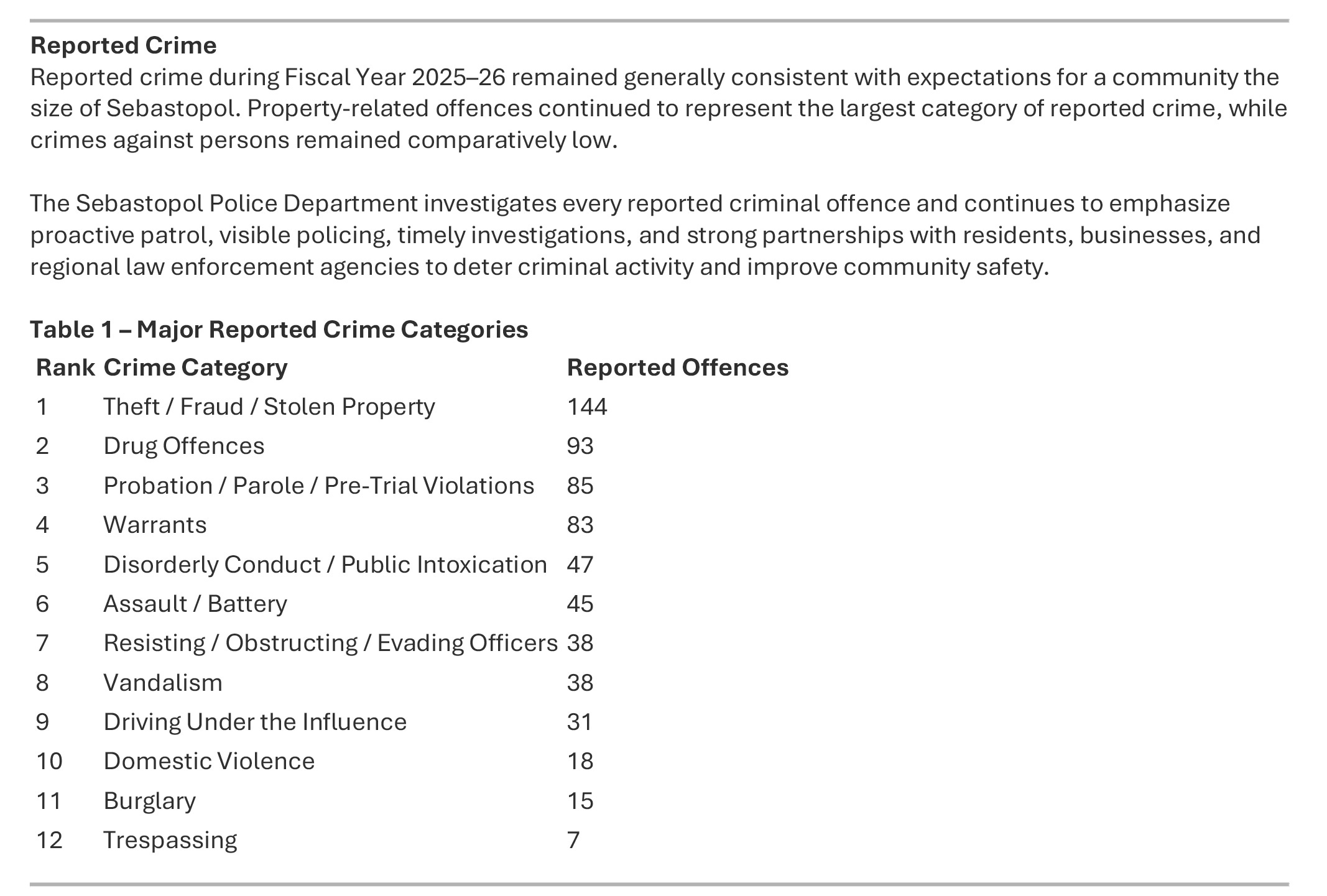
McDonagh said that reported crimes remained relatively stable over the last year. “Our violent crimes were infrequent, which was good…but property-related offenses—stealing—is huge. We really are working hard on that because I feel like that reflects a large number of the calls that we respond to and cases that we have.”
He also expressed some frustration with the catch-and-release policy at the county level. Sebastopol doesn’t have a jail, so anyone arrested in Sebastopol is transported to the County Sheriff for processing. “They are transported to the sheriff’s office and booked—the city of Sebastopol is billed for that booking—and then within the day or the next day, they’re back out here again, and I arrest them again for something else. It’s concerning to me,” he said.
He also commented on the rate of homeless-related crime, something Mayor Jill McLewis picked up on in her questioning. “You mentioned that transient-related calls are 25% of the workload. That’s like less than 1% of our population utilizing 25% of our police time. Is that right?”
McDonagh said that was probably an understatement.
On the other hand, he mentioned that the number of calls from Elderberry Commons, a permanent supportive housing complex for the previously homeless, had decreased over time. “I feel like we’ve had a reduction in police responses to that location…they moved a few groups out of that facility that were real problem children, so to speak…It’s not to say we don’t have issues there, but it’s remarkably less than it was.”
The chief and several people in public comment gave a shout-out to Julian Sanchez, a homeless outreach worker from the County’s HEART program.
Lee Mathias also expressed his appreciation for McDonagh, “I don’t know if anybody’s been following the conversation on Nextdoor, but he [the chief] is apparently quite visible to the public. Folks on Nextdoor have commented on him making traffic stops. I see him walking the downtown area. He’s been actively involved in issues like vandalism on the back of the Safeway, and a lot of these issues are getting resolved. I don’t think we’ve ever had a police chief before do night shifts on patrol.”
Perhaps irked by the emphasis on crimes of the homeless, Kyle Falbo said, “What doesn’t get reported enough or given enough of our attention is the kinds of crimes that may be happening within city government,” he said. “So, is there misallocation of money in ways that would be considered theft?” he asked, referring to the long-term overcharging of the water and sewer funds by city government. “Is there a reporting mechanism that, when these things are identified…that somebody can take action to make sure that those funds that were maybe stolen potentially are investigated, and then, if deemed that those funds were in fact stolen, that those funds would be returned to their rightful owners. I’m not sure that we have a mechanism in place. Maybe it’s something that we can prioritize for our police, rather than many of the types of crimes that are associated with social ills.”
See the full crime stats report here.
Regular Agenda
Sebastopol City Council agrees to rebate 50% of the Barlow Hotel’s TOT taxes
The council unanimously agreed to rebate 50% of the planned Barlow Hotel’s TOT taxes during its first 10 years of operation. (The TOT, or Transient Occupancy Tax, is a tax charged by local governments to hotel guests.) Vice Mayor Sandra Maurer, Councilmember Phill Carter, Councilmember Neysa Hinton and Councilmember Stephen Zollman voted to approve this amendment to the hotel’s development agreement with the city.
Mayor Jill McLewis recused herself and left the council chambers during these discussions because she owns a small business across from the Barlow Hotel site.
Read our full coverage of this story from last week.
Council votes to forgive $1.1 million loan to sewer fund
The council made quick work of this proposal to forgive the $1.1 million loan that the General Fund made to the city’s Wastewater Fund on August 6, 2024. The council voted unanimously to forgive the loan, which was only necessary in the first place because a faulty rate study and years of overcharging for city services had drained so much capital from the Wastewater Fund that it was unable to meet its obligations.
There was literally no council discussion of this item, but several folks in Public Comment supported the loan forgiveness.
Kate Haug, a member of the Enterprise Funds Oversight Committee, noted that the $1.1 million loan forgiveness was one of that committee’s recommendations. She was one of several public commenters to speak in support of forgiveness.
“We believe that the loan was forced onto the enterprise funds due to historical misallocation of ratepayer funds, which is a Prop 218 violation,” she said. “So I fully support this. I also agree that it does not fully remedy the main issues of the Grand Jury report.” (See our earlier article about the Grand Jury report.)
City responds to the Grand Jury Report on Sebastopol’s handling of its water and sewer funds
Released on May 30, the Grand Jury’s 22-page report offered damning evidence that the city of Sebastopol had overcharged its enterprise funds (i.e., water and sewer) for city services for many years, in violation of Proposition 218. The city is required to respond to this report within 90 days.
The Grand Jury Report had four findings and three recommendations, and the city responded to each:
FINDINGS:
Finding # 1: The City’s failure to update its Cost Allocation Plan for more than 20 years resulted in the City over-allocating approximately $5.5 million of indirect costs to the Enterprise Funds. This was non-compliant with Proposition 218 and left the Enterprise Funds without sufficient money for maintenance and capital improvements.
The city “partially agreed” with this finding, and noted that it had already taken several actions to fix this problem. In addition to the current cost allocation plan, they’ve scheduled an update for 2027/28 and are investigating time tracking and direct billing, which they have already instituted for legal services. The city did not confirm the figure of $5.5 million.
Finding #2. When the City updated its Cost Allocation Plan in 2024, reduced allocation of indirect costs left approximately $714,000 in the Enterprise Funds to be used for systems maintenance and capital improvements.
The city agreed with this finding as well, with the exception that the $714,000 in savings to Water and Sewer hasn’t been slated for anything in particular at this point.
Finding #3. Because the rate study conducted by the City in 2019 underestimated a reduction in consumption due to conservation measures, the rate adjustment for 2019-2023 was insufficient to keep pace with escalating costs. This resulted in the need for a 37% increase on July 1, 2024, which has been difficult for many ratepayers to accept.
The city “partially agreed” with this analysis but argued that absent such a rate increase, the water and sewer funds would have required steeper increases in the future, noting that “Years of insufficient rate adjustments combined with the prior allocation methodology contributed to underfunding of the Enterprise Funds…”
Finding #4. In November 2025, the City Council reinstituted an Enterprise Fund Oversight Committee. This promises to provide the City Council with insights and expertise regarding decisions concerning oversight of these critical systems.
The city basically agreed with this finding, noting only that the Oversight Committee had been created by the current council, not “reinstituted.”
RECOMMENDATIONS
Despite building a strong case against the city for mishandling its water and sewer funds, the Grand Jury praised the city for its recent efforts to right the ship. It had just three recommendations:
Recommendation #1. By October 1, 2026, commit to fully comply with Proposition 218 by conducting cost allocation and rate studies at least within 3-5 years intervals and adjusting its cost allocation and ratepayer fees accordingly.
The city responded that it had already implemented these changes. “The City adopted the ClearSource activity-based Cost Allocation Plan in 2024 (FY 2024-25). Additionally, the Raftelis Rate Study was completed and implemented following Proposition 218 procedures in June 2024. The City Council recently directed staff to retain consultants to prepare a new cost allocation plan and rate study to be implemented no later than FY 27-28, 3 years after the current cost allocation plan and rate study were approved. The City Council included money for these studies when adopting the FY 26/27 Budget.”
It’s important to note, however, the city’s Enterprise Funds Oversight Committee has criticized the current cost allocation plan—something not mentioned in the city’s response.
Recommendation #2. By October 1, 2026, reach an agreement on the dollar value of mis-allocated indirect costs and commit to a repayment schedule to restore funds transferred from the Enterprise Funds to the general fund by overallocation of indirect costs. This money can be used to implement critical improvements identified in the Master Plan.
In response to this recommendation, the city balked or at least stalled, arguing, “The recommendation requires further study and analysis. While the City acknowledges the likelihood that an outdated cost allocation plan may have resulted in overallocation of General Fund costs, the City has not yet determined a specific dollar amount.” The City mentioned its forgiveness of the wastewater loan, but didn’t outline a plan for determining the specific amount of money required to reimburse its enterprise funds.
According to the Grand Jury report, it has until October to do so.
Recommendation #3. By October 1, 2026, consider adding a Certified Public Accountant to the Enterprise Fund Oversight Committee to assist the City Council and City Manager with fiscal compliance, analysis, and transparency.
The city agreed with this recommendation but noted that no CPAs had responded during the recruitment process for the Oversight Committee. The city said they would attempt to reach out to accounting professionals directly next time.
COUNCIL RESPONSE & PUBLIC COMMENT
There was relatively little council discussion of the draft response, other than a brief quibble over the peculiar phrasing, “This city partially agrees with this finding.”
Mayor Jill McLewis said she wanted to see an acknowledgement that “we haven’t done everything correctly.” She suggested the following language and her fellow councilmembers agreed to add it:
“The city acknowledges that in the past we fell short in our communications and clear, transparent reporting regarding the water and wastewater enterprise funds. We sincerely apologize for the shortcoming and are committed to significantly improving transparency moving forward, including through the work of the Enterprise Fund Oversight Committee and more open, regular reporting to the community.”
The response in public comment was less restrained. First up was Kate Haug, a member of the city’s Enterprise Funds Oversight Committee (EFOC), and, arguably, the person who brought this whole debacle to light, long before the Grand Jury delivered its judgment.
“The Grand Jury report is an accounting document,” Haug said. “The city’s reply has zero accounting in it. Where did all the money go? We don’t know because the city has not identified it. The Grand Jury report is also asking for documentation. The city has provided zero documentation. The EFOC, on the other hand, has rigorous analysis, using city budgets that show where misappropriated funds are. The city’s response does not address the main concerns of the Grand Jury report, which is failing infrastructure. The city needs to reply with accounting from their budgets.”
Haug then went on to discuss the “Pleasant Hill Loop,” a piece of the city’s water system infrastructure, highlighted in the Grand Jury report—though not included in its recommendations. Arguing that its failure would be catastrophic, Haug asked why it hadn’t been budgeted, funded and completed. (This $2+ million project is listed as the top priority in the city’s new Water Master Plan.)
This complaint was echoed by Mary Meilhaus, another member of EFOC, who also noted that “I think more time needs to be given with the city council members to reflect on what is being drafted.”
Both Meilhaus and Lee Mathias complained about the council’s recent decision to freeze water rates. The EFOC had actually recommended this freeze but only in combination with other revenue solutions.
Kyle Falbo said, “So what I want to just emphasize here is about trying to work forward in good faith. The draft does not hit that mark. The mayor’s suggestion about trying to kind of take responsibility for lack of reporting doesn’t hit that mark. There is misallocation of funds. Name that. Part of the problem and frustration that I’ve experienced with this whole thing has been the deliberate delaying of getting to where we’re at today,” he argued. “Don’t commit to exploring taking action because you have committed to exploring for years, and this, tonight, is the result of your pushing things out into the future.”
In response to Haug’s mention of infrastructure issues, Councilmember Phill Carter, who is also a member of the EFOC, said the city would be completing each project as it could afford to.
During council comment, Vice Mayor Maurer repeatedly asked the council if it was committed to having the city do, as the draft response promised, the “further study and analysis…to reach an agreement on the dollar value of misallocated indirect costs and commit to a repayment schedule.”
Mayor Jill McLewis supported this—“I think the people are going to expect that,” she said — but other members of the council seemed squishier on this point.
Regardless, the council voted unanimously to accept the draft response, with the addition of Mayor McLewis’s preamble about transparency. After council approval, the City’s response was sent to the Grand Jury.
Read the city’s response to the Grand Jury report here.
You can watch the full July 21 city council meeting here.
Rather than hire a CPA, I recommend the city hire a forensic accountant to review every dollar that went into and out of the city over the past 7 years. As a city resident for 27 years, it has been clear for at least 7 years that the water and sewer bills were way out of whack. Unfortunately, I have strong suspicion that significant funds have actually be fradulenty stolen from the city coffers. Hope I'm wrong and fear I'm not.
I was surprised that the police chief was part of traffic enforcement during the Apple parade. I really like that he is hands on