


At Tuesday’s Sebastopol City Council meeting, the council unanimously agreed to rebate 50% of the planned Barlow Hotel’s TOT taxes during its first 10 years of operation. The TOT, or Transient Occupancy Tax, is a tax charged by local governments to hotel guests.
The planning commission gave its thumbs up to this plan last week, with the proviso that a certain percentage of the hotel’s million-dollar marketing budget be used to market the town of Sebastopol itself. (See the full text of the development agreement amendment and the planning commission’s suggested revision at the end of this article.)
Vice Mayor Sandra Maurer, Councilmember Phill Carter, Councilmember Neysa Hinton and Councilmember Stephen Zollman voted to approve the original amendment, without the planning commission’s addition. (Mayor Jill McLewis recused herself and left the council chambers because she owns a small business across from the Barlow Hotel site.)
The presentation
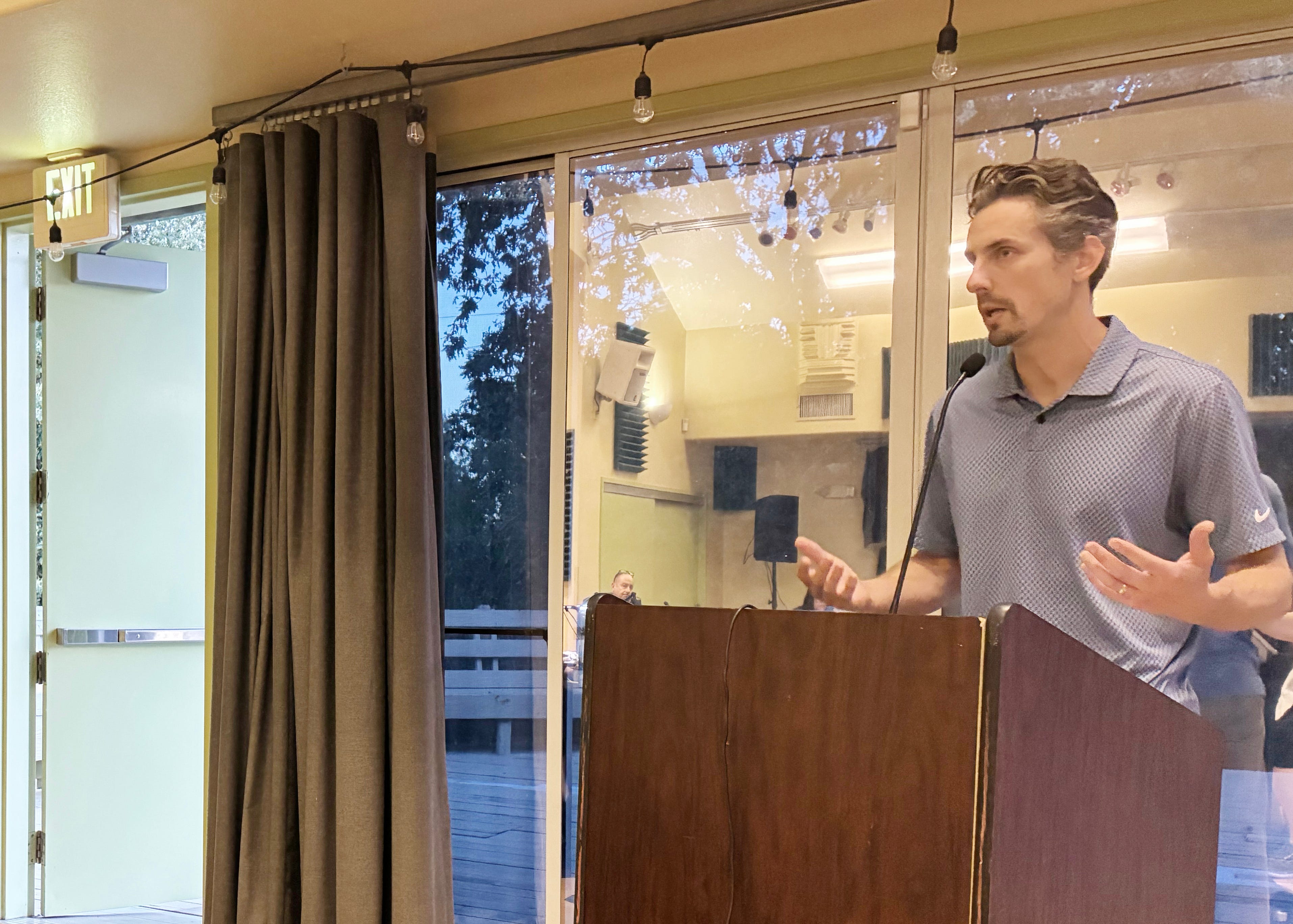
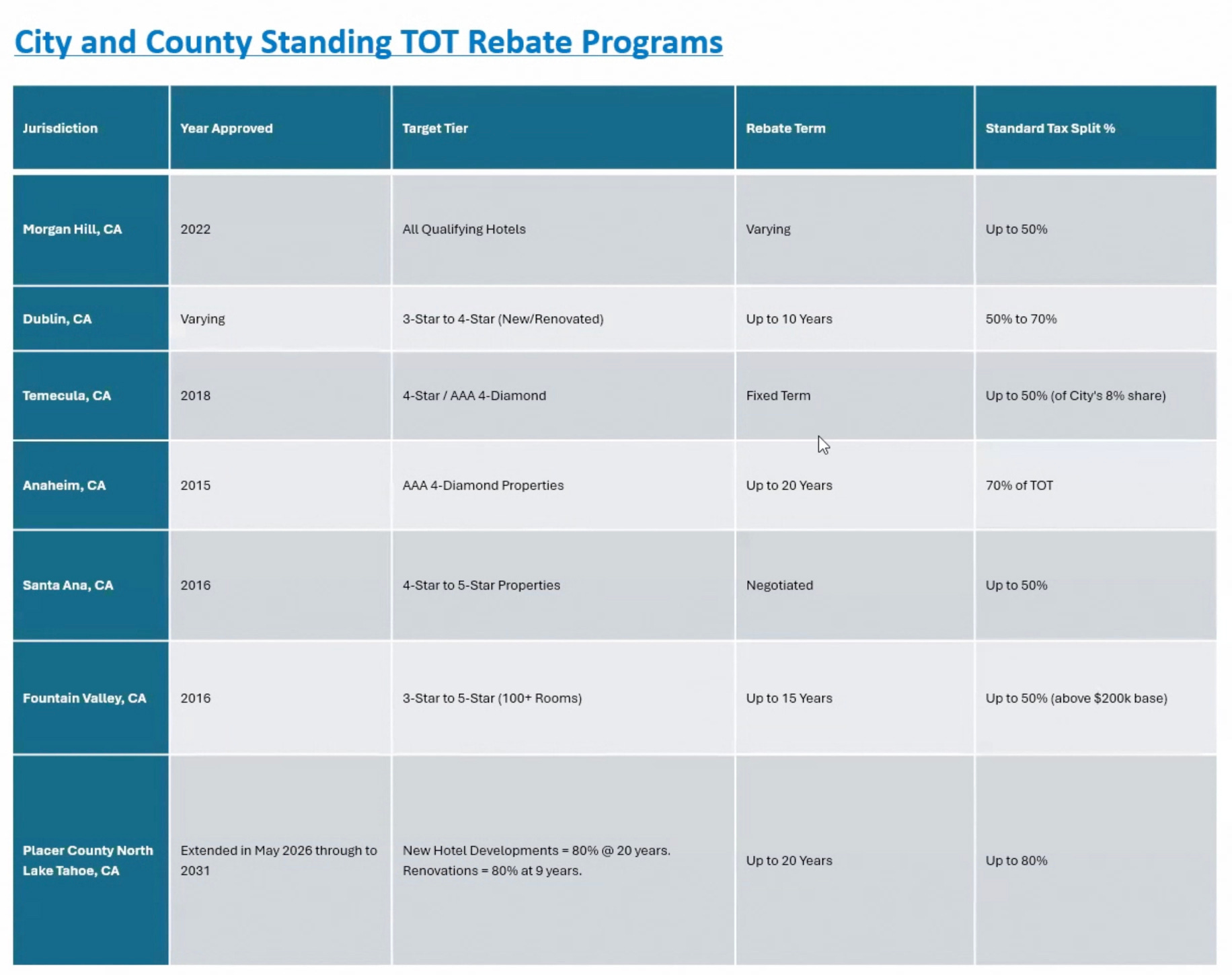
For most of the meeting, Ari Wangerin, director of development for the Barlow Hotel project, stood in for Barney Aldridge, who was sick that evening. Wangerin gave a presentation on the proposed TOT rebate, offering examples of other cities that had made similar deals with hotel developers.
He also affirmed that without this sharing agreement, the Barlow Hotel will halt development, something Barlow owner Barney Aldridge confirmed later in the evening.
Wangerin then gave an analysis of the impact of the rebate, based on the original financial projections created by two different consulting groups. EPS, hired by the City, shows conservative projections, and RRC, hired by the Barlow, offers more optimistic projections. The slide below shows the projected TOT tax over ten years and how much the city would get under the 50% rebate plan:
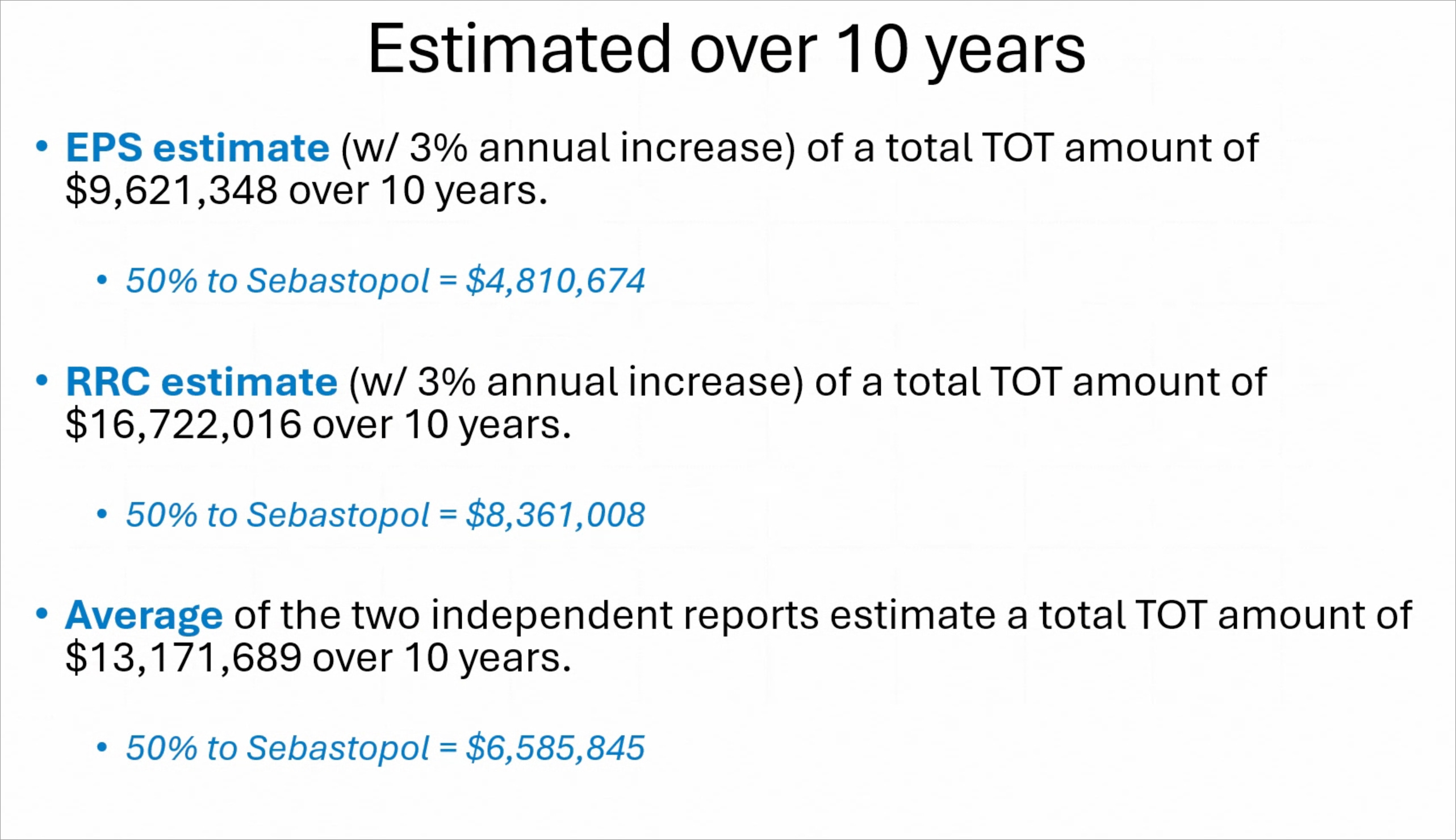
Wangerin noted that these figures don’t include the other economic benefits to the city of having a new hotel in town, including increased retail spending at local businesses, the resulting sales tax revenue to the city, and employment opportunities. EPS estimated that the hotel would bring 53 permanent hotel-related jobs to the area.
Finally, Wangerin underscored the challenging market conditions for real-estate projects and said, “It’s especially challenging for hospitality, a from-the-ground-up hotel, in wine country, in a currently unproven market…Right now, the project is not feasible without some public-private partnership.”
The developers of the Barlow Hotel would use the promise of higher returns made possible by a rebate-funded marketing budget in order to attract the private equity they need to finance the project.
Stephen Zollman responded, “I don’t really know if that’s the best sales pitch.” Zollman recounted that even Piazza Hospitality, a seasoned hotel developer, has not yet found a way to move forward with its project, the Hotel Sebastopol.
Wangerin admitted, “It’s a hard business. Like you said, that’s a proven developer, and they have a dirt lot surrounded by a fence, and they’re trying to figure out what to do and they can’t. I think sometimes people look at Barney as the bad guy, but he’s here willing to take a chance and put his own money at risk. We’ve been working on it for three years. And so, if the community wants a hotel, and the City Council wants a hotel, then what he’s saying is, ‘I need your help,’ and it’s as simple as that.”
Public comment was evenly split
Former County Supervisor Ernie Carpenter suggested that the council raise the TOT rate (this would require voter approval). He also complained about the language of the amendment to the development agreement with the Barlow. In a long letter to the council, which challenged the legality of the TOT tax rebate, he wrote, “You seem to be giving carte blanche to the developer in the use of this tax money.” Frequent commenter Kyle Falbo shared Carpenter’s concerns about the legality of the rebate.
But the rebate proposal had supporters as well.
Frequent commenter Oliver Dick said, “I feel pretty strongly that if we get some momentum here, there will be a lot of other business momentum in the city that will hang off the back of this, and we don’t really have too much time to waste…overall I’m in favor.”
Commenters Lee Mathias, Kate Haug and Mary Meilhaus all argued for the deal.
“I feel like no rebate, no hotel, no additional TOT tax. If you believe that, you kind of almost have to go with this,” Mathias said.
Kate Haug, “Business is a risk. There’s no guarantee that this will work whatsoever, but if you don’t try it, you won’t have any money coming in…If he is highly successful, so will the city be highly successful. If he fails, the city loses nothing because the city hasn’t had to take out a loan, they haven’t had to construct a building, they haven’t had to hire employees, they haven’t had to take out insurance, and they haven’t had to do basically any work, except to come to an agreement to split the profit off the TOT.”
One commenter, rather late to the game, said, “Why do we need another hotel?...It’s just awful…I just feel like all this building is getting rammed down our throats.”
A conflicted council
Despite the skepticism coming from some public commenters and some of his own colleagues, Councilmember Phil Carter was all in. “We’ve been expecting this hotel on our books for quite a while. We’ve been dependent on it in our projections, and so why are we not just super enthusiastic?” he asked, attempting to reframe the debate.
In response to the last public comment, he explained that Sebastopol can’t survive as a bedroom community. “If you are just houses, you can’t pay the bills. You have to have some other way of making money. We’ve lost a lot of our industry and some other ways to make money, so this is about all we have.”
Councilmembers Hinton and Zollman argued that the Barlow’s rebate proposal should be seen as the starting point of a negotiation, not a take-it-or-leave-it deal.
“Someone with more expertise needs to start the negotiation with this hotel because I’m not willing to give you everything that you want,” Zollman said, suggesting that time be taken to study the agreement and explore options. “I don’t see this as being an urgent thing.”
Hinton also stressed the need for negotiation. “Because we’re talking about big money,” she said. “I just want to make sure that we’re doing the right thing for our citizens for the next 10 years, when maybe none of us will be sitting here.”
From his sick bed on Zoom, Aldridge delivered his ultimatum:
Yeah, it’d be great to sit down and negotiate, but I’d like to just give you a little dose of the reality, which is, debt is super high. Adjustable rates starting at 9%, and if rates go higher, it goes higher. So that’s a really hard thing to overcome.
It’s been very difficult for me to get equity to the table—that’s new equity partners, people writing checks for millions of dollars, and me telling them, ‘It’s going to be fine. Sebastopol is going to be a great market,’ but then you have construction costs, which keep going up and up and up. So the returns that we thought we had a year ago have diminished below what we’ll call a market return for investors.
A lot of times, these things, in my experience, there’s a time and a place. And right now is the time for you guys to say you want a hotel and do this. I’m not getting rich off this. I’m taking a ton of risk.
A lot of it has to do with the big giant vacant warehouse that either I need to start filling with storage or do some renovations and start renting that out. Once I do that, the hotel’s off the table. I cannot sit and just let the clock run without a plan for that space. I’m just not big enough to swallow up the cost of that. That thing has a huge mortgage on it, and taxes are ticking away. So that’s many tens of thousands a month to sit there vacant.
So we’re either building a hotel with your help, or we’re going to start dealing with that building. And I hate to say it, the time to negotiate would have been when I first brought this to you…The investors I have at the table, who are all awaiting my phone call in the morning to find out if you guys are on board to do this with us or not, their time horizon is 10 years. And the model is 10 years. And the model barely hits the returns.
That turned the tide.
“I appreciate the risk that he’s putting out for the city,” Councilmember Carter said. “The city has no risk on this whatsoever.”
Councilwoman Hinton gave in. “If he needs a decision tonight, I think I’m going to follow Phil and say OK. Fifty percent for 10 years gets us a hotel, and we have been talking about a hotel for the last 10 years. I don’t want to be here 10 years from now, and we still have no hotel.”
Councilmembers Zollman and Maurer also signed on, but their approval was more grudging.
“I really don’t like it at all,” Zollman said. “I don’t like strong-arming. That aside, it calls for moments of being a grown-up, and I don’t really see a way out of this for the city. I don’t really want the next generation of people who have to sit here…dealing with a city that’s in a perpetual state of financial crisis. I don’t wish that on anyone. So given that my other two council members are in favor, let’s just do it.”
Zollman and Maurer said they expected some blowback from the public.
“You said that there is no risk for the city at all. Well, there is risk in terms of how our public feels about this,” Maurer said.
Referring to the idea of using a percentage of the hotel’s marketing budget to publicize the city of Sebastopol, Zollman warned, “If it seems like [promotion] is all centered on the Barlow and not for our struggling downtown businesses, there will be retribution to be had. I’m quite sure of that.”
A confusing vote
Carter made a motion to approve the amendment to the Barlow Hotel’s development agreement. Hinton seconded the motion. City Manager Mary Gourley read out the motion “to approve the development agreement amendment for the Barlow Hotel to provide a TOT shared agreement arrangement of 50% for 10 years, with the addition of ‘the city may request and payee of tax shall provide, at least annually, documentation.’”
The council, weary of the debate, voted unanimously in favor.
Immediately after the vote, Maurer asked if the amendment they’d just passed included the revision recommended by the Planning Commission, regarding using a percentage of the hotel’s $1 million marketing budget to publicize the city itself.
The answer was no.
Maurer looked shocked. She motioned to reconsider the approval and Zollman seconded it, but Carter and Hinton opposed it, and the motion to reconsider failed. Their original vote stood.
Mayor McLewis, returning to the room from her recusal, asked “Are you all OK with moving on or do you need a stress reliever for a second?”
Maurer, looking rather shell-shocked, joked, “We should go out for a drink later.”
“That was the old days,” quipped someone in the chambers.
Here was the full amendment they approved, as listed in the staff report.
Section 7.5.5. Uniform Transient Occupancy Tax Rebate. In exchange for all of the benefits provided by this Development Agreement and the Project to the City, the City shall rebate a portion of the Uniform Transient Occupancy Tax collected from the Project. The City shall rebate 50% of the 12% tax that is levied through the Uniform Transient Occupancy Tax and provided to the City. In the event that the City increases the Uniform Transient Occupancy Tax, the City shall have no obligation to rebate any amount attributable to the portion of the Uniform Transient Occupancy Tax greater than the 12% tax rate. The rebate will commence upon occupancy of the hotel and continue for a period of 10 years. The Uniform Transient Occupancy Tax will be levied and submitted to the City and the City shall remit 50% of the 12% of the tax to the payee of the tax. The payee of the tax and/or the Developer or its Successor shall use the remitted tax funds for advertisement of tourism in the City of Sebastopol, including the Barlow Hotel as a destination in the City of Sebastopol. The City may request, and payee of tax shall provide, documentation [annually]of how the remitted tax funds were spent for such purposes, but the City shall have no authority to direct such spending.
The planning commission recommendation in red:

Another blow to the people of Sebastopol from the City Council to go along with two way streets that the people and Planning Commission did not want, the Grocery Outlet selling cheap almost expired food to put local stores out of business, bungled low income housing project on Bodega, harassing a local BBQ business, a second bagel store next to an existing one, whatever is going on with sewer/water, neglected library now with black mold, contracts where the city pays out for nothing and now the Barlow Bailout with a rooftop hotel bar residents can't use. The Barlow managers will come back asking for more more more for a project the free market does not want? Why will people stay in the ultra expensive hotel anyway? To see black mold at the library, to visit Grocery Outlet or the Nail Salon on Main St? Maybe there will be tours "Town Planning Gone Wrong: Ignoring the Residents."
This well written article realy helped me understand the issues involved. At first glance, I was appalled at the thought of a fancy hotel there. I already don't like the barlow...But...we have lots of different people here in Sonoma County, and if we can bring in more revenue via taxes the city can better support its entire population. Lower sewer and water rates? More support for low income housing? Money for homeless services?
Great article- changed my mind.