


This is Part 2 of a two-part recap of the Aug. 4 Sebastopol City Council meeting. Read Part 1 here.
After Enterprise Funds Oversight Committee member Kate Haug’s scalding public comment at the beginning of the evening (see Part 1), the council quickly adopted one of the low-hanging fruit suggestions from the EFOC report: reimbursing $350,354 in legal fees that were charged to Sebastopol’s Water and Sewer funds. As Haug pointed out in the EFOC Report, money allocated for legal services for water and sewer far exceeded the time that the city attorney actually spent working on water and sewer issues.
According to the EFOC financial report, “Prop. 218 and Prop. 26 explicitly state that the City cannot make a “profit” or use Ratepayer Fees as a tax. The City charged ratepayers $184,587 for legal fees for FY 2024/2025. Records show that only $13,850 was billed by attorneys for services rendered to Enterprise Funds. That means the City made a profit of $170,737. For FY 2025-2026, $189,263 was allocated. I have requested the attorney bills, and thus far, that shows $9,651.50 was billed, resulting in a $179,617 profit for the City. A total refund of $350,354 is owed to the Ratepayers/Enterprise Funds for this excessive allocation of Attorney’s Fees.”
On Tuesday, the council voted unanimously to reimburse its Water and Sewer funds the full $350,354.
Councilmember Stephen Zollman thanked Mayor McLewis for bringing this item forward, but also offered a defense for how such misallocations occurred in the first place.
“We need to start making amends and make amends as quickly as possible,” he said. “So even if this does affect the General Fund, the reserves, whatever, we can just start doing what’s right in acknowledging the fact that it’s probably true that past councils probably did defer to staff. You know, like, why shouldn’t we? … We’re not experts in this. We pay staff to deliver the best advice that they can, and then we try to be the best that we can with this. And clearly, that’s what happened with prior councils. And so now we know better. We should do better.”
While Councilmember Phill Carter agreed with the reimbursement, he also stepped up to defend the staff. “I just want to defend staff just a little bit because it wasn’t a choice to overbill the enterprise funds. It was a function of the cost-allocation plan that we all adopted a few years ago.”
In reality, that cost allocation plan—and the previous one from 2000—was the work of a paid consultant, hired for their expertise in the field of municipal finance.
The $350,354 will be divided between the two enterprise funds: Water will receive $130,867 and Sewer, $219,487. The money will come from the city’s reserve.
Councilmember Maurer asked Finance Director Ana Kwong how the reimbursement would affect the city’s reserve percentage. The city of Sebastopol’s General Fund Reserve Policy sets a minimum floor of 15% of annual operating expenditures, with a stated long-term goal of maintaining a 20% reserve.
After the reimbursement, the reserve will drop slightly to 24%. Because the city is in a structural deficit — meaning it’s currently spending more than it’s making—any spending down of the reserve brings the City closer to the precipice and gives it less time to make the needed adjustments.
Should people be allowed to sit or lie on the sidewalks in Sebastopol?
The mayor introduced a proposed ordinance that would have made it illegal to sit or lie on a sidewalk in Sebastopol between the hours of 7 am and 11 pm. According to the staff report, “The prohibition is intended to maintain safe and accessible pedestrian pathways, support walkable neighborhoods, and protect the vitality of local businesses during peak hours of commercial and residential sidewalk use.”
Mayor McLewis said she has heard complaints from some local businesses about homeless individuals sleeping in their doorways—and has seen this herself.
Police Chief Sean McDonagh argued for the ordinance as a tool for his officers to use in dealing with certain individuals. “This just tightens up the availability of enforcement for us, rather than us having more of a gray area … we can really come in and actually have that conversation with the person and say you need to move. We’d like you to vacate the front of this business so they can open and commence serving their patrons, rather than just having words of encouragement that are not followed through.”
A citation would have to be preceded by a warning, but penalties included a fine of $100–$500, community service, and/or up to ten days in County Jail.
Modeled on similar ordinances in Santa Rosa and San Francisco, the proposal immediately raised the hackles of the other councilmembers.
Councilmembers Maurer, Zollman and Hinton said they thought the ordinance was ripe for selective enforcement. Zollman and Maurer said they feared it could be used against political protesters doing a sit-in.
Mayor McLewis argued that it was never intended to be used in the case of civil disobedience, but was clearly focused on people, i.e., the homeless, sitting or lying in on the sidewalk and in front of businesses, a problem she said has gotten worse over the years.
“I lived here only 12 years, but I see it as a bigger problem now than I’ve ever seen it. And businesses are becoming frustrated. I’m becoming frustrated, and we need to give the tools to our public safety officers to actually be able to help us out here.”
Her colleagues weren’t having it.
Interestingly, public comment was more mixed.
Michelle Kelly argued that sleeping in town was safer than sleeping in the Laguna. She said she’s rarely seen people sleeping in front of businesses on her early morning walks, and even if she did, she would consider that an opportunity for compassion, not punishment. “When I see folks in rough conditions, I ask if they need a cup of coffee and a pastry. We have the ability to be compassionate … I’m frustrated even hearing this conversation.”
She also pointed out the anecdotal nature of the evidence supporting this proposal.
“I walk early mornings in downtown. I don’t see high numbers. We need some evidence. Let’s do an evidence-based ordinance. We don’t have that. Anecdotal doesn’t work. Please look at me,” she said to the mayor. “Anecdotal doesn’t work. This is a big ordinance, and the evidence just isn’t there.”
Commenter Kate Haug argued that Sebastopol is doing more than its fair share for the homeless already, in terms of various programs around town, as well as two permanent supportive housing complexes and other low-income housing.
“So Sebastopol is actually pulling like three or like maybe even 10 times its weight when it comes to homeless services … I’m downtown a lot. There are a lot of people who are using public spaces in pretty selfish ways. I would say you can’t privatize a public sidewalk by turning it into your bedroom. You can’t privatize a public park by turning it into your apartment.”
Oliver Dick agreed. “Again, this is the weakest link problem that we have a lot of in Sebastopol. The more you put out the welcome shingle for people who are unhoused, disadvantaged, mentally ill, whatever it is, the more people will come here, and then that’s more and more expensive for the city, more and more of the police’s time, and it just doesn’t work. So yeah, I approve of this measure absolutely.”
Kyle Falbo argued that the law was not written to simply keep the sidewalks clear. “It’s a law against poverty,” he said. “It would make it illegal to sit or lie on public sidewalks anywhere in Sebastopol from 7 a.m. to 11 p.m. even when no one is blocking pedestrian access. That distinction tells us what this ordinance is really regulating: it’s not obstruction, but poverty and the public visibility of poor people.”
Recalling the ACLU lawsuit over Sebastopol’s RV ordinance, Falbo said, “Are we that amnesiac here that we don’t understand that when we try to do laws against poverty, we’re gonna get sued?”
When the discussion returned to the dais, all four of the Mayor’s colleagues lined up against this ordinance.
“There’s just no way I’m supporting this,” said Councilmember Hinton, who noted that in her all her years here she’d only seen a homeless person blocking a business once. “We are Peacetown. I take that seriously. We’re a liberal town, I think, but we’re peaceful, and we appreciate people—all people,” she said firmly. “There’s just no way.”
Zollman said “Ditto,” and reiterated his concerns about selective enforcement, the legal risk, and the unintended consequence of providing the police with a tool against civil disobedience.
Maurer echoed these concerns.
Clearly frustrated, McLewis said, “I just implore my colleagues to pull your head out of the sand and look at what’s happening to our downtown. And as a business owner, I don’t know what to tell you. I see this all the time. I have businesses complaining to me, so I will be referring them all to you, and I’ll be giving them your names when they have trouble. And then, I implore you to come up with some other solutions to help deal with the challenges that are downtown.”
She made a motion to pass the ordinance; no one seconded it, so it died on arrival.
Her comment about her fellow councilmember having their heads in the sand didn’t sit well with them. Zollman pointed out the efforts that the council (and he in particular) had made to deal with homelessness in downtown: from the HEART Program to his work with the Homeless Coalition to the Citizens Police Academy, which he said the police have been reluctant to organize.
Dealing with racist harassment by high school students behind Safeway
This spring a small group of high school students sprayed racist and Nazi graffiti on a wall behind Safeway. (See our article on this unfortunate event.) The perpetrators were found and cited by the Sebastopol Police within 24 hours, and they were referred to the juvenile justice system.
Then in June, a different group of students hanging out behind Safeway on Pitt Avenue began making monkey sounds at two black children at the apartment complex across the way. This was also reported to police.
Neighbors say this is not the first instance of this behavior, and they are dreading the start of school, when they expect groups of students to appear again at this spot.
Victims of this harassment, which includes adults as well as children, say they’ve reported their concerns to the police, the high school, and to Safeway, but somehow their complaints have fallen between the cracks.
At the last council meeting, one of the victims of this harassment asked the city council to add the issue to the agenda at an upcoming council meeting, which Councilmember Zollman did.
Mayor Jill McLewis said she has been in contact with the victims. She, the police chief, Analy’s principal, and the ever-changing management of Safeway have also been having regular monthly meetings—though these mostly focused on the problems of shoplifting and of students hanging out in front of Safeway.
The victims of this harassment and their supporters decided they wanted to postpone this item so that everyone involved could attend the council meeting, but since it was already on the agenda, Zollman decided to move forward with a request asking City Attorney Alex Mog to prepare a report on what the city could do about this problem.
Mog noted that the neighbors have made several suggestions: that Safeway build a fence around this area to keep people out; that either Safeway or the city install cameras to identify troublemakers; that graffiti be cleaned up immediately (Safeway has committed to cleaning up graffiti within 24 hours), or possible legal action around the area being “an attractive nuisance.”
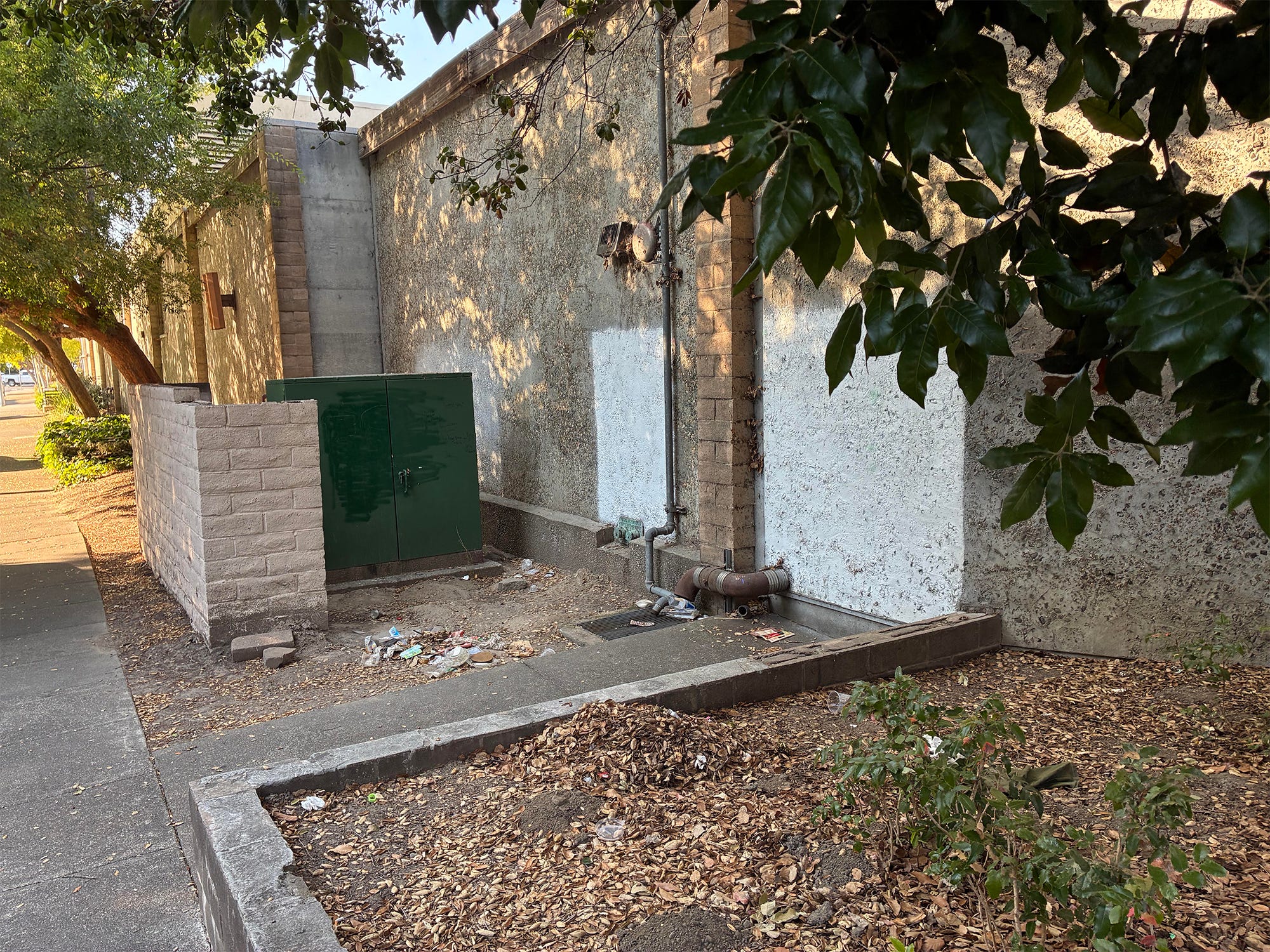
There was a tense interchange between Mog and Zollman around the question of restorative justice. Zollman, a former juvenile public defender, asked if there was some way the city could offer a restorative justice option to juvenile perpetrators before embroiling them in the legal system.
Mog clearly thought that restorative justice was an option offered once you are in the juvenile justice system; otherwise, how could you compel someone to do it?
Zollman said there were programs where restorative justice was offered as an alternative to entering the juvenile justice system.
“Because having represented youth, that is an option,” Zollman said. “You bring the parents in and go, ‘Listen, little Johnny has been accused of X, Y, and Z. Here’s what’s going to happen. Here’s an option to do restorative justice, or our police can haul them away, do fingerprints, which will be logged in the system for probably the rest of their life, and they’re going to look at jail time.”
Mog asked Zollman if he had any examples of a city with such a system.
“No,” Zollman snapped, “because this is not my job, but this is your job.”
“I’m not aware of a single local municipal authority because what it seems you’re implying is that this interaction on the street or wherever this occurs before someone is arrested or cited, this offer should be made.”
“Of course, they’ll be cited,” Zollman said hotly. “They’ll be cited, and then you have the policy saying these are your options: you can participate in restorative justice, or you can go ahead and address the prosecuting agency.”
Then he threw up his hands. “Never mind. I’m exhausted.”
The final motion went like so: “Councilmember Zollman moved and Councilmember Carter seconded the motion to approve 10 hours for city attorney time to research legal options on the response to the community concerns of the graffiti and the racial mockery associated with the Safeway area, focusing on the restorative justice model and returning this item to the September 1st City Council meeting.”
The motion carried 3 to 2, with McLewis and Hinton dissenting.
The EIFD moves forward
Cast your mind back to 2024 and early 2025 when most everyone on the council—except Jill McLewis—was all aflutter about the possibilities of creating an Enhanced Infrastructure Financing District or EIFD
An EIFD is a special kind of financing district that captures a percentage of the increase in property taxes that result from rising property values and uses it to fund infrastructure improvements within the district. An EIFD siphons off a portion of those increases, which would normally go to the County, and sets the money aside in a restricted account that can only be used for infrastructure.
It’s a complicated municipal financing instrument—and it was late, and everyone was exhausted—and Councilmember Phill Carter’s attempted explanation of the EIFD was so garbled as to be incoherent.
Councilmember Hinton said Sebastopol’s efforts to create an EIFD with the County were put on hold for a while because the city wanted to focus on passing its sales tax measure. Now the effort to create an EIFD is back on track—and it requires some investment up front, with hopes that it’ll pay off in the future.
That investment involved the hiring of a consultant from Kosmont for financing district formation advisory services, which include, according to the staff report, “carrying the EIFD through its remaining formation steps: stakeholder and County outreach to confirm partnership, preparation of the required Infrastructure Financing Plan (IFP), and support through the public meetings and hearings needed to form the district.”
The council voted to approve the agreement with Kosmont Companies for Financing District Formation Advisory Services in an amount not to exceed $40,000, plus an additional $20,000 to look at including some areas outside of the City.
In discussions, it came to light that the effort to form an EIFD would also require city staff to devote about 10 hours a week for six months to get the district off the ground.
That soured Councilmember Maurer on the deal, and McLewis was already dead set against it. Public commenters were also skeptical of this project.
Hinton defended it as one of the only ways for Sebastopol to wring more monetary support from the county. “I’ll just say that this replaces, in many ways, the old money cities used to get that was called redevelopment funds…It’s a long-term project, and it helps us pay for big infrastructure projects.”
The final vote was 3 to 2, with Zollman, Hinton and Carter in favor and Maurer and McLewis opposed.
Chipping away!!! Now let's get the other 5M back and into the well infrastructure. One small step towards the larger restitution. This is great to see. Onward towards an incrementally improved, more ethically accountable future Sebastopol? Common Sense Party?
Regarding the EIFD. As a taxpayer IN the City of Sebastopol and someone who has watched almost every council meeting for the last 4 years, I am not happy that this was voted on with the council members apparently not completely understanding this complex issue.
There is no accurate number as to what the cost will be for city staff time, yet Phill, Steven and Neysa agreed to another 10-15 hours a week for city staff to work on this.
They also voted to spend $125,000 of our taxpayer money, (adding to the deficit), to work on something no one really understands.
There is no concrete - in writing - contract with the county to match funds.
Thank you to Sandra and Jill for voting no - which was the appropriate vote to make if one was voting to protect the taxpayers and the budget.