

This is Part 2 of a three-part recap of the Sebastopol City Council meeting of May 19. Find Part 1 here.
Mayor Jill McLewis, Councilmember Phill Carter, Councilmember Neysa Hinton, and Councilmember Stephen Zollman were present in chambers for the May 19 Sebastopol City Council meeting. Vice Mayor Sandra Maurer attended via Zoom, and Councilmember Hinton left for work-related reasons at 7:30 pm.
Council adopts plan proposing two-way streets in downtown
The council voted 4 to 1 (McLewis dissenting) to adopt the “Reimagining the Core” plan, which would convert both Petaluma Avenue, Main Street and McKinley (in front of the Whole Foods shopping area) to two-way traffic and add pedestrian safety and streetscape elements throughout the downtown.
The plan—and the long process to develop it—was funded by a $260,000 Caltrans Sustainable Transportation Planning Grant that the city of Sebastopol won in 2023. Over the last two years, the consultants from Fehr & Peers have held a number of public meetings and introduced several iterations of “walkable downtown” plans. (See our two-part article on the various alternatives.) After a lot of public input and negotiations with the Sebastopol Planning Commission over several meetings, they landed on the configuration below:
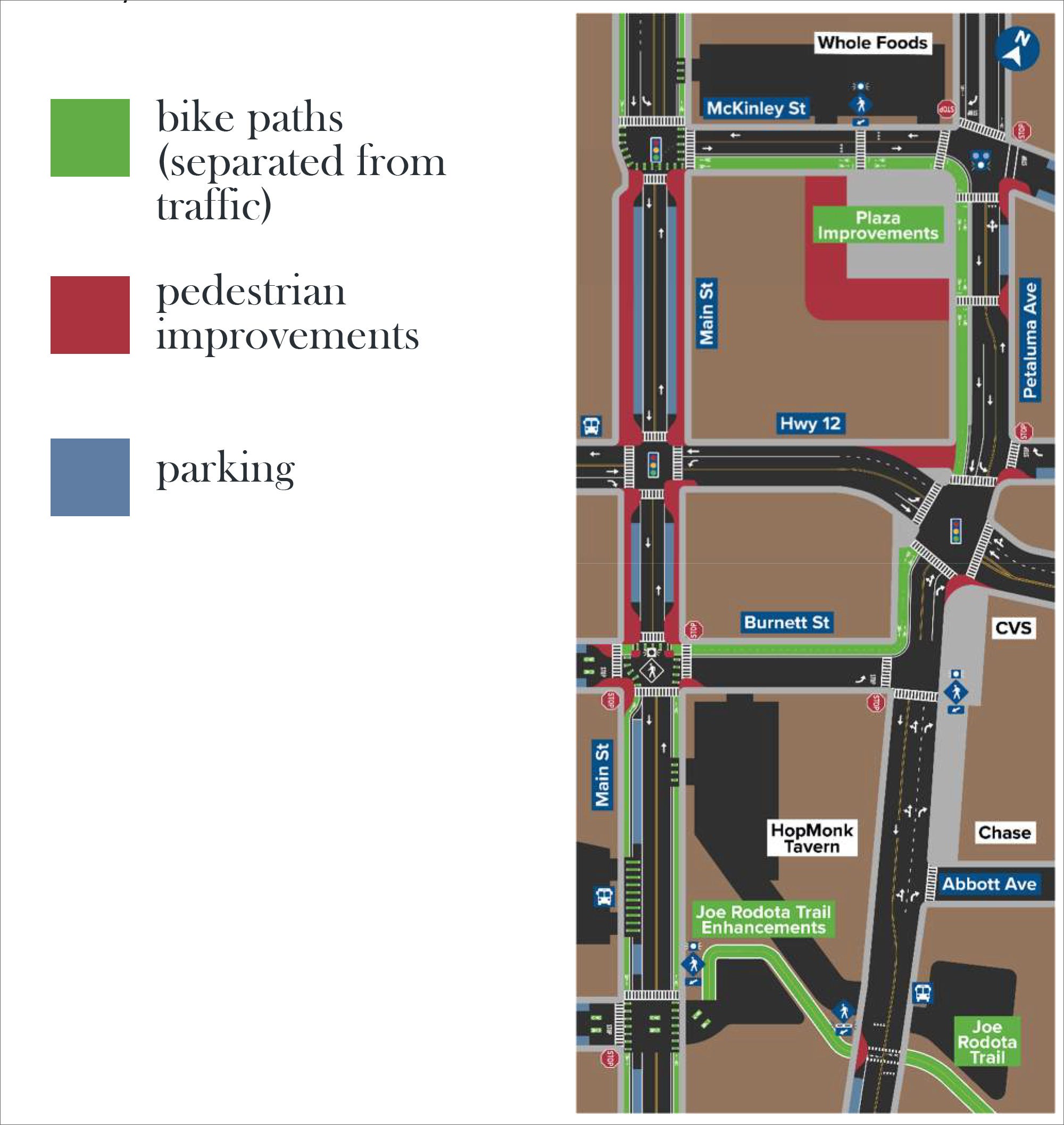
According to the Fehr & Peers’ final report, key improvements—in addition to the two-way traffic—include:
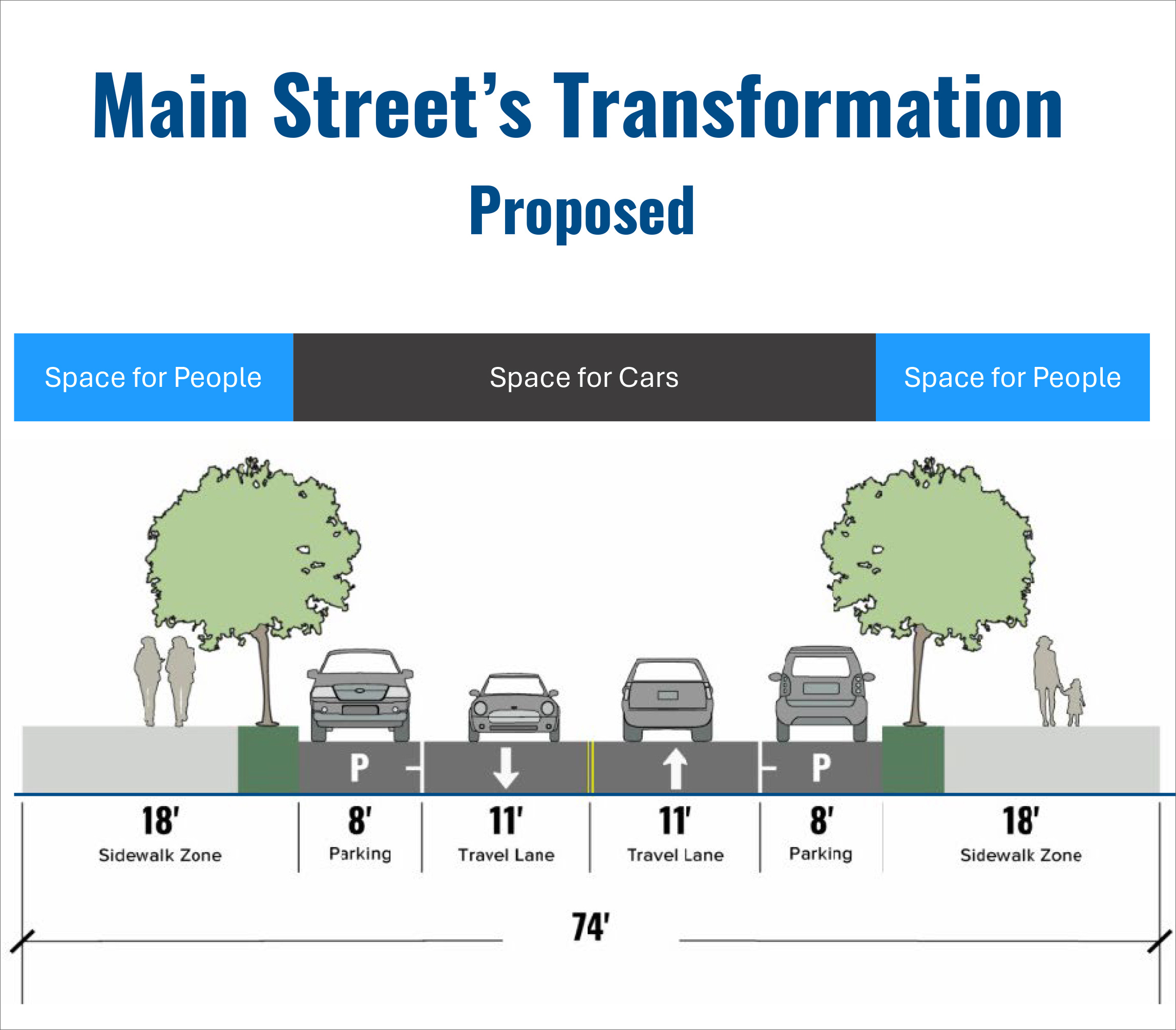
Wider sidewalks and enhanced streetscape on Main Street to support walking, gathering, as well as local businesses
Curb extensions and improved crossings throughout downtown to shorten crossing distances and improve safety
A multimodal corridor on Petaluma Avenue and McKinley Street, including a shared-use protected bike pathway connecting to the Joe Rodota Trail and regional routes such as the Gravenstein Trail and Apple Blossom Trail
Traffic signal upgrades and timing changes to support slower speeds, safer crossings, and more intuitive circulation
Movement versus Place
Fehr & Peers consultant Geoff Rubendall explained the philosophy behind these improvements in terms of the dichotomy of movement versus place.
“We really want to echo that this makes Main Street a place—it’s the place where people really come to gather and to interface with the downtown businesses. Petaluma Avenue and McKinley are really designed for movement—it’s getting cars through, it’s getting cyclists through, and folks that aren’t coming to partake of the downtown to get to their destinations. You can’t have one street do both movement and place.”
Main Street and the bike lane dilemma
The choice not to put a bike lane on two blocks of Main Street between McKinley and Burnett was a controversial one. As you can see from the map above, the protected bike lane basically jogs around the heart of downtown.
Rubendall said it basically came down to a matter of space. Ideally, there would be room on the street for cars to park, for people to walk and for cyclists. Realistically, however, this stretch of downtown didn’t have room for all three, so the designers had to choose two out of three.
In surveys and comments, the public had expressed a strong desire for wide sidewalks and better streetscapes. Local businesses and their supporters expressed a desire not to lose on-street parking on Main Street. Cyclists, of course, wanted access to downtown.
The team from Fehr & Peers did a Bike Study as part of their analysis. “What we found kind of boils down to a trade-off between three things that we want, but only two can fit,” Rubendall said.
This graphic explains the dilemma.
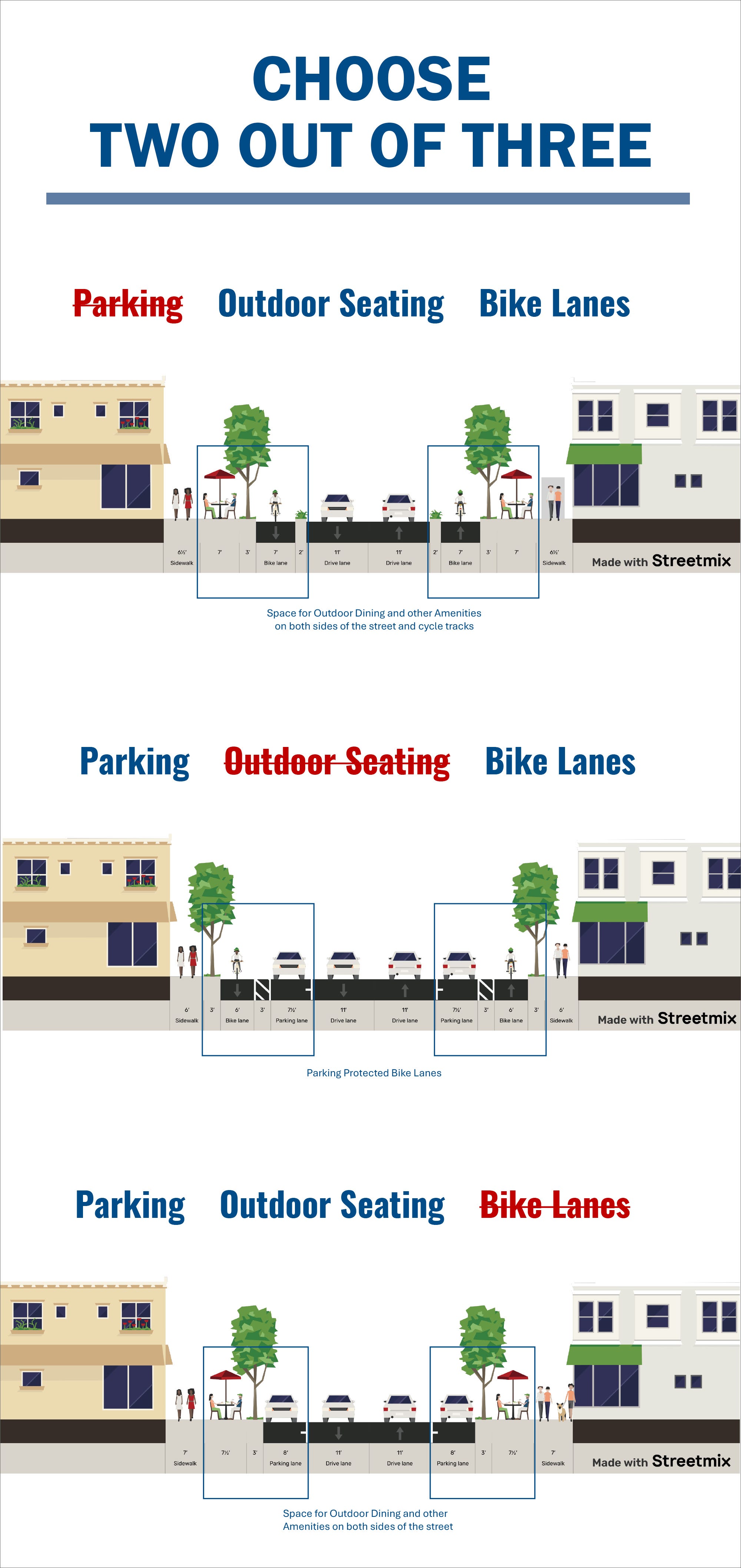
The third option—18-foot wide sidewalks and on-street parking—won out.
Predictably, cyclists weren’t thrilled with this solution. In public comment, Emily Shartin from the Sonoma County Bicycle Coalition (STBC) said, “STBC is certainly in favor of designs that include bike lanes on Main Street. Bike lanes contribute more to the creation of place than lining the streets with vehicle parking. Bike lanes on Main Street also get bikes where they want to go.”
She also took issue with the two-way cycle paths around the plaza.
“You’ve heard me say it before: two-way cycle tracks and paths are difficult. How do cyclists get on and off them? What happens at intersections? It creates uncertainty and some unpredictability.”
The real challenge
Although it took two years of steady work by a team of consultants, creating the design for “Reimagining the Core” is the easy part. The hard part is turning that design into reality. Rubendall spent the end of his presentation explaining how that might be done.
“In order to deliver something like this, it requires involvement from Caltrans, SCTCA [Sonoma County Transportation Authority], other agency partners, as well as the commitment from the city and the community to move this forward,” Rubendall told the council.
In her introduction to the project, Interim Planning Director Jane Riley passed along a planning commission suggestion about the creation of “a community advisory group or similar engagement process to support ongoing community involvement and to pursue funding for technical studies, environmental review, partnership opportunities, and so on.”
The real question, of course, is: Where is the money needed to implement this plan going to come from?
“This will require funding from several different places,” Rubendall said. He suggested “phasing the project in a strategic way that capitalizes on the grant programs that are available at the regional level, state level, federal level…This is not going to be paid for solely by the city. It really takes those grant programs—and this project checks all those boxes to be a really good candidate. I think Sebastopol, with its commitment to safety, to environmental stewardship, and business vitality, is a very strong candidate for competitive funding,” he said.
Mayor McLewis asked about the timeline.
“I think 10 to 15 years for full realization of everything is the timeline,” Rubendall said.
That may seem like a long time, but Councilmember Hinton thought that seemed about right. She noted that the process that led to the Bodega Avenue improvements, which just wrapped up this month, was started when she first joined the council in 2016.
Public Comment
There have been so many public meetings devoted to this plan that, at this point, the number of people opposing the project during Public Comment was relatively small. Lee Mathias, Oliver Dick, and Laurence Pulgram expressed their ongoing concerns about traffic.
“Fifty-nine percent of the people don’t want two-way traffic,” Pulgram said, referring to a public survey about the project. “Traffic coming down on 116 every day is jammed. We’re talking about going from three lanes and a bike lane to one lane at McKinley. Where is the traffic going to go?”
Oliver Dick knew where: onto the side streets. “We have so much traffic flow through the city, we’re going to have gridlock. People aren’t going to go through downtown, they’ll start driving through all the residential streets, which have horrifically bad road surfaces…This is very incomplete planning. We’re ignoring the elephants in the room, which is all this incredible volume and traffic.”
Dick also doubted that people would use all the extra bike lanes. As it is, “Seeing cyclists on the green cycle lanes, it’s like seeing a rare bird or something,” he said.
“How are you going to find money and staff to do this?” Lee Mathias asked, noting the budget deficits predicted for upcoming years. “There’s not a lot of extra money floating around in the city to use for matching funds or to do the planning that’s necessary in order to submit grants.
Only one person spoke in favor of the plan during public comment: a member and former longtime chair of the Planning Commission, Paul Fritz.
“I strongly encourage you to adopt the plan before you tonight. I think this is a good culmination of the past couple of years of this process…There are many details that still need to be worked out, but this will be transformational for downtown in a very positive way,” he said.
He added that while he sympathized with cyclists’ desire for a bike lane (instead of parking) on Main Street, such a choice would have made the downtown business owners “go ballistic,” and that the current plan was a good compromise.
A majority vote in favor and a notable dissent
When it came time for council comment, one by one, four councilmembers expressed their support for the plan. Councilmember Zollman said he was “1000% in support of this,” and Councilmember Phill Carter called it “a vision we ought to go with.” Maurer expressed concern about the loss of parking adjacent to the plaza, but said she was still in support, as was Councilmember Hinton.
“I’m going to be a different voice here,” Mayor Jill McLewis said. “I’m not supportive of this. Residents do not feel heard about this—based on my discussions with many people and the comments that we received—and they don’t feel like their input has truly been considered. Some people used the word ‘railroaded.’”
The second thing that concerned the Mayor was the way large visionary plans for the future get in the way of smaller improvements that could improve the lives of residents in the here and now. She compared the Reimagining the Core plan to the Calder Creek restoration plan for Ives Park—another plan with a 10 to 15 year time-horizon.
“That’s been a hurdle for making a lot of different progressive steps and improving it [Ives Park] right now—all for the idea that later on, because of that plan, we might get a grant somewhere down the line—and I’m like, I’d like to live in today. I’d like for us all to be able to enjoy the park today and next year, and not continually talk about ‘in 10 years or 15 years.’ I’m here now, and I think that’s how residents are feeling as well.”
McLewis said the “Reimagining the Core” plan is “just another plan that’s ‘down the road,’ and it’s just going to be another hurdle” to making more immediate and practical improvements in the here and now.
She knew she was on the losing end of this vote, however.
The council voted 4 to 1 to confirm that work under the Sustainable Transportation Grant has been completed, and they adopted a resolution approving the “Reimagining the Core” plan, including the Planning Commission’s suggestions for recommended future actions. Those actions were enumerated in the staff report as follows:
Establish a downtown implementation advisory group as a near-term action. Recommend formation of an advisory group (or similar) early in implementation, with a defined role in guiding design refinement, phasing decisions, and ongoing community coordination.
Add a public realm plan / streetscape design guidelines. Include development of a public realm plan or streetscape design guidelines to ensure consistent, high-quality streetscape and landscape design across all downtown improvements.
Emphasize coordinated, corridor-wide implementation. Update the report to reinforce delivery as a coordinated program, avoiding fragmented, project-by-project implementation and ensuring all improvements contribute to a unified vision.
Prioritize and sequence supplemental studies. Revise to clearly identify which studies come first, why they matter, and how they support implementation and funding readiness.
Integrate studies, funding, and phasing into a single framework. Clarify how supplemental studies, funding strategy, and phased improvements work together as a unified implementation approach, rather than standalone efforts.
Read the staff report and the entire “Reimagining the Core” plan here.
Watch for Part 3 of this city council recap article, which will discuss the council’s decision to increase the monthly stipend for city council members from $350 a month to $950 a month.
Here we are again, the city council is moving forward on something that the 59% of people who responded to their survey said "No" to. When is the city council going to start listening to the people who live here?!?!
Excellent, the Council made a decision which stated a clear intention: Make Main Street a place. Massive and complex projects need a single focal point to drive all subsequent decisions. Now that we know what the City is for, we can better understand the necessary tradeoffs required to make it happen. Too often, Council meetings and community discussions are mired in the details as if they were the goal.
It makes sense that not everyone agrees that Main Street should be a place first and everything else second. Any major policy/vision decision that everyone agrees with would already be enacted. With any divisive civic plan, some official body has to define the priority...a goal that in the context of everything else, helps the entire community thrive.
We all generally agreed downtown could use some structural help, and now we have a stated direction and a priority. Going forward, the job is to fine tune and make sure as many of the sub issues are handled as best we can. But those sub issues all exist in a system. Every decision about something affects something else. Fixing potholes in one street means more and faster traffic in one place and less somewhere else.
As much as some people would like to imagine their issue is a stand alone simple choice, they just aren't. Every civic decision is a balancing of different ideals and practical realities. When you make downtown thrive without attracting more visitors, you make the South and North end commercial areas suffer. When you bring in more visitors without changing traffic patterns, you make locals suffer more traffic.
Cities need a growing tax base to thrive. Cities are in competition with each other to entice residents and visitors. Wanting to keep things the way they are is wishful thinking. Demographic trends, the economy, and climate change forces change on all municipalities. The question is: what is the "character" of the area we are trying to preserve? What are we for? From there we move to messy implementation tradeoffs.
Only in the context of the larger system can we understand the usefulness of any particular complaint about a particular tactical issue.