


Last night in Guerneville, the West County EIFD became the second official Enhanced Infrastructure Financing District in Sonoma County. (Santa Rosa was first.) The EIFD’s Public Financing Authority (PFA)—made up of Sonoma County Supervisors Lynda Hopkins, Rebecca Hermosillo, and two public members, Pip Marquez De La Plata and Thai Hilton—voted the new district into existence, after the Sonoma County Board of Supervisors approved the EIFD’s Infrastructure Financing Plan on a vote of 5-0 at its meeting on Tuesday of this week. (James Gore is also on the PFA, but he was absent last night.)
An EIFD is a special kind of financing district that captures a percentage of the increase in property taxes that result from rising property values and uses it to fund infrastructure improvements within the district. An EIFD siphons off a portion of those increases, which would normally go to the County, and sets the money aside in a restricted account that can only be used for infrastructure inside the EIFD district.
An Enhanced Infrastructure Financing District is what California came up with after it killed redevelopment agencies in 2012. Nobody’s taxes go up. Nothing new is levied.
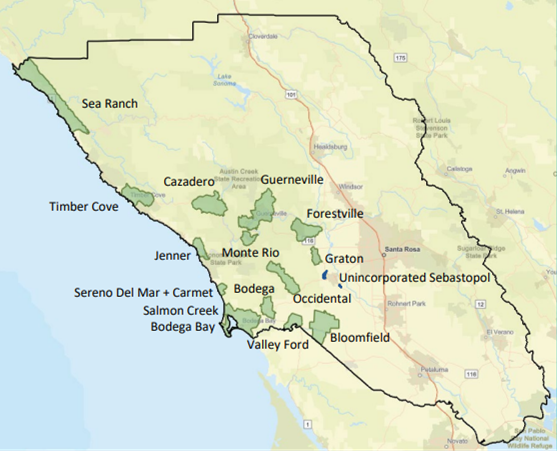
As the map above shows, the West County EIFD includes Guerneville, Monte Rio, Forestville, Occidental, Graton, Cazadero, Jenner, Bloomfield, Sereno del Mar, Sea Ranch and some unincorporated areas around Sebastopol.
The city of Sebastopol, which is slowly moving toward creating its own EIFD, isn’t a part of the West County EIFD.
What West County will get
The West County EIFD includes about $7.1 billion in existing assessed property value, roughly 6% of the countywide total. It is the largest EIFD planned for Sonoma County.
Over the next 50 years, the West County EIFD expects to bring in about $308 million. (That sounds bigger than it is — most of that money arrives decades from now, when a dollar will buy less. In today’s money, that comes to about $86 million.)
The list of infrastructure projects that this money will fund is long, and the plan sets it out alphabetically because nobody has ranked it yet. It includes affordable and workforce housing, community gathering space, dock and coastal infrastructure at risk from sea-level rise, emergency access, energy micro-grids, recreation, roads, a sheriff’s substation, sidewalks and bike improvements, and water and wastewater work (those last two each capped at 10% of revenues).
But don’t get too excited yet. Nothing on that list is funded yet. Every project has to come back to the PFA for a vote. EIFDs take time to build up their funds. Although the money will start flowing in the 2027-28 fiscal year, it doesn’t reach critical mass for several years. It takes five years to build up enough money to stand up a bond, for example.
This means that for a few years, while the money grows, the PFA will meet only once a year.
“We have to meet once a year at minimum. Once a year makes sense while we are waiting for enough time to pass so that we can accumulate funds and bonding capacity,” Hopkins said. “Once we have sufficient revenue, we would meet more often and engage with the community to prioritize projects. The PFA approves the projects with input from the community, including local government agencies like local park, fire and water districts.”
The board of supervisors contemplates the big picture
The West County EIFD is just the start of a wave of local EIFDs expected to be formed over the next few years.
“We are the tip of the spear here,” Hopkins said at last night’s meeting. “I mean, Santa Rosa did form theirs, but there is like a whole bunch of people falling in line who now want to do the same thing from other jurisdictions.”
For their board meeting on Tuesday, the supervisors asked staff to add up all the existing and planned EIFDs in the county and put a number on each one.
Seven districts are on that list. Santa Rosa’s is already formed. Unincorporated Sonoma Valley and the city of Sonoma are in discussion. Cotati has adopted a resolution of intention. Rohnert Park is in early conversations. Sebastopol’s EIFD process was on hold for several months, but now it’s moving forward again. Together, those areas hold 13.7% of the county’s assessed value.
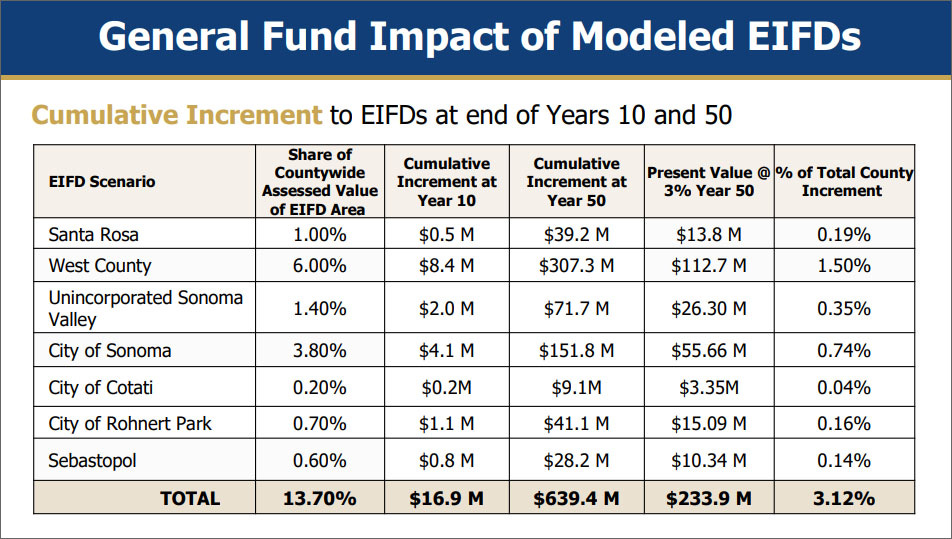
If all of them come in at 25% of property-tax growth in their district, the county will have committed $639.4 million of future general-fund property tax over the next 50 years—or about 3.12% of its projected property-tax growth. (That’s $233.9 million in present-value terms.)
At $307.3 million, the West County EIFD is the biggest single piece, close to half the whole thing.
Three people spoke on the item at the Supervisor’s meeting. Cotati’s city manager, there to thank the board for considering his city’s request. A caller on Zoom, cut off by the chair for calling Hopkins names. And Duane De Witt, a longtime Roseland advocate, who asked the supervisors to help Santa Rosa make Roseland a district too. “Let that become a EIFD also.”
Then it came back to the board.
“Now it feels like the floodgates have opened, and everyone is interested in one of these things,” Hopkins said.
Her question was about staffing: Does the County Executive Office have the people to shepherd this many jurisdictions?
The representative from the County Executive Office said it has the staff for the districts already in motion, and it will size up what the rest would take in next year's budget.
Vice Chair Chris Coursey ran with it. “Whoever drew that map was a genius,” he said of the West County boundary. “The individual amounts are striking.”
He voted yes, then spent a few minutes naming places with the same argument and the same needs. The first one out of his mouth was Roseland. Then Moorland, Penngrove, the Springs, Larkfield. “I don’t think this is a complete list,” he said.
Supervisor James Gore noted that the county has been paying for this kind of infrastructure work anyway out of the General Fund, and that an EIFD at least commits to a plan of projects, instead of hauling one project at a time up to the dais.
According to the West County EIFD plan, the district will even make money for the county in the end — a net positive of about $26.3 million in present value over 50 years because the EIFD will catalyze development—new hotel rooms and retail—that will throw off lodging and sales taxes.
What impact will a West County EIFD have on Sebastopol’s EIFD plans?
After putting its EIFD on hold for several months, the Sebastopol City Council on August 4 approved a $60,000 consulting agreement with Kosmont Companies to carry the Sebastopol EIFD through its remaining formation steps.
According to the staff report, this includes “stakeholder and County outreach to confirm partnership, preparation of the required Infrastructure Financing Plan (IFP), and support through the public meetings and hearings needed to form the district.”
Unfortunately, some of the unincorporated areas near Sebastopol that the city hoped to include in its EIFD have already been scooped up by the West County EIFD.
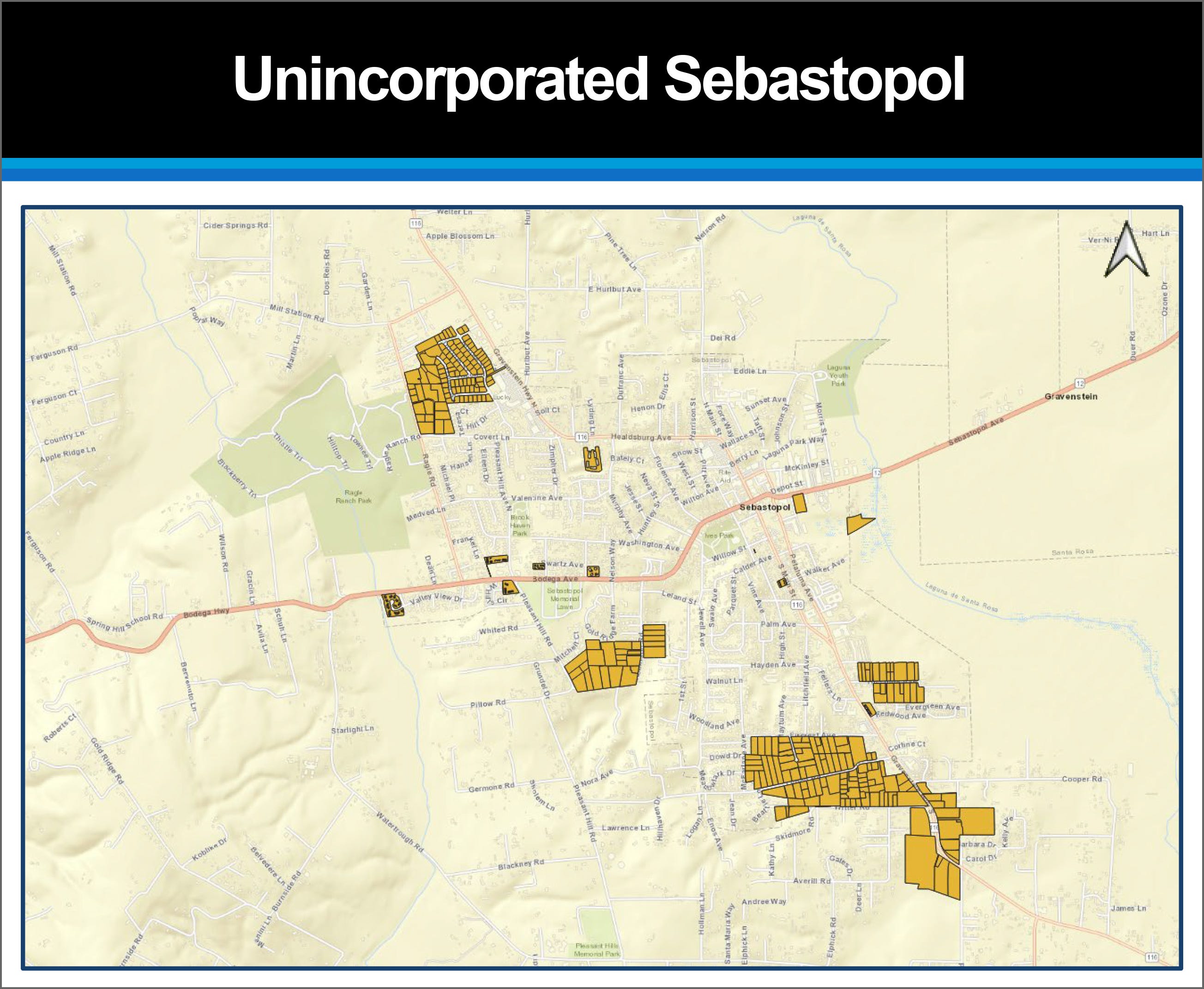
These areas can’t be included in a Sebastopol EIFD, but the city may look at other nearby unincorporated areas to add.
“They’re looking at different areas now, Hopkins said. “They’re aware that they kind of missed their opportunity because originally, when we were meeting with Sebastopol, those were on the table as potential Sebastopol opportunity sites.”
When Sebastopol decided not to move forward, however, she said the county decided it “would move forward with incorporating those into the West County EIFD.”
One commenter at last night’s meeting noted the language of the West County EIFD resolution talked about “projects of community-wide significance that provide significant benefit to the EIFD or the surrounding community.”
Asked if projects in Sebastopol that served the larger West County area—like the Sebastopol Area Senior Center or the Center for the Arts—might qualify for funding through the West County EIFD, Hopkins said that was “less likely.”
“I think that when we went through this process of whether we were going to create one West County-wide EIFD or one that was unincorporated and one that was city-specific, there was sort of a lot of apprehension around like, “Oh, is all of the unincorporated funding going to go to Sebastopol or vice versa?” Hopkins said. “That would have to be taken into consideration as part of the deliberation—like, what is the percent being utilized by folks who live inside the EIFD boundaries versus inside the city of Sebastopol.”
Hopkins said that while Sebastopol projects were “legally, technically” allowed, “I would say that they would probably be less likely to be selected, given how huge our [meaning the West County] EIFD is, right? Thinking about the needs of the North Coast, and it’s a very wide area with very disparate needs.”
See the West County EIFD draft plan, which includes lot-by-lot maps, here. More documentation from the August 18 Supervisor’s meeting regarding the West County EIFD can be found here.
I would like to sanity check the costs of the EIFD for the city of Sebastopol versus the County, in case the city of Sebastopol is inadvertently overestimating costs:
1) Any idea if the County did the same as the city of Sebastopol and paid a consultant $60K for “carrying the EIFD through its remaining formation steps”?
2) Any idea if the County will also require “staff to devote about 10 hours a week for six months to get the district off the ground”
(Both of these actions were mentioned in your previous article: https://www.sebastopoltimes.com/p/city-of-sebastopol-to-reimburse-350354)
Thanks! Note I am a huge proponent of both EIFDs, but want to understand costs better.