

Part 1 of this series, which addressed the Grand Jury’s report on the Sebastopol’s Water and Sewer Funds, was posted on June 11. This article addresses the recent report from the city’s Enterprise Funds Oversight Committee.
The Enterprise Funds Oversight Committee (EFOC), formed at the end of last year, is calling on the city of Sebastopol City Council to drastically reduce the amount of money the City charges its Water and Sewer Funds for city support services and return millions of dollars for years of overcharging.
The report from the Enterprise Funds Oversight Committee followed close on the heels of a similar report from the Sonoma County Grand Jury, which estimated that city owed its Water and Sewer departments more than $5 million. At the June 2 Sebastopol City Council meeting, EFOC member Kate Haug said her committee’s report is meant to provide a detailed plan so that the City can meet the Grand Jury’s recommendation by the Oct. 1 deadline.
The Grand Jury’s recommendations were as follows: 1) That the city commit to complying with Proposition 218 by conducting cost allocation and rate studies every 3-5 years and adjust ratepayer fees accordingly; and 2) That the city decide how much money was misdirected from Water and Sewer funds to the city budget over the last several years and create a plan to repay those funds. The Grand Jury’s third recommendation was that the city consider adding a Certified Public Accountant to the Enterprise Fund Oversight Committee.
There are five members of the committee: Councilmember Phill Carter (Chair), Greg Dabel (Vice Chair), longtime council watchers and commenters Oliver Dick and Kate Haug, and relative newcomer Mary Meihaus. Haug and Dick were instrumental in pushing for the creation of the committee, an effort that Councilmembers Carter, Maurer and Zollman supported.
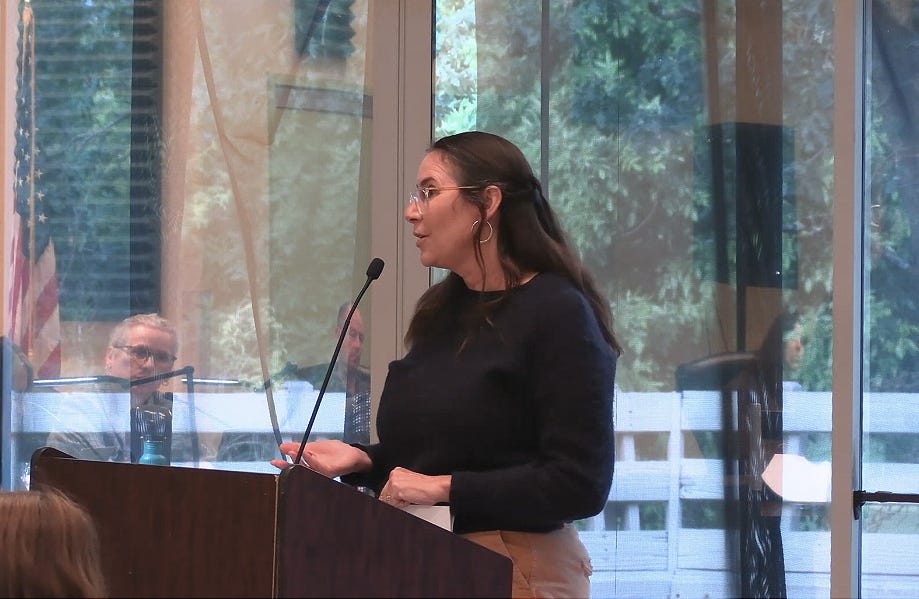
The Oversight Committee immediately subdivided itself into two subcommittees—the finance subcommittee and the infrastructure subcommittee—and those subcommittees gave their first information presentation before the Sebastopol City Council meeting on June 2.
Too little time for a long and complex report
The City Council has a general rule of allowing 10 minutes for a presentation, which meant that each EFOC subcommittee got just five minutes to give its report. This was particularly unfortunate in the case of the finance subcommittee, which had prepared a complex and detailed 45-page report and a 22-page PowerPoint presentation (cut down from 36 pages).
Haug sped through the PowerPoint as quickly as she could, leaping over whole sections, but it was impossible to do justice to their report in the 5 minutes allotted for the presentation. The report, for example, had 13 recommendations about how to fix the city’s Water and Sewer Funds. City staff had asked them to trim that to four for the presentation.
The goal of this article is to summarize their report.
The legal framework
Like the Grand Jury report we covered on June 11, the EFOC Report asserts that the city of Sebastopol is in violation of Propositions 218 and 26, both of which mandate, among other things, that local water and sewer rates cannot exceed the cost of providing services and prohibit revenue from ratepayers to be used for general government purposes.
The EFOC report also says the city’s conservation-based, tiered water rate structure—the more you use, the more you pay per gallon—is in violation of AB 1827, which requires cities to prove that a higher rate reflects the actual cost-of-service and isn’t just a penalty designed to discourage usage.
How does a city determine the reasonable cost of providing water and sewer services?
(If you read part 1, you can skip to the next section)
To set ratepayer fees for water and sewer, cities hire highly paid consultants to conduct two complex and different (but connected) studies: a cost allocation study and a rate study.
A cost allocation study examines what it costs to run a city and then allocates those costs among the city’s different departments. The cost allocation study also determines how much the city’s Water and Sewer Funds need to pay the city for the use of city services, such as administrative, legal, human resources, and IT, as well as policy and management costs, like the cost of the city council or city manager. Water and Sewer are expected to reimburse the city for those services. The result of this analysis is a Cost Allocation Plan.
A water and sewer rate study looks at the full cost of delivering water and sewer services and how that will be shared among rate payers (i.e., the rate structure). In order to establish that, one needs to know how much the city is going to charge Water and Sewer for the city services listed above. These charges are enumerated in the Cost Allocation Plan.
Cities are supposed to update this plan every three to five years to ensure that enterprise funds like Water and Sewer are charged a fair — not inflated — share of those overhead costs. (While updating these plans every 3 to 5 years is considered a best practice, it is not legally mandated.) Though the city hired consultants to run several water and sewer rate studies over the years, Sebastopol hadn’t updated its Cost Allocation Plan (CAP) since the year 2000. By the time a new Cost Allocation Study was finally conducted in 2024, the city had been operating on an outdated CAP for almost a quarter of a century.
A department-by-department critique
The EFOC report identifies problems across several different city departments.
Legal and Engineering
First the EFOC takes on two contracted city services: engineering and legal services, arguing that these should be based on direct billing and not included in a cost allocation plan. Their logic is this: cost allocation plans are meant to account for city services, like administration, HR, etc., but all of those are normally wrapped into a consultant’s fee.
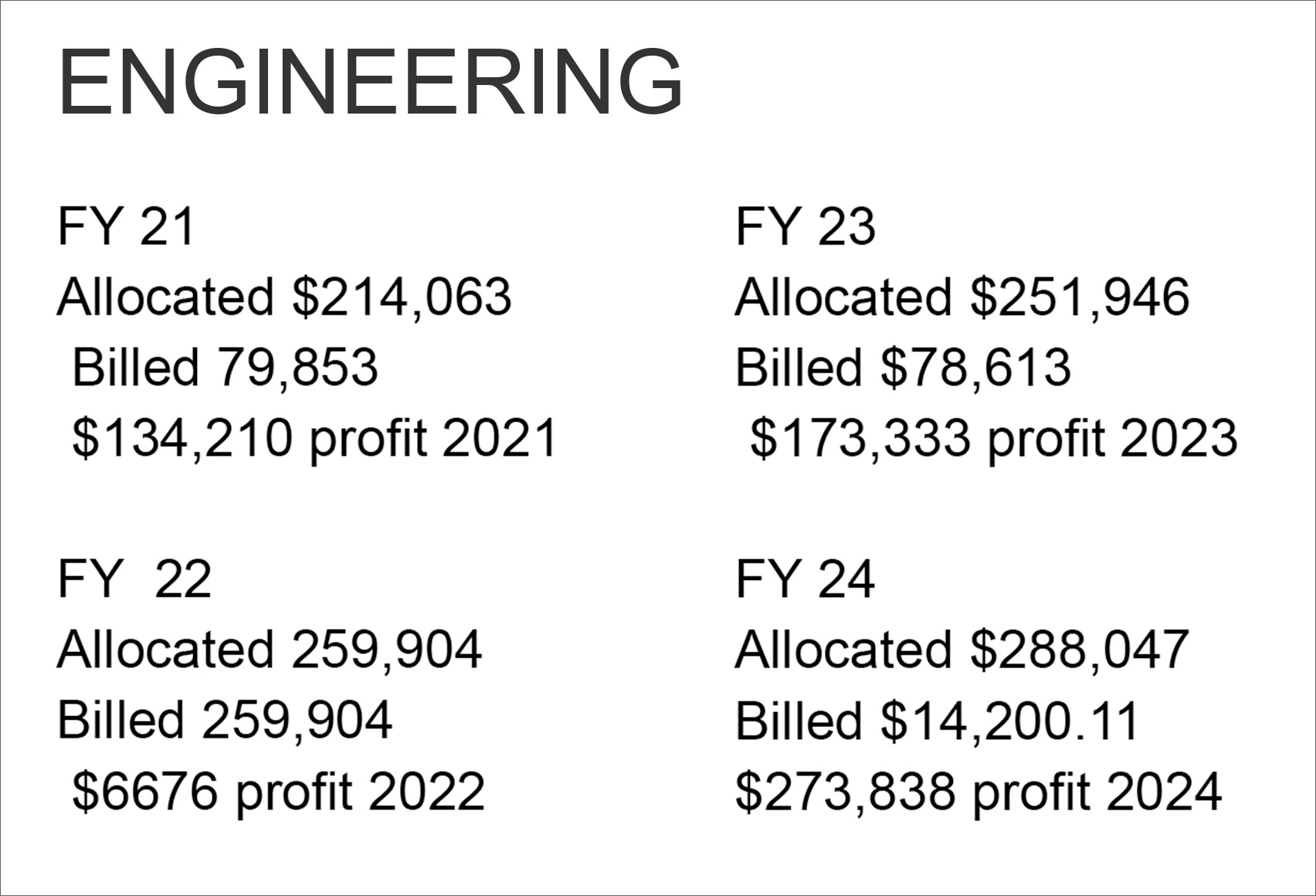
In the case of both legal and engineering services, the amount billed to Water and Sewer via the cost allocation was far higher than the amount directly billed by the contractors
LEGAL SERVICES: According to the EFOC report, “The City charged Ratepayers $184,587 for legal fees for FY 2024/2025. Records show that only $13,850 were billed by attorneys for services rendered to Enterprise Funds. That means the City made a profit of $170,737. For FY 2025-2026 $189,263 was allocated. I [Kate Haug] have requested the attorney bills and thus far shows $9,651.50 was billed, resulting in a $179,617 profit for the City.”
After longtime city manager/city attorney Larry McLaughlin retired in 2024, the City contracted its legal services from Redwood Public Law. According to the report, “At this point, the legal fees for Water and Sewer rose dramatically even though there was no litigation for Water and Sewer.”
As part of its recommendations, the committee is requesting that the city refund $350,354 in misallocated legal costs to Water and Sewer.
ENGINEERING SERVICES: The city contracts its engineering services from GHD. According to the EFOC report, “The City made a $588,057 profit from ratepayers (FY 2021-2024) by overcharging from what was billed to Water and Sewer through the Cost Allocation Plan v. what was actually billed by the Engineering consultants.”
Administrative Services takes the wrong cut
The fees charged to Water and Sewer from the city’s Administrative services more than tripled over nine years, rising from $306,989 in 2015 to $944,971 in 2024. How did this happen? According to the EFOC report, the old cost allocation plan from 2000 allocated 71-75% of the Administrative Service’s total budget to Water and Sewer. That was fine in 2014, when there were only two employees. But when Administrative Services added two more employees over the next few years, that percentage should have dropped to 37.5%. According to the report, “The failure to adjust the allocation resulted in massive overcharging of customers.” The report estimates that from 2015 to 2024, this error resulted in the City overcharging the ratepayers by $2,845,489.
Double-billing in Public Works
Public Works is the City department most directly associated with Water and Sewer Service. Time tracking from January and February 2026 indicates that Public Works employees spend approximately 20% of their time on Water and Sewer. The new Public Works director says that might be higher, perhaps 30%.
According to the report, the City is charging Water and Sewer too much for the amount of time Public Works actually spends on it.
Using the new data, it would appear that 1.5 FTE in Water and 1.5 FTE in Sewer and a 15% allocation of the Corporate Yard for Water and 15% allocation of the Corporate Yard for Sewer would be an appropriate allocation for Public Works.
Currently, Public Works has 2.85 FTE in Water and 2.3 FTE in Sewer as a distinct line item in the budget. For FY 2024/2025, Water had $280,890 in salaries, Sewer had $253,365 in salaries.
In addition, there are Salaries for Public Works in the Cost Allocation Plan. Water had $309,277 in Public Works fees via the Cost Allocation Plan, and Sewer had $217,364 fees via the Cost Allocation Plan.
Since Public Works salaries appear both in direct departmental billing and again in the cost allocation plan, the EFOC says this means that ratepayers are being overbilled and double-billed for Public Works salaries.
How much time do the City Manager and City Council really spend on Water and Sewer?
The EFOC report estimates that the Sebastopol City Council and the City Manager spend only 4% of their time on Water and Sewer.
City council members are not paid a salary. They get a $300-a-month stipend and can opt into the city’s health, dental and vision insurance programs if they like.
Yet according to the report, “For FY 2024-2025, Ratepayers paid $102,674 for Council Time. For 2025-2026, $104,658 is allocated for Council Time [in the City’s cost allocation plan]. This is not an accurate reflection of time spent on Water and Sewer and needs review.”
Ditto for the city manager: “For FY 2024-2025, Ratepayers paid $280,228 for City Manager. For 2025-2026, $286,063 is allocated for City Manager [in the City’s cost allocation plan]. This is not an accurate reflection of time spent on Water and Sewer and needs review.”
Other problems
The report also said that Water and Sewer are also being charged for a portion of vacant positions, and the Water department’s use of tiered rates (for the purpose of conservation) is a violation of Proposition 26. It also takes issue with the cost of smart meters, which the city approved in 2021. (We’ll deal with the latter in a separate article.)
The EFOC recommendations—and its discontents
The Enterprise Funds Oversight Committee came up with 13 recommendations that they believe will bring the city into compliance with Propositions 218 and 26. These changes would also begin restoring funding to Water and Sewer that is desperately needed for infrastructure improvements—improvements that have been delayed in the past for lack of money.
When it came time to present their recommendations to the city council, however, the finance subcommittee of the EFOC was told to choose their four most important recommendations. At the meeting, Kate Haug, who spoke for the finance subcommittee, chose the following:
Reject the current cost allocation plan from ClearSource Financial Consulting and don’t use that company in the future.
Implement time tracking immediately for any city department that bills the Water or Sewer Enterprise Fund.
Eliminate tiered water rates and don’t increase water and sewer rates in July as planned until time tracking is implemented and a new cost allocation plan based on that can be developed.
In addition to the $5.5 million found by the Grand Jury, reimburse Water and Sewer for the $350,354 in excess attorney fees they were charged over the last two years.
The full list of EFOC recommendations is much more extensive—and it’s a pity that the EFOC finance committee wasn’t given time to explain their findings in full.
We are reprinting the 13 recommendations verbatim so readers can appreciate the grand scope of the EFOC’s investigations and recommendations.
But before we do, a note of caution: This list of recommendations—and the subcommittee report in general, as deeply researched as it is—is not an objective look at how cities can manage their water and sewer funds. It doesn’t examine how cost allocation plans (CAPs) work and the different ways they can be structured. Rather, it is a well-researched argument for a particular approach—time tracking and direct billing. And while Haug calls this “the gold standard,” there are other, perfectly legal approaches.
Representatives from ClearSource have argued that relying primarily on time-tracking and direct billing “leaves money on the table.”
Professor Justin Marlowe at the University of Chicago’s Harris School of Public Policy, where he also serves as Director of the Center for Municipal Finance, explained what that meant: “When you do that, you’re typically not able to incorporate all of those indirect costs, because you’re only focused on the measurable direct costs, which is usually the time that an individual spends, so you’re giving up in most cases that additional 10-15-20% or more of the indirect costs that are attached to those direct costs.”
Haug gestures at the idea of accounting for indirect costs via FTEs, but that’s probably the weakest part of the report.
In addition, there doesn’t seem to have been any effort in this report to look at what systems other small cities that run their own water and sewer departments—Calistoga, St. Helena, or Ukiah, for example—use to manage their finances, and how those compare to Sebastopol’s approach. (Honestly, I get it—that sounds like a full-time job.) Subcommittee members did take a field trip to the Sweetwater Springs Water District, but that is an independent, stand-alone, water-only district serving Guerneville, Monte Rio, Rio Nido, and Villa Grande. At the last city council meeting, Kate Haug mentioned that Cotati uses time-tracking—and their city budget is in much better shape than Sebastopol’s.
That said, like the Grand Jury report, the EFOC report makes a persuasive argument that over the last dozen years, something has gone seriously awry in the way that water and sewer funds have been used to buoy the city of Sebastopol’s bottom line. The city seems poised to claim that it did all this legally; the Enterprise Funds Oversight Committee—and the Sonoma County Grand Jury—beg to differ.
Here is the full list of the EFOC’s recommendations verbatim:
Recommended Cost Allocation Plan: None of the current scenarios.
The Financial Sub-Committee does not recommend any of the scenarios
presented as the current models are not best practice and are not supported by documentation. The Finance Sub-Committee recommends moving Engineering Contract to direct billing and reducing Financial Administrative Department allocation by 50% based on historical modeling. All contract billing should be moved to direct billing for Prop. 218 compliance.
Recommended forgiveness of the $1.2M Sewer Enterprise “loan” to the General Fund.
The Sewer Fund had no fiscal oversight. Cost Allocation expenses rose by 75% between 2014/2015 and 2019/2020 with no oversight by City Manager or City Council. This drove the Sewer Fund into deficit with no justification for such an extreme rise in costs. Cost Allocation amount in 2014/2015 was $476,690. Cost Allocation amount in 2019/2020 was $837,433. There is no data to justify this rise.
The Financial Sub-Committee recommends forgiveness of loan from General Fund to Sewer Fund as this loan was caused by the gross mismanagement of the Sewer Fund by the former City Manager including the Syserco Loan, which lacked proper due diligence and oversight, not performing regular 3-5 year updating of Cost Allocation Plan, not basing the Cost Allocation Plan on time-tracked hours, which is the standard method of proof in court cases involving Prop. 218. Syserco Loan added $280,796 annually to Enterprise Funds as 75% of cost was allocated to Enterprise Funds. While the loan was promised to reduce expenses, Finance/Administration expenses INCREASED by $206,200 or 29% from FY 2021 to 2022! See Cost Allocation for Finance Department at the end of the document. [Editor’s note: See full PDF of the report at the end of this article.] The SmartMeters yielded a net increase of expenses for the Water Enterprise Fund with no discernible energy or cost savings to counteract the loan payment and increase in Finance charges.
Syserco loan for SmartMeters was done without competitive bidding as Staff used California Government Code Section 4217, the state law that authorizes public agencies to use energy-savings performance contracts to pay for efficiency and infrastructure upgrades using the savings generated by the project itself, rather than upfront capital. Savings have not materialized.
It looks like the City of Sebastopol paid double for SmartMeters when compared to the recent purchase by Sweetwater Springs for similar meters. Sweetwater looks like they got a better service contract.
The Citizen Survey never indicated that SmartMeters would incur debt and
increase Water and Sewer Bills.
City should consider suing Syserco or getting loan forgiveness for Syserco Loan as cost savings never materialized, and City was overcharged by 30-50% for SmartMeters. In addition, SmartMeters provided zero cost savings for the City and might have increased costs. The switch to digital meters leaves the City vulnerable to cyberattacks, which are more aggressive due to the rapid progress of Artificial Intelligence. A case could be made that a small City like Sebastopol would have been significantly better off with analog meters, given the increased Cybersecurity risks.
The aged sewer system of clay pipes is the biggest source of waste within the current system. The clay pipes incur rainwater during storms, which is then pumped (energy usage) and processed (energy usage and cost) at the Santa Rosa substation. The volume triples during storms, which is hugely expensive and uses substantial amounts of energy. If the Council wanted to remedy a source of waste, money should have been borrowed to fix the clay pipes, which would have shown real savings and conserved energy.
Refund Enterprise Funds $350,354 for excessive Attorney Fees for 24/25 and 25/26. There is no data to justify charged amounts. No invoice records, no historical precedent, no reasonable comparison to other districts.
Prop. 218 and Prop. 26 explicitly state that the City cannot make a “profit” or use Ratepayer Fees as a tax. The City charged Ratepayers $184,587 for legal fees for FY 2024/2025. Records show that only $13,850 were billed by attorneys for services rendered to Enterprise Funds. That means the City made a profit of $170,737. For FY 2025-2026 $189,263 was allocated. I have requested the attorney bills and thus far shows $9651.50 was billed resulting in a $179,617 profit for the City. A total refund of $350,354 is owed to the Ratepayers/Enterprise Funds for this excessive allocation of Attorney’s Fees. Prop. 26 mandates the burden of proof is on the City. The City has no records to document these fees. In addition, the Ratepayers are paying an excessive amount for Administrative Fees and any handling of attorneys contracts or project management should be included in the Administrative Fees Ratepayers are already paying.
Implement Time Tracking Software for Employees to Record Time. There are many applications that charge a small monthly fee for time tracking. Time tracking is the way to avoid lawsuits and to bill Water and Wastewater correctly and to be most Prop. 218 and Prop. 26 compliant.
Staff has never implemented any time tracking to account for salaries and hours attributed to Water and Sewer. Any institution that is billing a variety of entities should be tracking time and attributing it accordingly. The City of Sebastopol has at least 3 billing pools: the General Fund, the Wastewater Fund and the Water Fund. Employees should be attributing their time to one of three Funds.
Springbrook, the City’s current administrative software provider, offers time tracking that is integrated into the system the City already uses. See flyer. [Editor’s note: See full PDF of the report at the end of this article.] City can easily implement time tracking using Springbrook.
Time tracking can also be used in Council Meetings to determine where Council spends the majority of their focus and time.
Time tracking might also help City Staff and Council see where staff time is spent and help the City decide how to allocate staff time to meet priorities.
Here is a list of potential software vendors, in addition to Springboard: https://connecteam.com/pricing/, https://www.infor.com/industries/public-sector#solutions, https://www.getharvest.com/time-tracking/time-tracking-app-for-government, https://www.timetac.com/en/government-organizations.
Recommended to implement the following measures to be transparent and within Prop. 218 and Prop. 26 compliance:
Direct billing of contracted services, including any contract services such as
Attorney, Contract Engineer, Consultant and all other contractors. This needs to be done immediately.
Implement Time Tracking for any department that bills the Water or Sewer Enterprise Fund. This includes Finance/Administration, Public Works, City Manager, City Council, City Clerk. This has never been done by the City. This is the standard for Prop. 218 Compliance and meets the burden of proof for Prop. 26. Time Tracking should denote if the employee time is spent on Water or Sewer.
Correction of FTE allocations based on Time Tracking. Assume that part of the Salaried Employees job includes managing Contracts so that no additional time will be added for contract management.
Correct managerial Cost Allocation based on time tracking for City Manager, City Council and City Clerk. City Council cannot justify 61% of its time on Water and Sewer.
Adjust shared departmental costs (utilities, office supplies, equipment) based on Departmental FTE. Corporate yard is one example of shared costs.
Direct bill salaries and benefits based on Time Tracking. Remove Salaries and Benefits from Cost Allocation.
Eliminate redundancy. The Finance Department sends out a single Water and Sewer bill. The total time it takes to send out a bill needs to be split between the two accounts. Currently, it is doubled.
Eliminate any costs that are not of benefit to the ratepayer and the delivery of water and management of wastewater, such as cleaning up homeless encampments, subsidizing holiday decorations, grants to local nonprofits, conference costs for government employees. Costs that serve the general city services and general city government must be eliminated to be Prop. 218 compliant.
When the actual annual expenses are confirmed by an audit, either additional payment by the Enterprise Funds to the General Fund or a refund from the General Fund to the Enterprise Funds must be made and recorded. The audit will reveal either an overpayment or underpayment by the Enterprise Funds. This must be reconciled.
If the Adopted Budget contains vacant positions, a refund must be made to the Enterprise Funds to reflect money transferred via Cost Allocation during the fiscal year, which was not spent on the employee as the position was vacant.
Re-evaluate the Cost Allocation and Direct Salaries any time there is a new hire or vacant position that relates to Water and Sewer Enterprise Funds.
Include contractor management and invoice processing in any FTE administrative salaries assigned to Water and Sewer.
It should be assumed that if an Administrator has a direct-billed FTE salary assigned to the Water and/or Sewer Enterprise Fund that part of their job is managing contractors and paying contractor invoices as is already the standard practice for contracts paid by the Enterprise Funds.
Issue request for proposals (RFP) for outside utility billing services.
The Finance Department sends out 6 bills per year to approximately 3,000 Water and Sewer Customers. The bill is combined Water and Sewer.
Billing is extraordinarily expensive and appears to be burdensome to the Finance Department. Bids have been received that are under $200,000 per year, which is significantly less expensive than the current system. In addition, the City’s Finance Department has had problems receiving different types of payment.
Outside vendors can provide the same service for less money, with more transparency and more accountability.
Transferring to an outside vendor would free up the Finance/Administrative services for other work for the City.
Reach out to other cities to see if they have done an RFP.
Issue request for proposals (RFP) for a comprehensive forensic audit of the Enterprise funds.
The Committee recommends engaging an independent forensic auditing firm to perform a detailed examination with the following scope: 1) Review past Adopted and Audited Budgets to make sure that the Enterprise Accounts are reconciled for any over or underpayment to the General Fund and 2) Make sure the Ratepayers were not charged for vacant positions.
Per Prop. 218, the City can only charge ratepayers for ACTUAL expenses.
Cost Allocation Transfers happen quarterly based on the ADOPTED budget. If the ADOPTED budget is more than the ACTUAL Expenses, Ratepayers are owed a refund. This has not been done for 2024/2025 and 2025/2026. It is unclear if this was ever done, meaning that Ratepayers have been consistently overcharged, with the overcharge being recorded via City Budgets, which is a violation of Prop. 218. This is a stark example of how the Cost Allocation Plan does not adhere to Prop. 218 compliance.
See Email Exchange with Finance Director Kwong at end of document. [Editor’s note: See full PDF of the report at the end of this article.]
Designate public works director as lead for capital improvement projects and Capital improvement financing.
Historically, there has not been follow-through by the City Manager or the Public Works Director to make sure Capital Improvements are completed and funded. This has led to an aging infrastructure, which now requires extensive Capital Improvements. The City needs to assign a single person to follow Enterprise Capital Improvements from month to month and year to year and to also follow available capital to make sure that Capital Improvements can be completed on a timely basis. The City’s Capital Improvement Lead should work with the Enterprise Oversight Committee to ensure Capital Improvements are identified, funded and completed within a reasonable timeline.
Recommended that all financial decisions [related to water and sewer] be presented to Enterprise Oversight Committee prior to council and that Enterprise Oversight members represent ratepayers in council meetings.
Council has an extraordinary amount of data and topics to track. Historically, Council has spent very little time analyzing and following Water and Sewer Capital Improvements or the Enterprise Funds and their Budgets. This has led to problematic decisions like the Syserco Loan.
The Enterprise Oversight Committee focuses solely on the Water and Sewer Enterprise Funds and Capital Improvements. They follow and track Water and Sewer and represent the ratepayer in decision making. The Enterprise Oversight Committee is typically most versed and historically informed on the budgets and ongoing infrastructure needs.
Remove tiered water pricing and do not raise water prices until the new cost allocation model supported by time tracking is in place. This has no impact on the general fund.
Tiered Water Rates are illegal unless tied to costs. The City has not documented any costs in relationship to the current tiered rates. There is no data to support the tiered rates. Per attorney discussion, tiered rates are illegal if there is no documentation. During pricing discussions, members of the public made several requests for data which justified tiered rates. None was presented. City is open to class action lawsuit as there is no documentation to support tiered rates, and the previous Cost Allocation Model is not Prop. 218 compliant due to lack of time tracking of employee time.
If the City would like to use Tiered Rates, they could base it on Time of Use when PG&E rates are higher which is 4 pm to 9 pm. SmartMeters should allow this type of designation.
Eliminate consultant for cost allocation model.
Prop. 218 is easy to implement with employee time tracking. Once employees track their time, the Enterprise Committee can establish a Cost Allocation Model based on data from employee Time Sheets. This is best practice and is legally valid.
Retain Enterprise Oversight Committee to update Cost Allocation Model on an annual basis.
Work with Public Works to clarify the impacts of new development on the Sewer system to develop [sic].
Fee Schedule for Developers to ensure that there is enough funding for System Upgrades needed to support new Development.
City needs to determine 1) How many MORE units can be built under CURRENT capacity and 2) an ideal number of development units we want to see in the future (i.e., 150 ADUs, 350 hotel rooms, 2500 more bedrooms - dispersed across housing types such as single family, apartment, ADU, etc.)
ADUs under [750 sq. ft.] cannot be charged for increased demand and wear on the sewer system either through higher hookup fees or impact fees. Demand, wear and tear on the infrastructure system created by ADUs must be offset by fee increases in other areas. This should be taken into consideration as developers build more ADUs in conjunction with single family and town homes and as individuals add ADUs onto existing properties.
Under Proposition 218, a property with two units can be charged a higher fixed water meter charge than a single-family home if the utility can demonstrate that the two-unit parcel imposes a higher proportional cost on the system. The fee must directly relate to the cost of providing service, and higher usage or demand justifies higher charges. It is recommended that each unit on a property be charged a Water Meter Fixed charge to help fund the wear and tear on the Sewer and Water system from ADUs.
Create a funding and infrastructure timeline that is viable for system upgrades to happen prior to development so the sewer and water systems are robust enough to support new customers.
Create funding model so capital improvement costs are proportional to benefit to property. [Haug explained that this item meant that existing property owners shouldn’t have to pay for water and sewer upgrades that benefit new development.]
Sebastopol’s aged sewer system is costly to consumers and probably the biggest source of energy waste as it takes in rainwater during high storm periods, which is then pumped (energy usage) and processed (cost) at the Santa Rosa station.
“We’re not making these recommendations in a flippant or casual way. They are based on a lot of research and analysis,” Haug wrote to the Sebastopol Times on June 19. “It is important that people understand the recommendations are a whole package. You can’t freeze rates and eliminate tiers unless you repay the restitution identified by the EFOC and the Grand Jury, and the Cost Allocation is adjusted to reflect actual time. You simply can’t reduce revenue to Water and Sewer. You need to have expenses be Prop. 218/ Prop. 26 compliant, and the City needs to pay restitution back toward the Enterprise Funds to make amends for past violations.”
Haug was extremely disappointed when, at its June 16 meeting, the Sebastopol City Council approved the 2026-27 City Budget on a narrow 3-2 vote (Maurer, Carter, and Hinton in favor, and Zollman and McLewis opposed). Many of the financial decisions in that budget rely on the Cost Allocation Plan that Haug says is invalid. (While the EFOC and the city council voted to approve that particular cost allocation plan, Haug was the dissenting vote. Her EFOC finance subcommittee partner, Mary Meihaus was absent for the EFOC vote.)
Councilmember Phill Carter, who is chair of the EFOC, believes the City is moving slowly in the right direction.
“Mary Gourley’s intention and our intention is to move in that direction—to get better and to figure those things out,” he said. “It’ll take time because it’s also systems improvement…We made a baby step this direction, and this next year we’re going to make a bigger baby step by removing all the lawyers’ fees that aren’t directly billed and then we’re gonna start picking them [the recommendations] off as we have the capacity to do so.”
Carter takes a gradualist approach, arguing that the City has to balance its duty to Water and Sewer with all the other needs of the city. “If you really do too much, you end up focusing so hard on that, and you kind of screw up on some other activities that you have,” he said.
Councilmember Sandra Maurer feels the same. In an exchange of correspondence with Haug, she pointed out the steps that the council has recently taken to move toward remedying the problems with Water and Sewer.
These are steps that are being taken in the direction the [EFOC] Committee has advised:
Staff is looking into time tracking.
We are having a master sewer plan done, and we completed a water master plan.
The budget committee will be addressing credit card charges. [The city currently picks up the credit card charge for rate payers that pay with credit cards.]
An ongoing council goal is grant funding.
The request to refund the attorney’s fees may need to be brought back as an agenda item.
The Grand Jury report will be publicly addressed either July 21 or August 4.
A Council majority said they will forgive the million dollar sewer loan. This will be addressed July 21.
A Council majority said they will freeze water rate increases for one year. This will be addressed July 7.
Council set aside $75K for either time tracking or a new rate study.
According to Haug, this is weak sauce.
“It is very dubious and financially precarious to cherry-pick and not address the full scope of necessary action,” she wrote the Sebastopol Times this morning.
“Obviously, the Council did not take our recommendations. Council is still in the budget at 52% allocation, and City Manager is 63%, despite any evidence that would support this. Finance/Admin charges are above $600,000 without any justification. Council has not removed water tiers and frozen Water and Sewer rates. Council has not set aside money to repay the phantom attorneys’ fees.” [Editor’s note: The council froze Water rates at their last meeting.]
“The reason why we recommended steps is that all the elements fit together into a logical sequence to bring the City into Prop. 218/ Prop. 26 compliance, restore compliant water and sewer pricing, and move toward a Prop. 218/ Prop. 26 compliant billing system,” Haug wrote.
Over the last six months, during their monthly meetings, the EFOC has heard presentations from both ClearSource Financial (the creator of the current cost allocation plan) and City Attorney Alex Mog, explaining the city’s reasoning. Mog has said at council meetings that he believes that the city is not in violation of Prop. 218 because it made a reasonable effort at quite a significant cost to fulfill its requirements. City Council Members Stephen Zollman and Neysa Hinton said much the same: namely, that the city had hired respected experts in the field and did what those experts advised.
Meihaus said she and Haug were unimpressed with the city’s experts (Mog and the rep from ClearSource), who spoke to the EFOC meetings. Meihaus said ‘They were like, ‘The city is fine, we’re in compliance, we’re not doing anything wrong.’”
Meihaus said she felt they were just protecting the city—possibly, from future legal jeopardy.
This is not a moot point. Professor Marlowe said, “There’s a whole industry of plaintiffs’ lawyers who do class action suits around exactly this issue.”
Haug has said numerous times that the whole point of the EFOC report is to warn the city of that danger and put it back on the right course, but she doesn’t see herself primarily as an advocate for the city.
“I’m an advocate for ratepayers,” Haug said, “because I don’t feel like there’s been an advocate for ratepayers, which is why we’re in the position we’re in now.”
You can read the staff report and full report from the Enterprise Funds Oversight Committee here. The EFOC report starts on page 7.
When we started this series, we envisioned it in three parts: the Grand Jury Report, the EFOC Report, and the city’s response. The city is still formulating its response to these reports, however, so Part 3 may take a while.
This is excellent reporting, and this is why local news is so important. My only quibble is the lack of accountability -- if I read between the lines it would be the former City Manager who was responsible along with the previous councilmembers? What does he say? What do the longtime councilmembers say to straight up questions whether they have been more or less stealing from one budget to cover mismanagement in another? And all the people in city hall now have been there a long time. What does Mary Gourley say? And if none of them will talk, I would like to see their "no comments" recorded for the record.
Thank you, Laura, for such a detailed article. It is very important for people to understand that their water and sewer rates are based on the cost allocation plans and also that paying for water and paying for infrastructure is tied to how much money the enterprise funds are able to retain from fees paid by Ratepayers. When the city over charges the water and sewer funds for administrative overhead, there is not enough money to pay for infrastructure.