

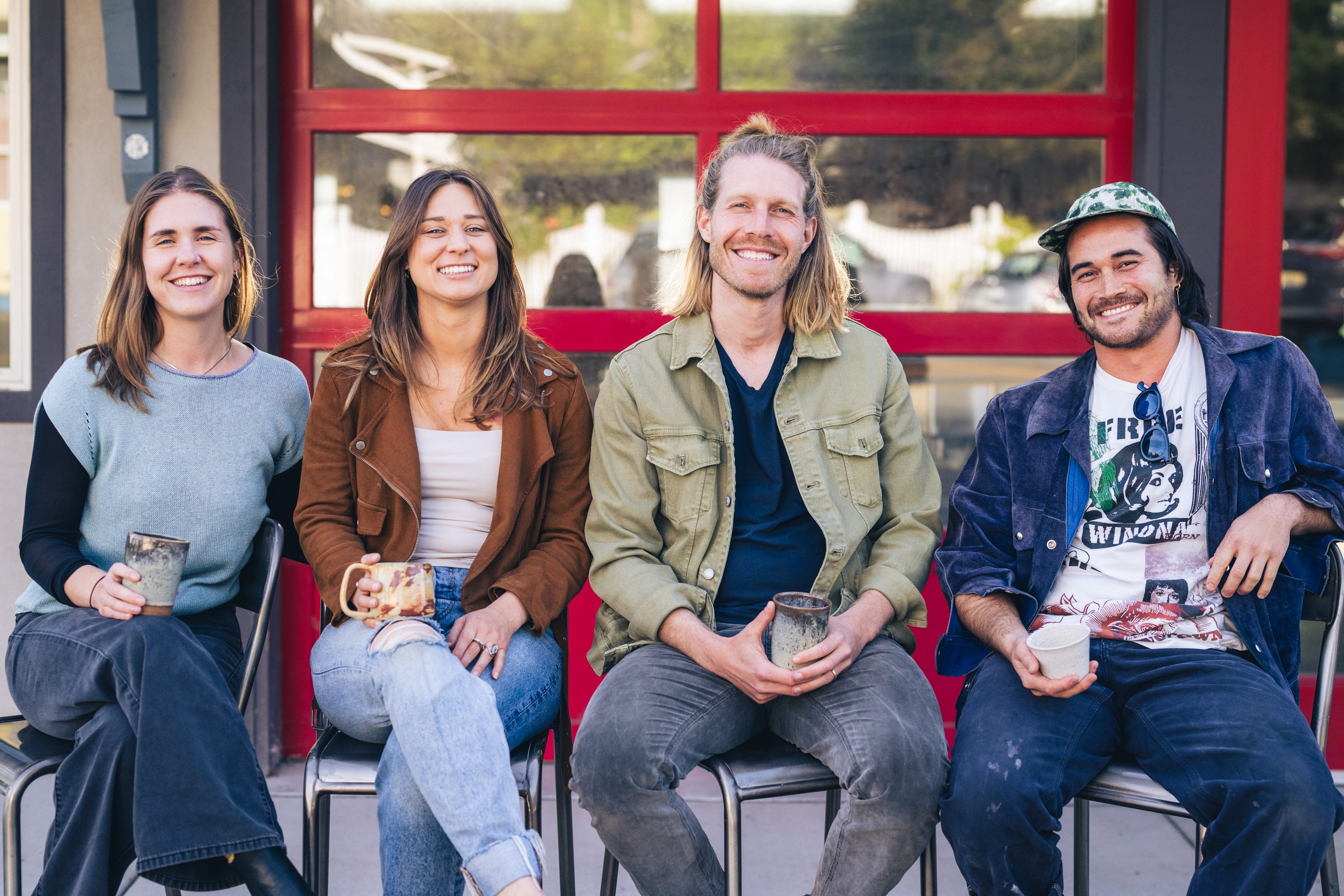
For the past several years, we’ve all watched the journey of the old firehouse from an empty building to owner George Melo’s workplace to the recent evolution into a community gathering spot for food, friendship, and families. That transformation from train station to fire station to Graton Station is now close to becoming a reality.
A Firehouse, a Festival, and an “Aha Moment”
With the opening approaching this fall, I sat down with Tori Immel, one of the four partners at Graton Station. Tori is also a co-founder with Matt Jorgensen at ReVillage Foundation, the 501(c)(3) nonprofit collaborating with the Graton Community Services District to develop the Town Square. The connection with the current food program for Graton Station began at the food and wine festival in Graton Square in 2025.
Someone in the crowd pulled Matt aside, insisting he had to meet a chef working on a project called Preservatory — a project turning surplus produce from backyards and local farms into shrubs, ferments and preserves that would otherwise go to waste.
“It was just kind of an aha moment,” Tori said. “Adrian and Ferrell are working on this incredible preservation project — taking all of this surplus and giving it new life as shrubs, ferments, education, and stories along the way. Meanwhile, Matt had been talking to George Melo about leasing the firehouse and was looking for chef partners.”
The more Jorgensen and Tori learned about Adrian Apana and his partner, Ferrell Carter, the more the pieces fit. Both chefs spent years in some of California’s most demanding kitchens — SingleThread, République, Troubadour Bread & Bistro, Quail & Condor, Maison Porcella, The Redwood — and, according to Tori, had grown wary of the waste baked into that world. Preservatory was their answer. Graton Station became the place to build it out loud, in public, as a cafe.
Adrian traces the shift back to his earliest days in professional kitchens. “I’ve known since I began cooking that I was interested in more approachable, rustic food,” he said. “There’s an element of fine dining that brings important lessons — respect the ingredient, master technique, keep it clean. But ultimately I went to those kitchens to learn the disciplines that make really great food, and apply them in a casual setting. Like how a fine woodworker might enjoy carving a children’s toy.”
Ferrell described the same arc in her own terms. “Fine dining taught us how to execute with high standards and how to dream into new ideas,” she said. “At the same time, we know that thoughtful food doesn’t exclusively belong to fine dining. We’re just excited to bring everything we’ve learned into a space that’s built for our neighbors — where you can have a great cup of coffee, grab a quick lunch made with local produce, or a loaf of bread to take home for dinner.”
A Menu Built on What’s Actually There
The central challenge of the model is also its appeal: instead of ordering from a distributor who guarantees the same ingredients every day, Adrian and Ferrell are building menus around whatever Sonoma County farms are harvesting that week — and around what’s already preserved in the larder from seasons past.
“In any given meal you might have like a six-month runway,” Tori said. “The tomatoes preserved from last season — we know they’re in the larder, and they get woven into next spring’s season. It’s that same freshness concept, year-round.”
That means a given week might feature fresh tomatoes on the menu, or a slow-cooked tomato jam, folded into a shakshuka made from last summer’s surplus — with a Preservatory workshop on the cafe’s calendar that teaches guests how to make the same jam at home. Asked what a meal might look like in the dead of winter, Tori deferred the specifics to Adrian and Ferrell. Reached separately, both offered a preview.
“We’re so lucky to live in a zip code where an abundance of produce is available year-round,” Ferrell said. “In January, we work with a lot of winter squash, brassicas, beans, mushrooms, hearty greens, and citrus. The menu will move with what’s coming from the farms, but preservation lets us bring other seasons into the room, too.” Think roasted chicken marinated in Meyer lemon marmalade, roasted root vegetables, kale slaw, or butternut squash soup — and, Ferrell added, sourdough pancakes, both savory and sweet.
Adrian sees the season’s limits as an asset rather than an obstacle. “Limitations are some of the best parameters to have,” he said. “It drives creativity and making something fun for fun’s sake. That overgrown, bitter root might make for a great paste mixed with lemon zest and a chili preserve, served over a bowl of potato soup. A robust larder will definitely be at play throughout the year, but it especially comes in handy when fresh ingredients are limited.”
The bread and pastry program is entirely in-house, a point of pride at the weekend pop-ups that have already built a following. “Every pastry you’ve had here is made in their kitchen,” Tori said, crediting much of the recipe base to Ferrell’s grandmother, who introduced Ferrell to baking in their family kitchen as a child. The sourdough loaves, currently baked at Bowman Cellars’ commissary kitchen, have become what Tori called “a cult favorite” people now show up to pop-ups just for the bread. At the Gravenstein Apple Fair in August, that meant a sourdough apple brioche, built on a brioche base with a backyard-apple compote baked into the top.
The team has also begun sourcing wheat locally, including flour from a nearby grower, Tori referred to as Farmer Mai (Mai Nguyen of Green Valley Food + Mill), whom she described as effectively growing and milling her own wheat as a form of activism. “We admire how she was doing it,” Tori said. Graton Station blends that flour with other local ingredients for some of its breads and plans to post signage identifying the specific farms — Hopyard Farms among them — behind what’s on the menu and on the shelves.
Protein sourcing remains the least settled part of the model. Tori said the team hasn’t fully locked down suppliers for chicken, beef, and pork, though Adrian and Ferrell are actively working on it, weighing local ranchers around Petaluma against opportunistic buys — such as a recent “freezer sale” from a friend’s farm that’s winding down its livestock operation. “It’ll probably be a mix,” Tori said. “How can we make it accessible while telling the story of the local producer?”
Adrian’s own kitchen background shapes how he thinks about that trade-off. “My time at Maison Porcella taught me how to make the most of off cuts — a French peasant specialty,” he said. “The price factor is probably the biggest limitation here, but buying bulkier cuts of meat and processing them ourselves helps make the equation work.”
For Ferrell, the goal isn’t a specific sourcing quota so much as a set of relationships. “It’s less about claiming a certain percentage and more about building real relationships with the people who produce food around us,” she said. “We want those relationships to deepen over time and for more and more of what we serve to reflect this place.”
A Kitchen You Subscribe To
Alongside the daily menu, the team is building what they’re calling a Community Supported Kitchen, or CSK — modeled loosely after a CSA farm box, but for prepared food. Members would receive a rotating selection of soups, stews, breads, and larder items, all built around what’s in season.
“People love that convenience,” Tori said. “It’s like the CSA — every week you go pick up your box — but instead of having to cook it, it’s a ready-made meal for your family.” She pointed to similar models already operating in the region and said the concept also serves as a planning tool for the kitchen: knowing roughly how many meals to prepare each week lets the team pre-allocate and pre-source ingredients, smoothing out the uncertainty of farm-driven sourcing.
Building the Room
Inside, the finished space will lead with a small retail area — refrigerated grab-and-go food and drinks, picnic supplies, and shelves of Preservatory’s pickles, preserves and pantry goods, alongside goods from other local makers. A long counter will run the width of the building for ordering food and beverages with barstool seating along its length. Beyond that, Tori described a single long communal table anchoring an indoor seating area, and a hearth lounge with armchairs and a couch that doubles as a children’s play space by day and an event stage when needed. Outside, patio seating will extend the gathering space beyond the building’s walls, featuring a sunken patio, native plants, and a central fountain.
Construction is underway but not yet complete. The patio — visible from the road and a frequent topic of questions from passersby — is partially unfinished by design: the team is holding off on landscaping until September, when cooler weather makes it more viable for new plantings to take root. The team is still deciding on the sunken patio’s surface and sourcing a natural-material fountain for what Tori called the space’s “conversational gem,” a central gathering point where people can sit along the edge while kids run and play.
Permits for the kitchen have been approved, and the team is targeting a fall opening. Ahead of that, Graton Station will continue its regular weekend coffee cart pop-ups on Saturdays and Sundays from 8 a.m. to 1 p.m., alongside its recurring “Patio Party” mornings.
A Longer Horizon
Immel was candid that full profitability — across the cafe, coffee cart, CSK, Preservatory workshops and cultural programming — is a multi-year runway, not a first-year milestone. “Even coffee shops with less investment sometimes take three to five years,” she said.
Asked where they see Graton Station in three years, both chefs described a sense of belonging rather than growth. “I hope it feels like it’s always been here,” Ferrell said. “I’m excited to see what takes root in our offerings and events — what gets people excited to come back to their favorite patio table, or which pastries sell out most on Saturdays. And I hope our relationships with local farms and producers have deepened, and the food has developed an identity that truly belongs to Graton.”
Adrian framed it in terms of the kitchen’s reach beyond the cafe itself. “I’d love for the kitchen and Preservatory to become part of the local food ecosystem beyond the cafe — buying from farms when they have abundance, preserving that food, creating things people can take home, and collaborating with growers and other food businesses,” he said. “The bigger vision starts simply: make really good food, take care of people, and be useful to the community.”
The longer-term vision extends beyond the balance sheet. Graton Station operates under a 10-year lease with an additional 10-year renewal option. Tori described the team’s ambition to move toward broader community ownership — with elected or representative seats at the table for employees, investors, local farmers and community members alike — to shape how the business’s success flows back into the neighborhood, whether through a future food pantry, community breakfasts or free public programming.
For Tori, that instinct traces back to her own path. Originally from Orange County, she studied business, accounting, and psychology at Chapman University and worked in public accounting before shifting to community-building work, including a stint with the national community group Summit Series and, more recently, the regenerative-agriculture nonprofit Farmer’s Footprint. She met Jorgensen a couple of years ago, when he was still in the early stages of developing the nearby Graton Town Square project. He had spent most of his career working on relocalizing food and economic systems, with an emphasis on community ownership and shared stewardship. Since then, she has been drawn to what she calls the deeper pattern underlying both projects: how people and organizations can reweave a sense of place.
She described Graton as a tide pool: small, self-contained, and already alive with its own history and momentum. “There are a lot of folks moving up to the area and bringing their gifts,” she said. “How do we know each other better and feel more connected? It’s that interaction — and doing good in the ways we spend our time.”
If fellow Gratonites want to participate financially in this community project, a great opportunity awaits. Having raised $625,000 in an initial qualified investor round, with a $125,000 match now feeding into a public community round on WeFunder, the financing for the construction build-out is secure. The campaign lets neighbors invest in a loan structure starting at $500, with a choice between a 5 percent annual cash return and a 7.5 percent “edible dividend” redeemable at the cafe. More than 45 community members have already signed on. Full disclosure: my wife and I are investors.
In Ferrell’s words: “We’re food people, but we’re hospitality people first. We want people to feel like they belong here and like they’ve been part of the story. Hopefully, a few years from now, someone can sit at the cafe and say, ‘I’ve been coming here since the cart,’ or remember taking a leap of faith on the crowdfund before the doors were even open. There’s something really special about getting to build a place alongside the people who will actually use it.”
Graton Station plans to open this fall. Updates on construction, events, and the community investment campaign are available at gratonstation.com and wefunder.com/gratonstation.

Love the team and their living their commitments to community
Graton and Forestville are improving life for the people there without a town government without the influence of wealthy real estate tycoons and by relying on the people. How does this compare to Sebastopol which has expensive projects that will benefit only wealthy developers (Barlow, Commons,, etc. ), special interests running the show, poor services and high taxes and ignores the will of the people (two way streets).