


The Sebastopol Commons, a longtime project of councilmembers Stephen Zollman and Phill Carter, is envisioned as a shared civic space and multi-use community hub that could house an array of civic agencies, local nonprofits and related businesses.
The Committee for Building the Commons was an outgrowth of a previous City Council committee, the Library Staffing and Facilities Ad Hoc, which was tasked with finding a way to provide more space for the Sebastopol Library. That committee gave its final report to the council on July 15, 2025, and one of their recommendations was, essentially, that it morph into a committee with a broader mission, the Committee to Build the Commons. (See our article on this meeting here.)
In some ways, as a public commenter pointed out at the time, the Sebastopol Commons project feels like an outgrowth of Zollman’s original vision for a Sebastopol Library that would also provide social services.
Zollman explained that the Committee for Building Commons was formed because several essential local institutions—the Sebastopol Library, Sebastopol City Hall, the Sebastopol Area Senior Center and the Sebastopol Community Cultural Center—needed more space (or, in the case of the community center, needed a space that isn’t underwater every few years).
The city council tasked the Committee for Building the Commons with guiding the early concept development of The Commons and providing the council with quarterly reports, identifying which organizations would be involved, what their needs are, where such a development might be located and how to fund it. The council also suggested the committee compile research on similar projects. All this was in the service of a future feasibility study.
The makeup of the committee includes many people left over from the original library committee and some new faces as well. Members include:
Councilmember Stephen Zollman
Councilmember Phill Carter
RM Horrell (Copperfield’s Books)
Sarah Glade Gurney (a member of Sonoma County Library’s Measure O Oversight Committee)
Naomi Hupert (Sonoma Library Foundation)
Kent Jenkins (Sebastopol Area Senior Center)
Mary Lou Schmidt (Gravenstein Health Action)
Fred Engbarth (Sonoma County Library Commissioner for the City of Sebastopol)
Sebastopol Library branch manager Deb Hoadley (non-voting)
The committee has been working hard since last fall.
“We’re moving pretty fast,” Councilmember Carter said at a meeting of the Commons committee last week, “and we’re pretty proud of what we’ve done thus far.”
The committee has divided up its tasks by creating two subcommittees:
The Funding Assessment Subcommittee is charged with exploring both possible sites and funding possibilities.
The Community Needs Assessment Subcommittee is in charge of finding and interviewing potential partners for the venture and determining what they need in terms of space and services.
(Honestly, the names of the committee and its subcommittees are real mouthfuls. For the remainder of this article, I will refer to them as the Commons committee, the Funding subcommittee and the Needs subcommittee.)
The staff report for the April 7 council meeting included the Needs subcommittee’s questionnaire for interviewing potential partners. (Scroll to the bottom of the report to see the questions.) The Needs subcommittee is just beginning to interview potential partners.
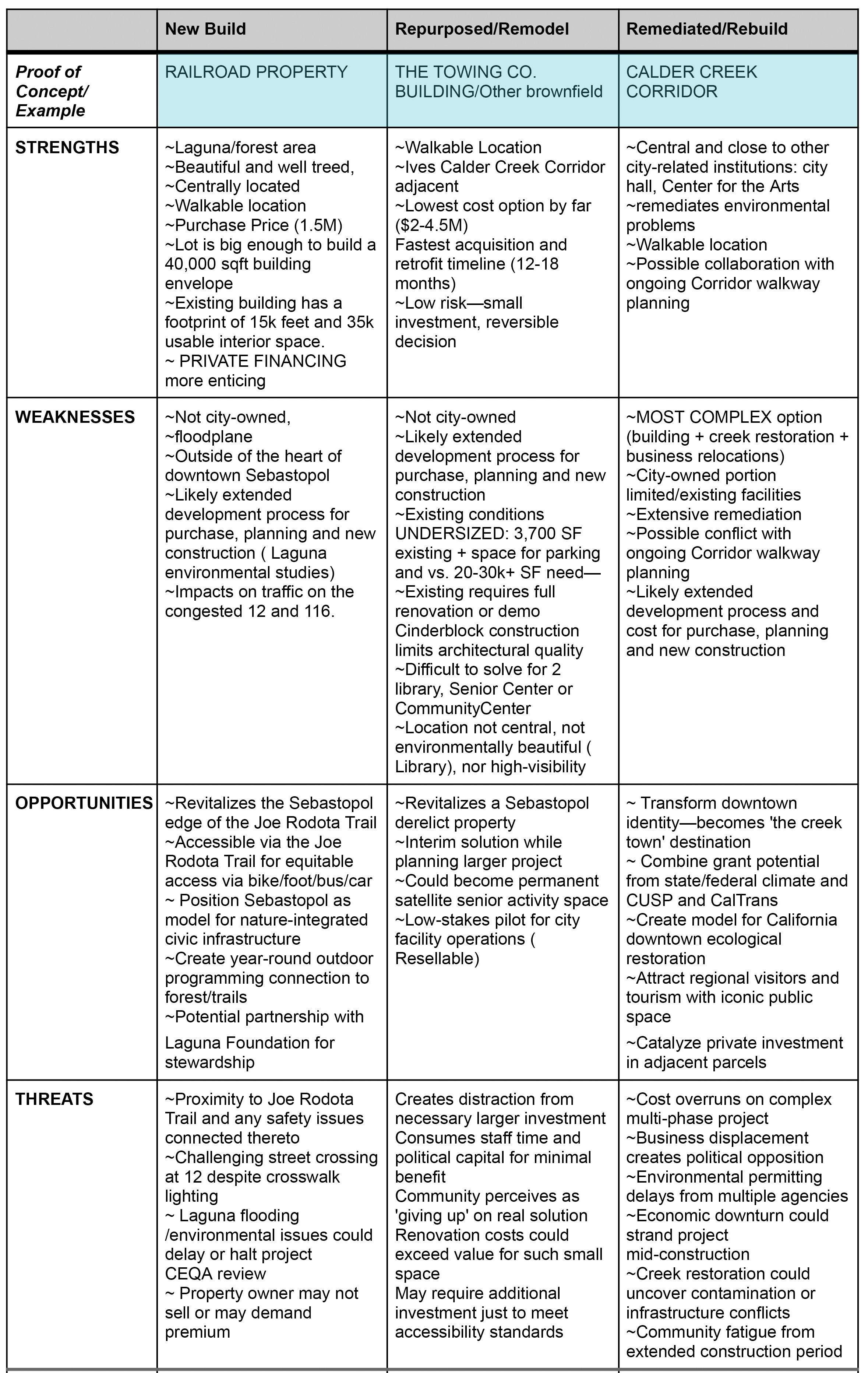
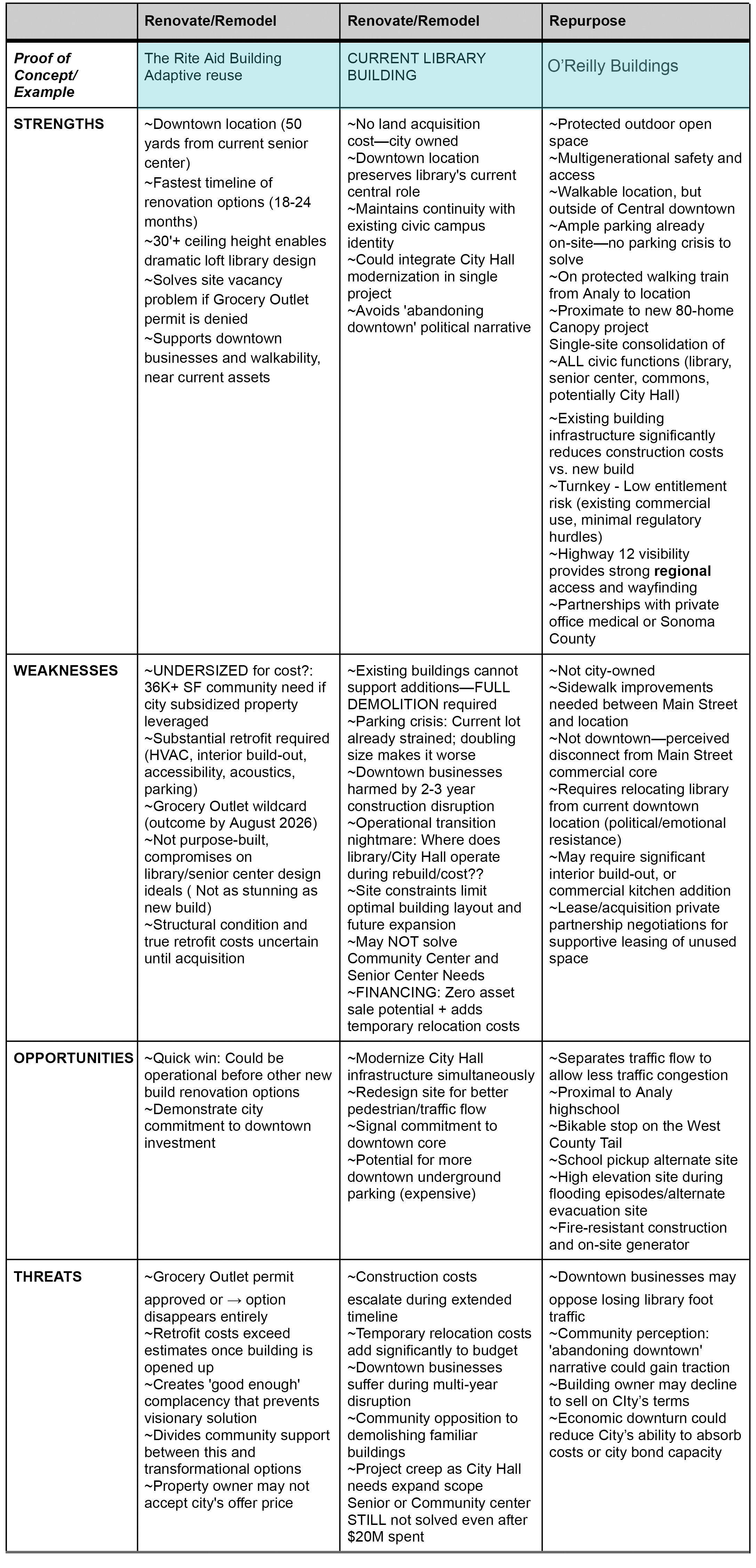
Much more exciting, however, was the Funding subcommittee’s SWOT analysis of six potential sites. (SWOT stands for strengths, weaknesses, opportunities, and threats.)
Six possible sites
The Funding subcommittee explored six potential properties around town: the railroad property (behind the feed store), the towing company site (next to the city parking lot behind the Chamber office), Calder Creek corridor (the city parking lot across from SebArts), the Rite Aid building in downtown, the current library site, and the O’Reilly complex at the north end of town.
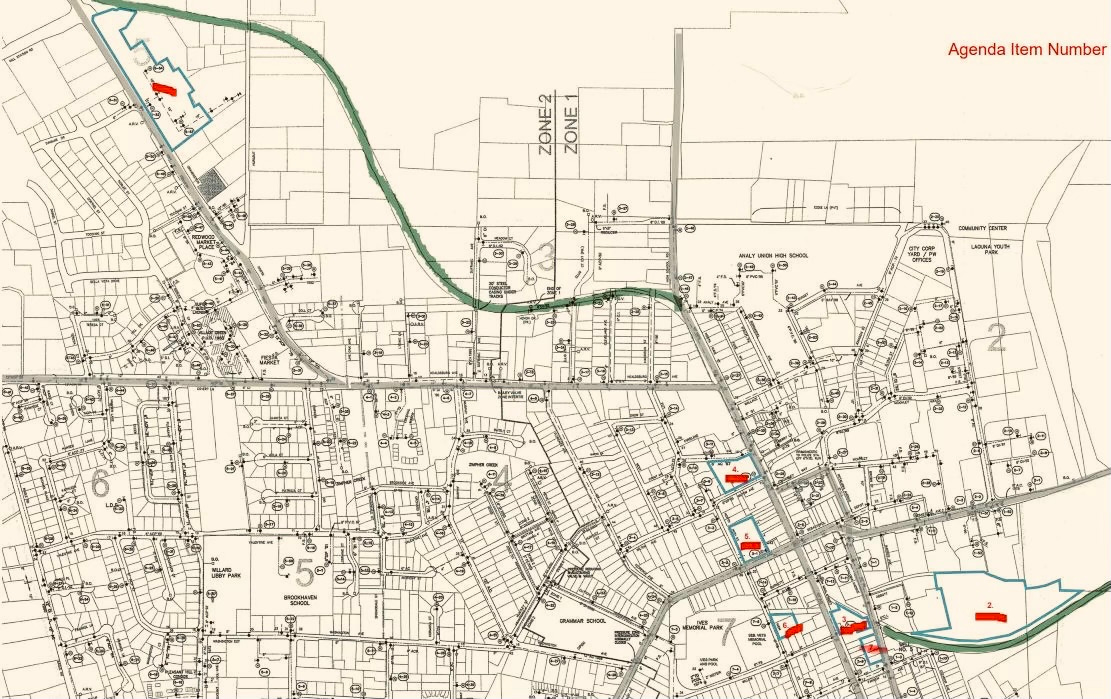
Here’s the SWOT analysis of the six sites:
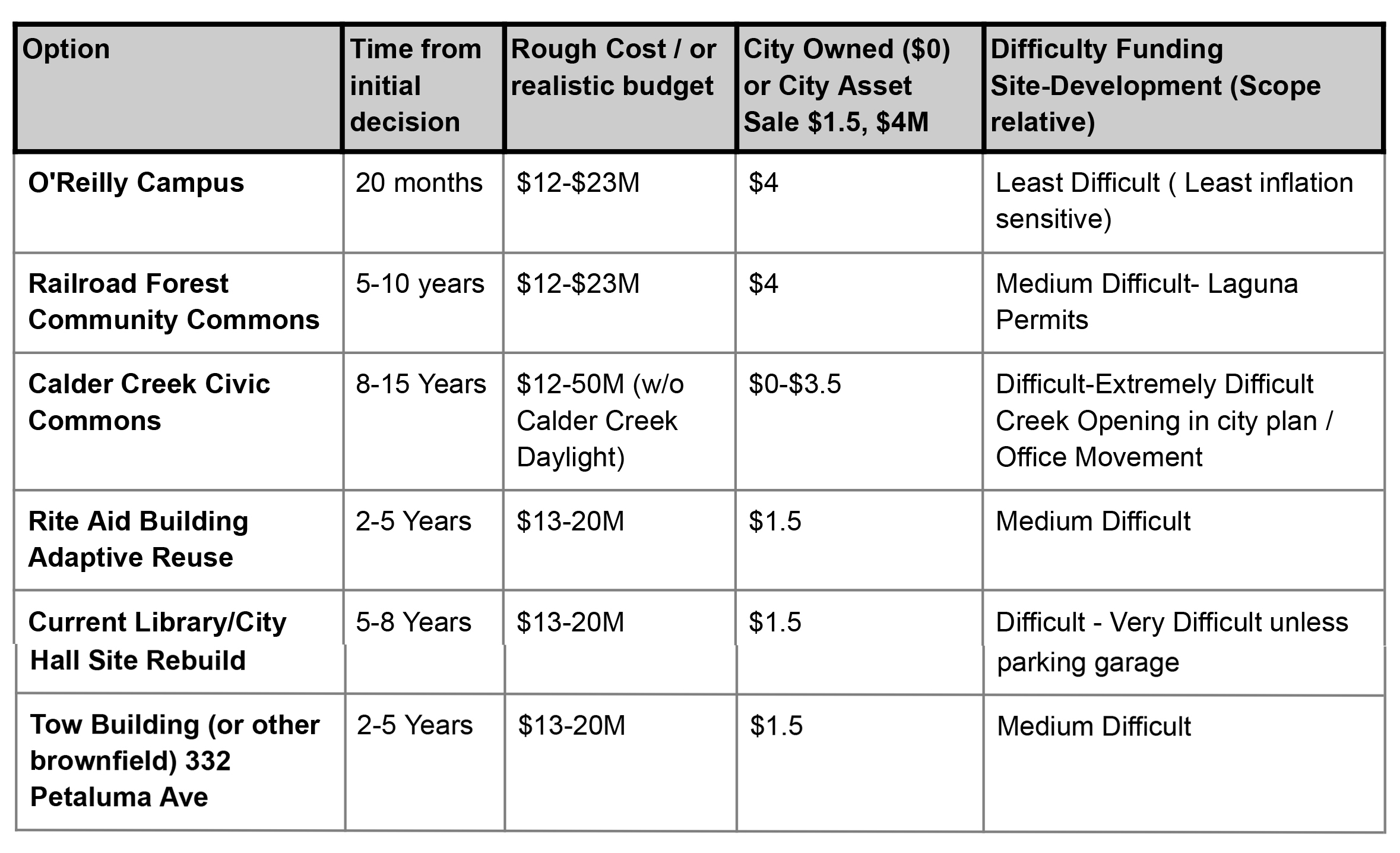
The Funding subcommittee’s report also included a rough comparison of development times and costs, as well as the potential for how much money might be raised by leveraging other city-owned properties. The former O’Reilly campus, which has been underutilized for years, ever since O’Reilly Media moved out, seems like a clear winner here. Committee members caution that nothing is set in stone, however.
At the Commons meeting on Tuesday, April 14, Kent Jenkins, an attorney who moved to west county with his wife Caroline from San Francisco in 2010, explained the public/private partnership envisioned by the creators of the Sebastopol Commons.
“The Commons would be a city-owned facility, which would have tenants who are either commercial or nonprofit or county or city entities,” said Jenkins, who is the Senior Center’s representative to Commons committee and a member of the Funding subcommittee.
Jenkins said the project would leverage existing city-owned properties in order to fund the Commons. “We have the resources,” he told his fellow committee members. “This is about realigning our resources into a new configuration.”
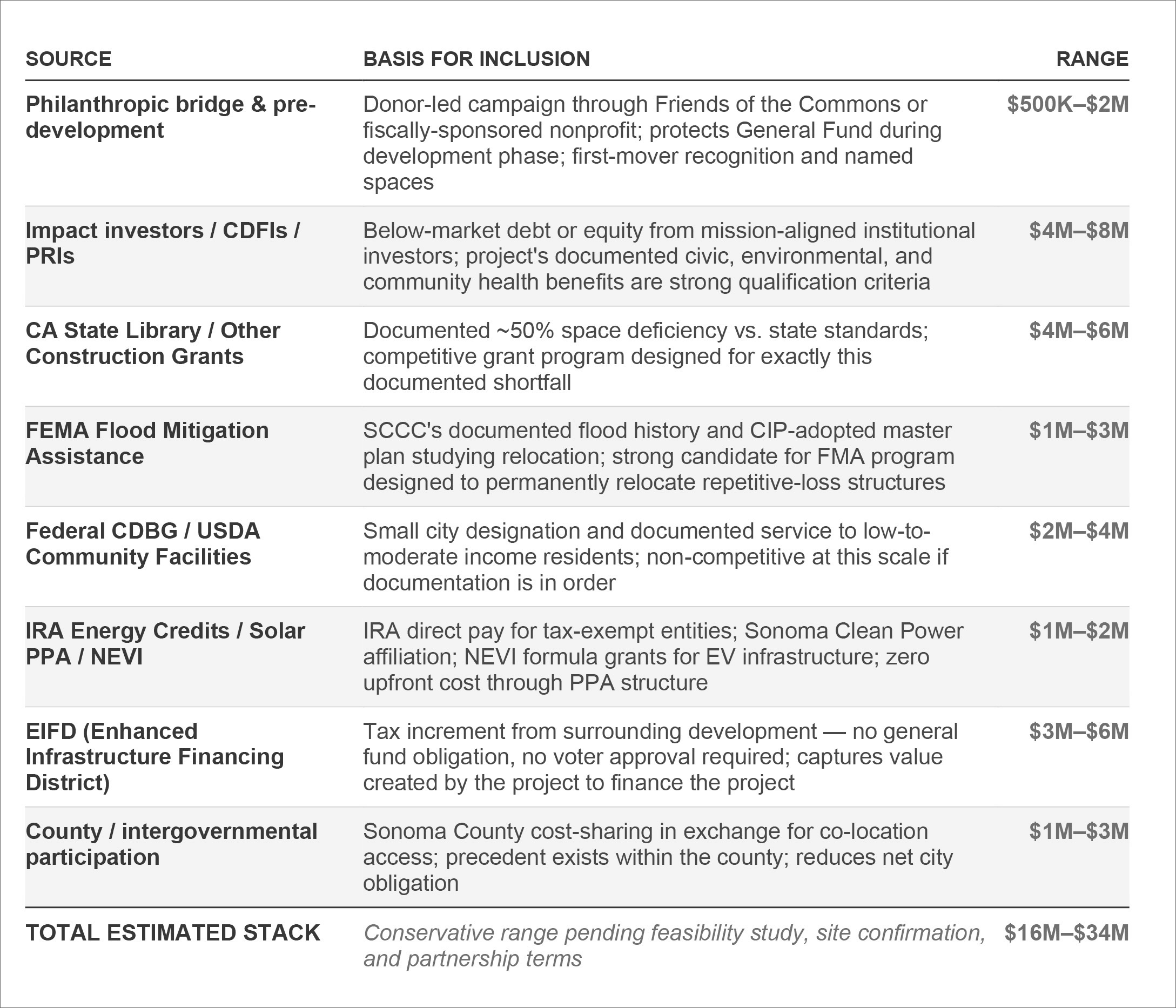
A new report produced by the Funding subcommittee noted, “There is not a model that makes a civic facility free. But there are structures that make it substantially more affordable than maintaining four fragmented, aging buildings indefinitely—and that protect the General Fund by relying first on private capital, philanthropic bridge funding and a dedicated tax-increment tool before any general obligation is considered.” (By “tax-increment tool” the report is referring to the EIFD district the city is currently working on with the county.)
Here is what the projected financial stack being considered by the Commons committee looks like so far:
Jenkins believes strongly in the vision behind the Commons project.
“I believe there is magic when we work together, literally sit together, have a coffee together. I believe there’s a certain magic there which leads to better outcomes,” he said. “I’m looking forward to the day when many of our nonprofits and community functions are at the same coffee shop, work next door to each other, and I think better things for the community will come out of that—both in a feel-good aspect and financially…in the form of shared administrative cost savings. So I am hell-bent on getting people to work together in closer proximity so we can improve our community.”
Zollman is also pleased with how things have evolved. “I am consistently heartened by the number of volunteers who have worked and continue to work on trying to solve the immediate and future needs of our hard-working nonprofits and businesses as well as the needs of the city itself,” Zollman said.
The Committee for Building the Commons is set to terminate on June 30. The committee plans to ask the Sebastopol City Council for an extension until the end of September, at which point they hope to have laid the groundwork for a feasibility study.
At the April 14th meeting of the Committee to Build the Commons, the Funding subcommittee handed out a useful summary of their work, “Creating the Commons: A 30-year planning framework for Sebastopol’s civic future.” Read it at the link below:

I’m curious why the Rite Aid site isn’t listed for demolition and rebuild. That seems like the perfect site for the Senior Center, the library, and City Hall. It could become a beautiful landmark on that corner right in the heart of the city!
Hopefully the Grocery Outlet application will be denied since it so inconsistent with the town's Master Plan. If it's approved, the floodgates will open for every chain store there is. If Grocery Outlet why not us they will ask? And sue. Grocery Outlet is currently closing 9 California locations leaving those less profitable communities behind. Which of our locally owned groceries would we like to see pushed out by Grocery Outlet, which will initially feature low prices, kill the locals, then raise prices when they are gone. Then leave.