

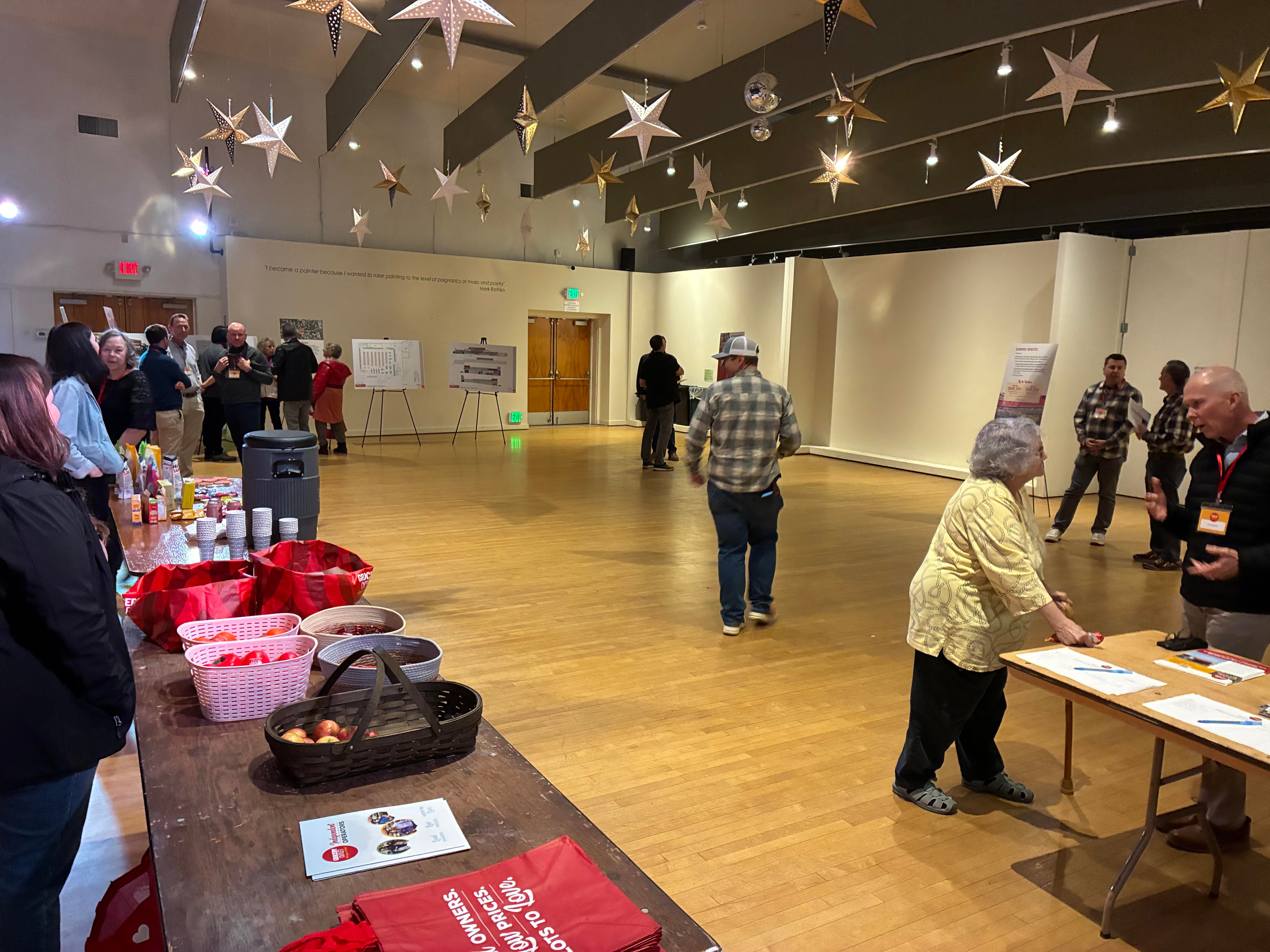
A specter is haunting Sebastopol—the specter of Grocery Outlet. The grocery chain held a second informational meeting on Monday, Feb. 2, at Sebastopol Center for the Arts. Unlike its first meeting the week before, this one was lightly attended.
In response to Grocery Outlet’s PR push, local independent grocery stores, including Fircrest Market, Pacific Market, Community Market, and Andy’s, began handing out a flyer about the threat Grocery Outlet posed to local grocers and to Sebastopol’s unique community character. Eric Meuse, one of the owners of Fircrest Market, said the stores had collaborated on the creation of the flyer below.
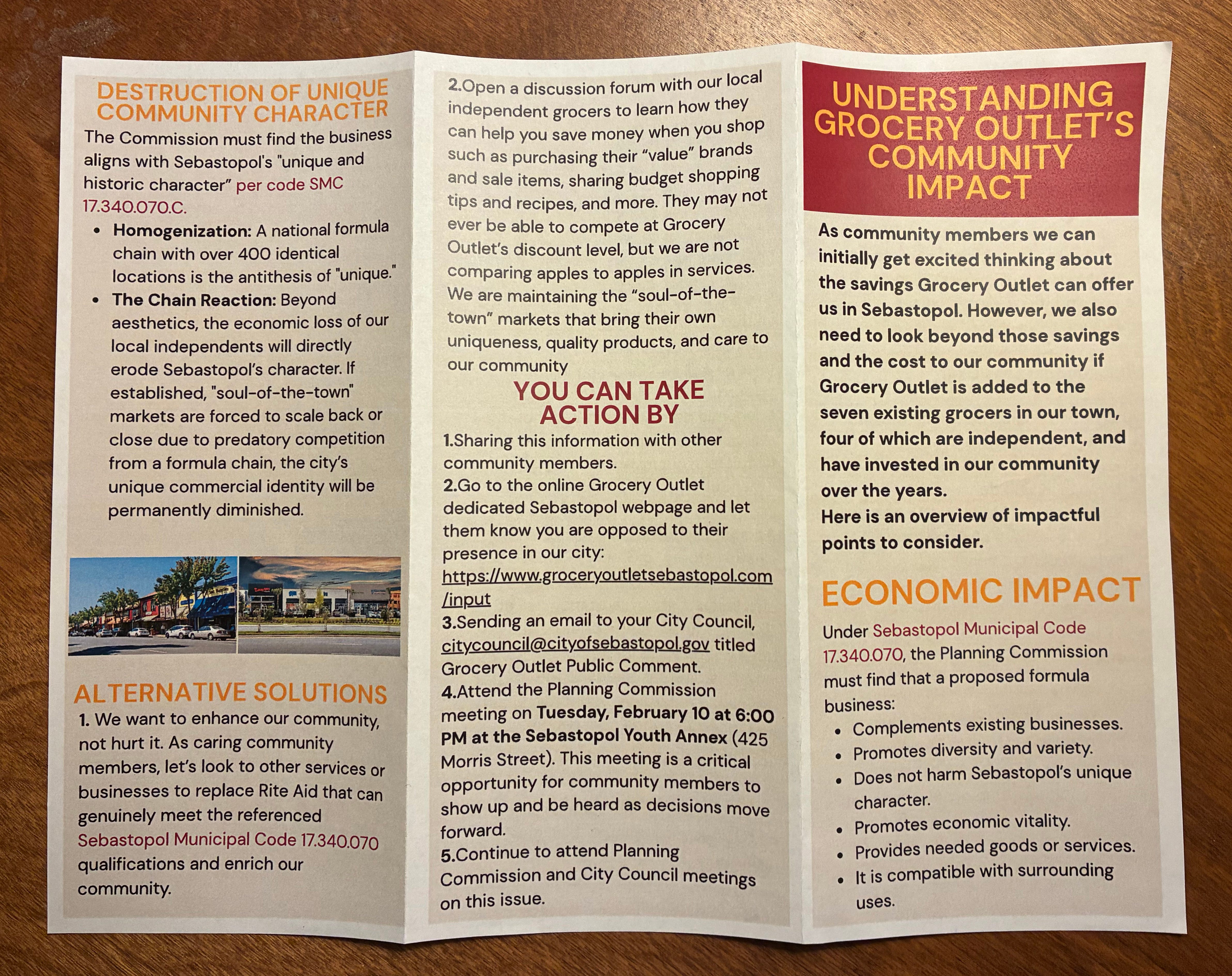
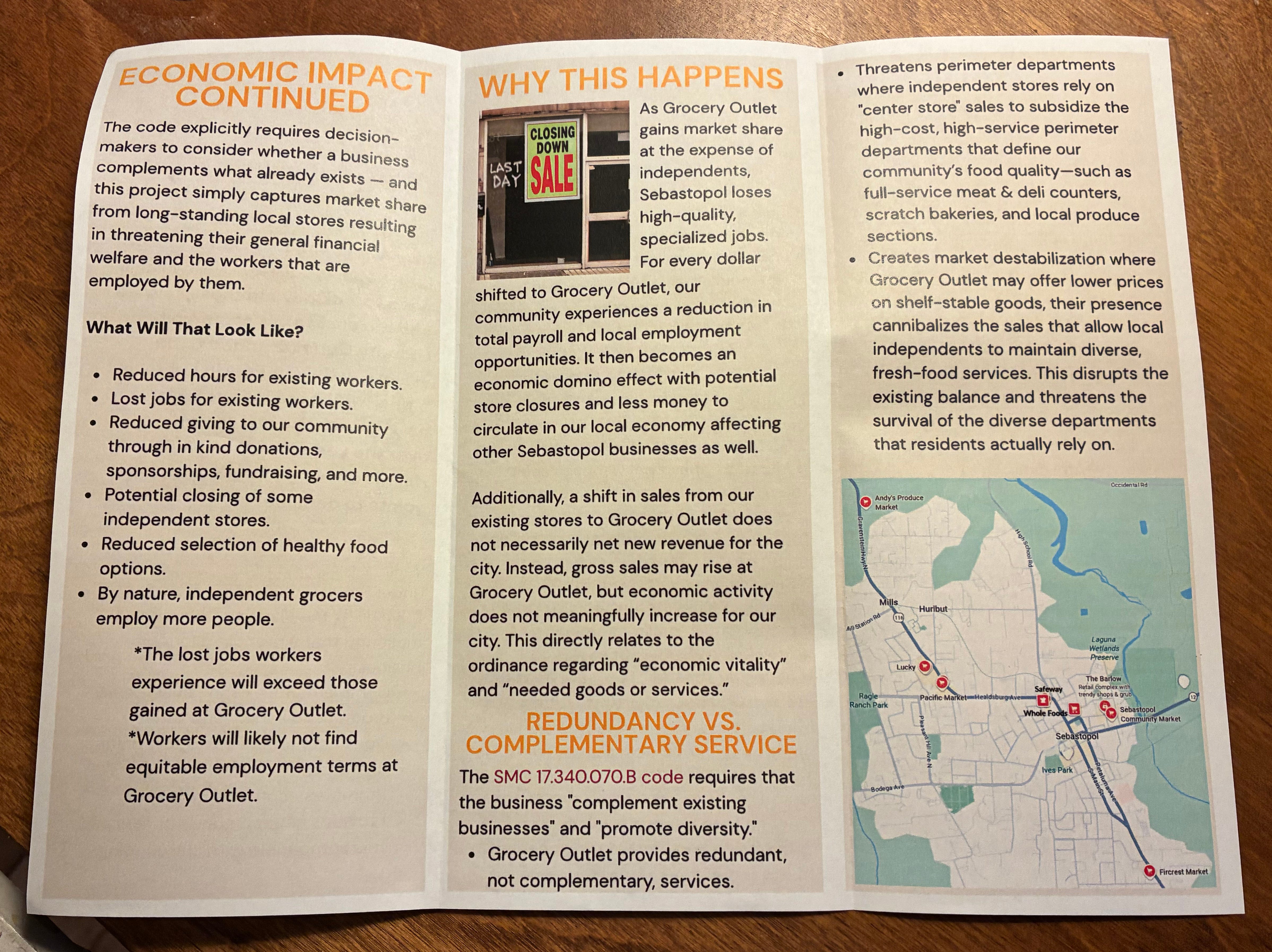
The flyer makes a strong case that Grocery Outlet violates the spirit and the letter of Sebastopol’s Formula Business Ordinance, which was designed to keep chain stores out of downtown.
The ordinance describes a formula business as “a business which is required by contractual or other arrangement or affiliation to maintain a standardized (“formula”) array of services and/or merchandise, menu, employee uniforms, decor, facade design, signage, color scheme, trademark or service mark, name, or similar standardized features; and which causes it to be substantially identical to 25 or more other businesses in the United States.”
The ordinance bans three types of formula businesses outright in Sebastopol’s downtown:
A. Formula business offices on the ground floor street front.
B. Formula business restaurants.
C. Formula business hotels and motels.
Other types of formula businesses, like Grocery Outlet, must apply for a conditional use permit to the Sebastopol Planning Commission, which is charged with determining if the proposed business meets the following standards:
complements existing businesses;
promotes diversity and variety to assure a balanced mix of commercial uses;
is consistent with the unique and historic character of Sebastopol;
will provide needed goods or services;
will promote Sebastopol’s economic vitality;
will be compatible with existing and planned uses;
will help residents and visitors avoid the need to shop out of town for goods or services.
On the face of it, as the local grocers’ flyer points out, Grocery Outlet fails to meet several of these. (The flyer understandably omitted that last standard because—as the Sebastopol Times discovered in recent interviews—many Sebastopol citizens do indeed drive out of town to shop at Grocery Outlets elsewhere because of their lower prices.)
Pacific Market Manager Phong Phan echoed a common sentiment that opponents of Grocery Outlet have been making repeatedly on Nextdoor. “We have seven grocery stores within a five-mile radius. We don’t need another,” he said. “They’ll take sales from all the independent grocery stores around the community.”
Phan, who said he worked for Safeway for 23 years before working for Pacific Market, said there’s a real difference between how corporate grocery stores and local independent grocers do business. “With corporations, it’s all numbers, numbers, numbers,” he said. “Local independents help out by donating a lot of stuff to the community.”
Several people who spoke to the Sebastopol Times at Monday’s Grocery Outlet meeting expressed similar misgivings:
Karen McClure said, “I think it will meet a need [in terms of lower prices], but I don’t want that to come at the expense of the locally owned grocers.”
West county residents Woody Hastings and June Brashares sometimes shop at Grocery Outlet in Santa Rosa, but they aren’t thrilled by the idea of having a Grocery Outlet in Sebastopol. “I’m worried about them making it tougher for—and maybe displacing—the current grocers,” Brashares said.
Hastings added, “I’m concerned about the erosion of the vision of the downtown area as being unique.”
He isn’t the only one.
Council tightens restrictions on new formula businesses
On Tuesday night, Feb. 3, the Sebastopol City Council moved to tighten its Formula Business Ordinance. Back in September, the council had asked City Attorney Alex Mog to review Sebastopol’s Formula Business Ordinance. At Tuesday’s meeting, he introduced changes which he said would close a large loophole in the Definition and Exemptions sections of the ordinance, that might otherwise allow a formula business to take over a property from another formula business without applying for a use permit.
He recommended the addition of the following language to the Definitions section:
“Substantial change in the mode or character of the operation” includes, but is not limited to: extending the hours of operation to open earlier than 8:00 a.m. or close later than 9 p.m.; any change in use requiring a new discretionary approval from the City; or any change in ownership requiring a new license to sell alcoholic beverages.”
“Type of business” has the same meaning as this term is commonly used and is intended to be narrower than the land use classifications used elsewhere in this Title. Similar types of businesses offer substantially similar goods and services. For example, a coffee shop would be the same type of business as another coffee shop, but a fast-food restaurant would be a different type of business than a coffee shop.
He recommended the following changes to the Exemptions section of the ordinance, which refers to the definitions above:
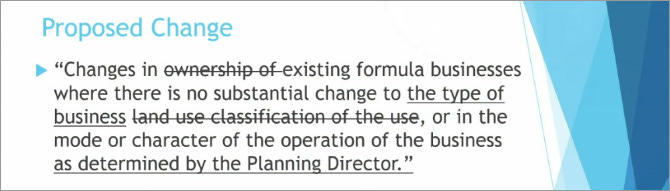
See the full changes here.
In public comment, Marghe Mills-Thysen made the connection between the council’s efforts that evening and the current controversy over Grocery Outlet.
“I find that this discussion is very relevant and significant to the very quality of our future and the quality of our city,” she said. “Moving toward banning all chain stores from Sebastopol is something I would support…There is a chain store that is right now trying to get into Sebastopol, and I’m concerned about the model of stores like the current one—Grocery Outlet, which prospers by undercutting and ultimately destroying local merchants and often has poor labor practices. I think that we need to find a better solution than the current applicant.”
Other speakers in public comment also supported tightening the formula business ordinance.
After a lengthy and repetitive discussion, the city council voted unanimously “to approve the first reading and introduction of the updates to the formula business ordinance.” (The council will give its final approval to the updates (or not) when they appear on the consent calendar at the next council meeting.)
Should Sebastopol ban all new formula businesses?
Mayor Jill McLewis then made a motion—which Councilmember Stephen Zollman seconded—to direct city staff to revisit the formula business ordinance and ban all new formula businesses outright from Sebastopol’s downtown.
When the city attorney suggested that the council could direct staff to create and then bring the ordinance to the council before running it past the planning commission, McLewis and Zollman jumped at this idea, but other councilmembers got nervous. Though they sympathized with the idea of a total ban, they felt such a move was too sudden and that there were too many unknowns, like how much staff time and attorney’s fees such a significant reworking of the ordinance would take.
Councilmember Hinton objected to it on procedural grounds. “I’m a little uncomfortable with this not going through our normal process, which means the planning commission,” she said. “It usually gets up to us after their feedback and recommendations…I don’t want to be telling the planning commission what to do without the process that we have in place for this sort of thing.”
When the vote was called, the proposal to ban all new formula businesses outright went down to defeat on a three to two vote, with the unusual alliance of Zollman and McLewis voting for it and Maurer, Carter, and Hinton voting against it.
as a person with limited means, I welcome GO to Sebastopol. you say no chain stores, and yet we have Safeway, Round Table and others. Many of us who live here have a hard time with the prices, which are high. If I can save some money and have a healthier diet because I can afford better choices, I am all for it. People must be reminded that not everyone in our town has sufficient funds for the high prices. and while I love Fircrest, I rarely shop there. I am a shut in and have to have my groceries delivered, and they do not offer that service. GO will be a blessing for folks like me who need to eat well while being able to afford it. while I love the small town feel of our town, we must realize that times are hard and our town needs to serve all of us, not some of us. there is enough of that going around as it is. Thanks.
I wish we could get down to the real argument sooner than later. There are plenty of statements of what people are against, but the real divide is what they are fighting for. What is our ideal of how Sebastopol looks and operates? Is Sebastopol a quaint artisan town that primarily serves the needs and interests of its immediate affluent neighbors, or is it the gateway to West County, servicing the interests and needs of a larger, more diverse population? Is Sebastopol to be a 12/116 drive thru city, or is it to be a destination stop for locals and outsiders? Which of these visions or blend of visions produces a sustainable visitor, recycled revenue, and tax base to achieve the intimate, healthy community we all desire?
For instance, the highlighted flyer has a surface argument to protect the independent grocery stores in Sebastopol: Fircrest Market, Pacific Market, Community Market, and Andy’s. On the face of it, it sounds like an economic cannibalization of our local treasures by a nasty chain store. But, this can't possibly be the foundation of the argument against GO. We have several thriving independent stores, precisely because locals choose them over the existing chain stores, despite pricing and due to a focus on local goods. GO will likely attract more shoppers to the city, meaning more customer opportunities for everyone. If there is significant cannibalization, it won't be our independents, it will likely be of the other chain stores that don't have a local profit sharing structure: Lucky, Safeway, and Whole Foods. Are we OK with those stores having competition?
If the primary argument is about economics, then why is nobody addressing the elephant in the room - property ownership? Do we have a local ordinance which prohibits outside/corporate ownership of the downtown properties? I'd be interested to know how much of rent and lease payments stay within Sebastopol, West County, or even Sonoma County at large. Is anyone suggesting that we don't allow outside developers and landlords to purchase our local properties? Of course not, because we don't have the local liquidity or interest to facilitate a healthy local property market. Local property owners win when outside interests bring outside money to maintain or raise other local property values.
It's OK to reveal that this is a discussion about town character. Yes, it reveals some uncomfortable truths. But, the sooner we speak to this reality, the sooner we get to finding an economically viable way to make it happen. Who are we trying to be?