

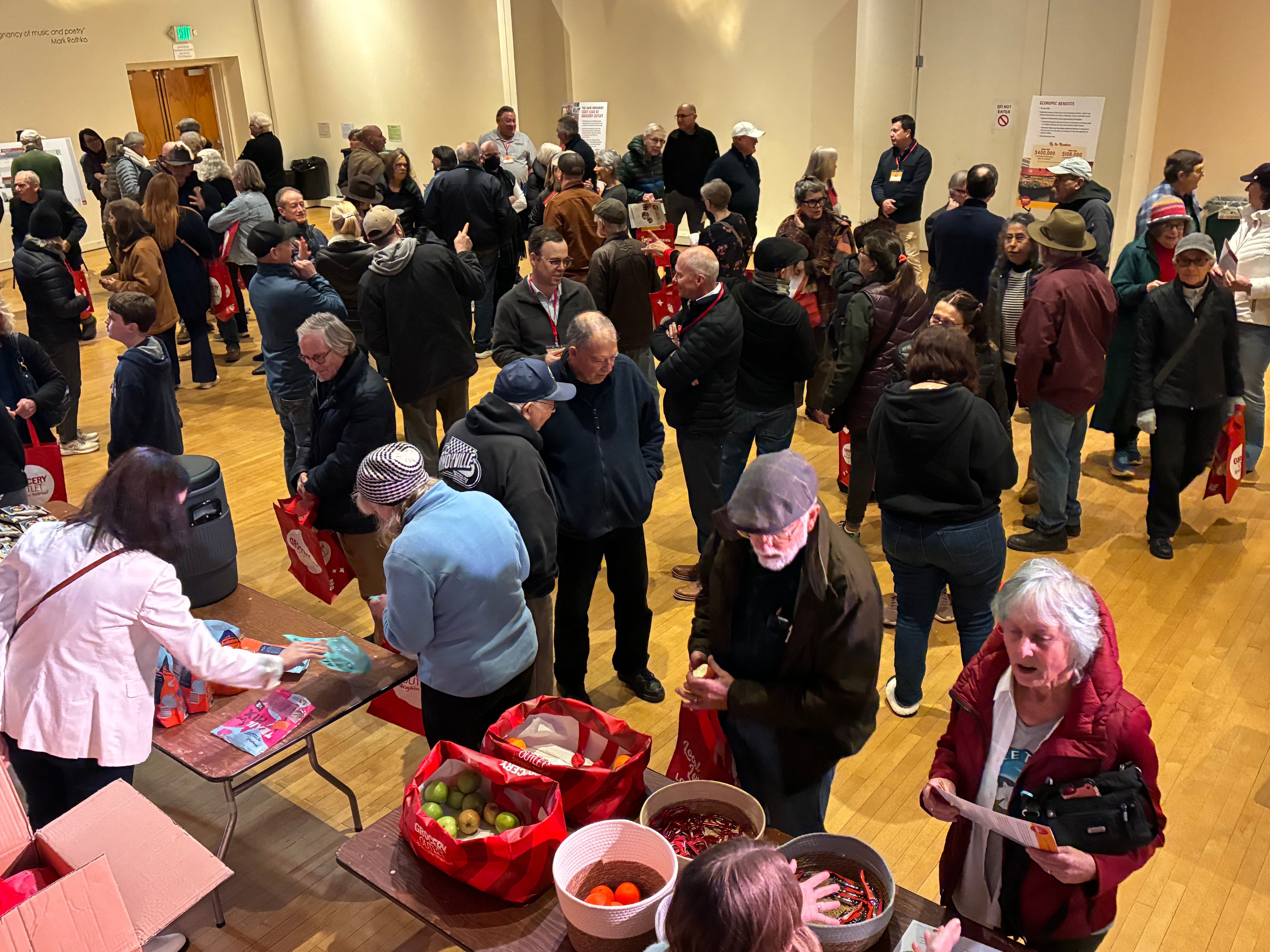
Grocery Outlet is hoping to get a use permit from the city to move into the old Rite Aid building, which has been vacant since last summer. That’s why a dozen or so Grocery Outlet employees came to town last Monday—and they’ll be here again this coming Monday, Feb. 2—to let people know more about the company.
Honestly, given the outraged tone of some of the comments on Nextdoor about this topic, I expected picketers. There were none. Rather, there was a large and curious crowd, filled with a surprising number of Grocery Outlet fans—people who are excited to have a Grocery Outlet in town rather than having to drive to the nearest one in Rohnert Park or Santa Rosa.
Grocery Outlet’s business model focuses on purchasing overstocked or surplus products at bargain prices. The savings are passed on to customers. According to Grocery Outlet representatives, their prices are 35% lower than local grocers and 41% lower than national chain grocers, like Safeway.
I spoke to several people who praised the affordability of the store. Melena Aubriel Moore, the owner of Bliss Organic Day Spa, praised their organic options and said “You get really good deals and save a ton of money.”
Kathy Myers said having a Grocery Outlet in town would definitely fill a need. “I know there’s traffic concerns and parking and all that, but I will say I was a single mom with two kids, one income, and I did all my shopping at Grocery Outlet when my office was in Rohnert Park. Now that I’m semi-retired, I go to the Grocery Outlet in Santa Rosa. I also do food distribution for the food bank here in Sebastopol and in Graton, and I know that there’s a big need for affordable food and other necessities.”
Sebastopol resident Cheryl Wallace, who normally shops at the Rohnert Park Grocery Outlet, said “It’s not just about the money. It’s about the model—it’s just fun. It’s like a treasure hunt. You never know what you’re going to find.”
There were skeptics, of course. Kyle Falbo is hoping the city’s formula business ordinance—which in the popular imagination bans chain stores from downtown—can stand up to the challenge. A close reading of the ordinance, shows that it bans only three types of chain businesses outright—hotel and motels, restaurants, and an array of street-level “office” chains, such as banks.
Other types of formula businesses must apply to get a use permit from the city. In that case, explained Interim City Manager Mary Gourley, “it goes through the planning commission. The planning commission renders a decision. If the applicant doesn’t like that decision, they can appeal it to the city council, and then the city council would be the reviewing authority on it.”
Falbo found this concerning.
“When I think about what the actual premise of a formula business ordinance is, it’s about protecting the local economy, right?” Falbo said. “And this [Grocery Outlet] is an organization that has profit sharing with shareholders that is extracting revenue out of the city of Sebastopol to folks that do not live within Sonoma County, and that, to me, should be the premise of a formula business ordinance. If our formula business ordinance doesn’t meet that standard, then it sounds like we had some terrible decision makers who made that formula business ordinance.”
Steve Pierce, a member of the city’s Climate Action Committee, had a number of conditions he’d like to see added to use permit if the city decides to grant one. “No. 1, we come up with some kind of agreement with the city in terms of parking, some portion of it should be available for public parking. No. 2, let’s get some public EV-charging fast chargers, four nozzles, 125 kW minimum. No. 3, let’s get some bike racks. Let’s get some covered, employee bike locker areas. No. 4, let’s get solar and batteries as if it’s new construction. And hey, what are they paying their workers? Let’s say you got to pay your workers the minimum that fast food workers make in California, which is $20 an hour.” (We wandered over to ask one of the Grocery Outlet employees, who said beginning pay would be more like $18 or $19.)
Friends Mary O’Neill and Liz Marks said they were “mixed” in their reaction to Grocery Outlet coming to town. On the one hand, they understood that there were people in town who would benefit from lower-priced groceries. On the other hand, they worried about its effect on the town as a whole.
“I’ve heard that it often is an indication when a Grocery Outlet goes into an area that it’s a city in decline or it’s an area in decline, and that it could affect the funding of some of the other things that are coming through, like the new hotel across from Community Market. That really concerns me because I’m really looking forward to that,” O’Neill said.
Marks criticized the format of the meeting. There was no presentation, just stations with posters on different aspects of the project and with Grocery Outlet employees to answer questions at each station. She was hoping for something more like a formal presentation followed by a Q&A. I heard several people make this same complaint.
“I was hoping that I would be able to, at this meeting, hear the pros and the cons, the arguments for and against, and then come to an informed decision,” Marks said.
It was obvious that people were asking questions of the various Grocery Outlet employees, she said, but who was hearing their answers? Just the few people at that particular station.
“This was just an introductory PR exercise,” Marks said. “Now take it to the next level. Let everybody formulate their thoughts, read the material and ingest what they heard, discuss with their partners who heard something different, then have a meeting where people can ask relevant, important, and informed questions.”
Speaking of those stations, here are a few bits of information gleaned from some of them.
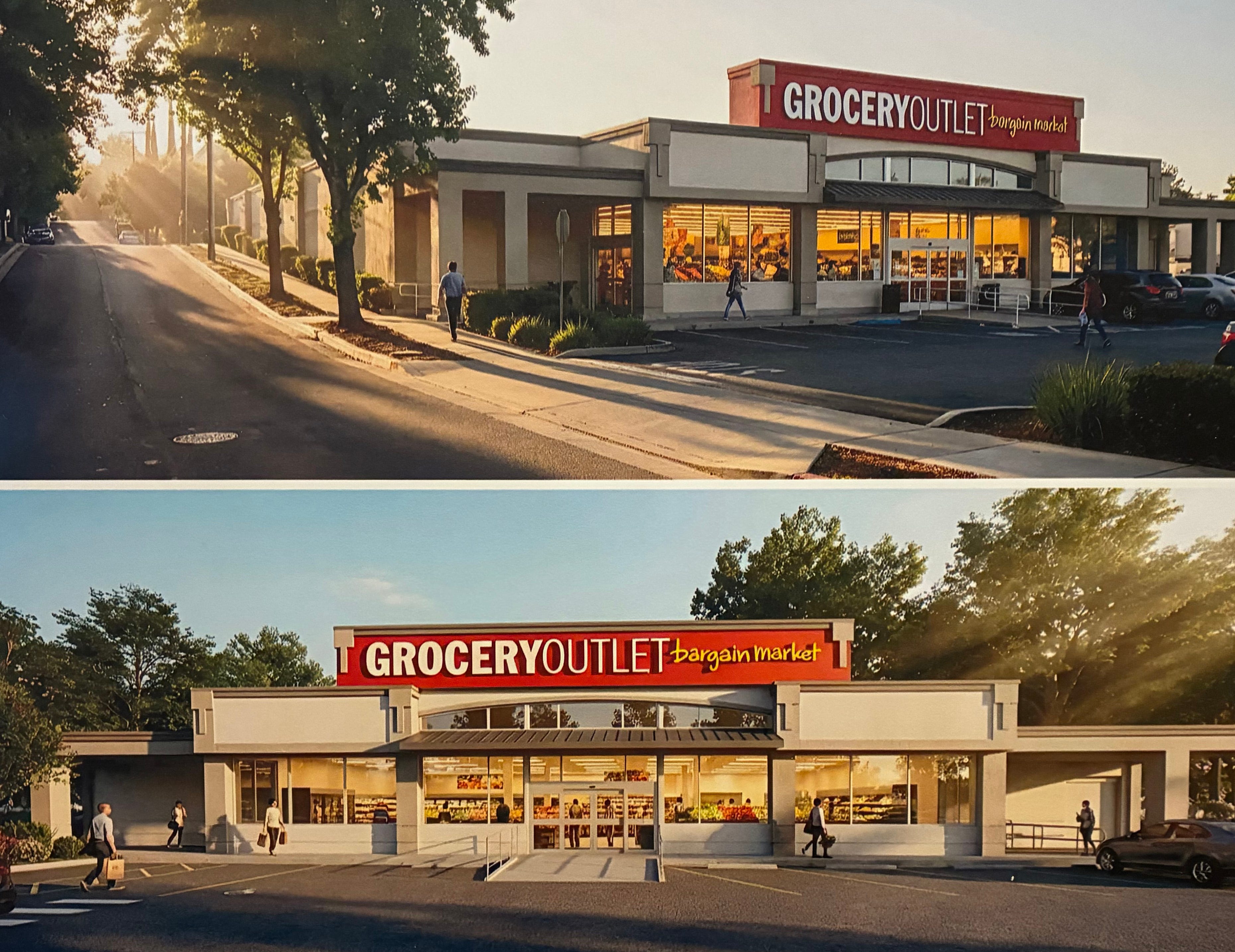
THE BUILDING: From the mock-ups of the new Sebastopol location, one thing is clear. Except for a paint job, they’re not planning on changing the exterior of the building much, except to add a giant Grocery Outlet sign.
BUSINESS MODEL: Another poster touted the store’s business model of local, independent ownership. And indeed, a local owner, Victor Soares was on hand to talk about his experience of running the Grocery Outlet in Rohnert Park. Another Grocery Outlet employee said that Soares is one of several people being interviewed to own/run the Sebastopol location. In the Grocery Outlet business model, owners share 50% of their profits with the company.
TRAFFIC STUDY: According to one of the posters, Grocery Outlet commissioned a traffic study that predicted that the addition of the store to Sebastopol’s downtown would cause a projected 252 new car trips each day—with nine during the morning rush hour and 44 in peak evening hours. The study also noted that 63 existing parking spaces is higher than the number of spaces required for the 16,000 sq. ft. building. The only recommendation from the study was that they install one bike parking space for every five vehicle spaces.
THE MONEY: Grocery Outlet will pay roughly $400,000 in sales tax revenue each year, only a small percentage of which—about $40,000—would go to the city of Sebastopol. They will pay $108,000 in property tax—of which 11-15% will go to the city. In addition, the business will provide 50 new jobs.
The next Grocery Outlet community information meeting is tomorrow, Monday, Feb. 2, 5:30 pm to 7 pm, at Sebastopol Center for the Arts, 282 S. High St., Sebastopol.
Have you ever seen a ghost rainbow?
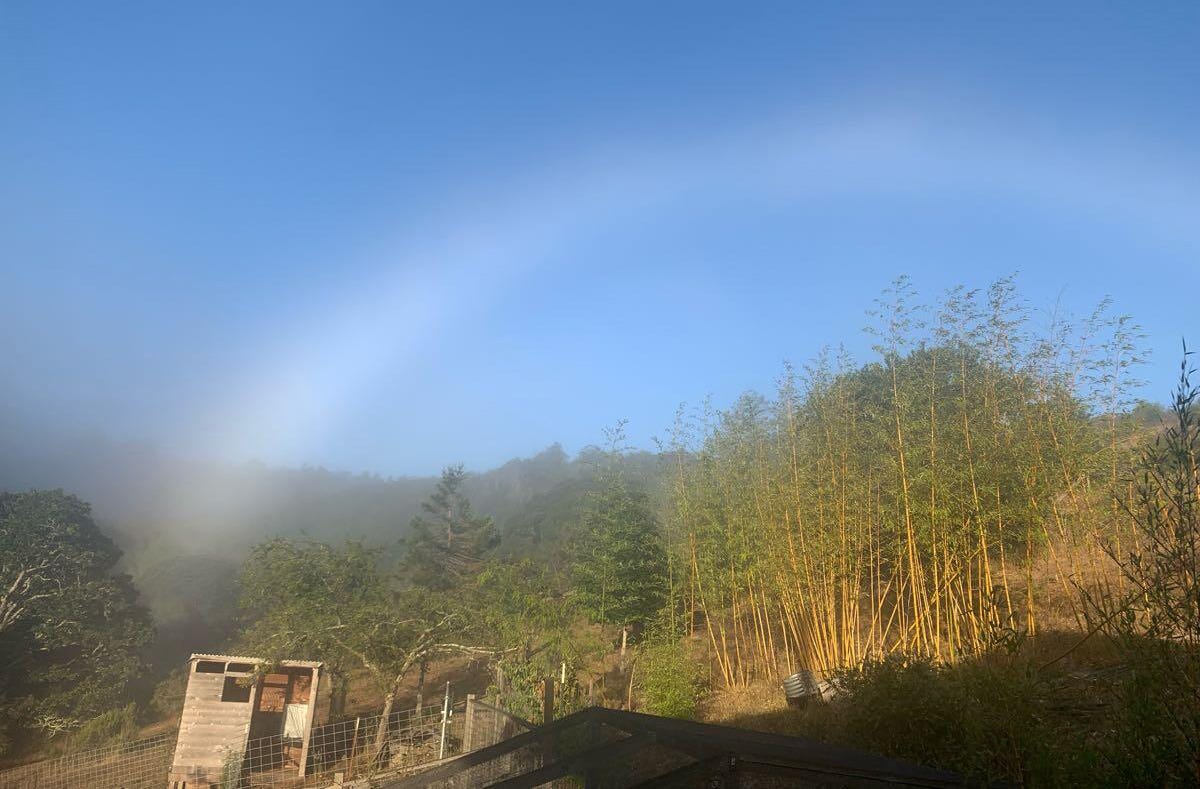
Dawn Hensley gave us permission to share this intriguing, rare weather phenomenon that she snapped a picture of last year from her property in Sebastopol. It’s called a fog bow, also known as a ghost rainbow or white rainbow. According to Wikipedia, it’s “a phenomenon similar to a rainbow; however, it appears as a bow in fog rather than rain. Because of the very small size of water droplets that cause fog—smaller than 0.05 millimeters—the fog bow has only very weak colors, with a red outer edge and bluish inner edge. The colors fade due to being smeared out by the diffraction effect of the smaller droplets.”
Last week, I photographed what I thought was a similar phenomenon above the Sebastopol Times office, but mine turned out to be, not a fog bow, but a solar halo around the setting sun, which is caused when sunlight interacts with ice crystals in clouds that form around 25,000 to 30,000 feet above the ground.
One way to tell the difference: in fogbows, the red band (if there is one) is at the top (or outside) of the bow; in a solar halo, the red band is on the interior edge. A basket of fresh-picked lemons to the person who best explains in the comments below why this the case.

Welcoming Lawson Gaylord to our team
The most recent edition of Sebastopol Living featured Analy student Lawson Gaylord on the cover. Though he’s just a sophomore, Lawson is the director of the Analy Journalism Club and editor-in-chief of the Analy newspaper, westcountyworld.org. He wrote an article for us in December, and we liked it so much we asked him to become a regular contributor to the Sebastopol Times. He’ll be covering news at Analy High School and anything else that strikes his fancy.

This morning’s gifts from Larry Robinson
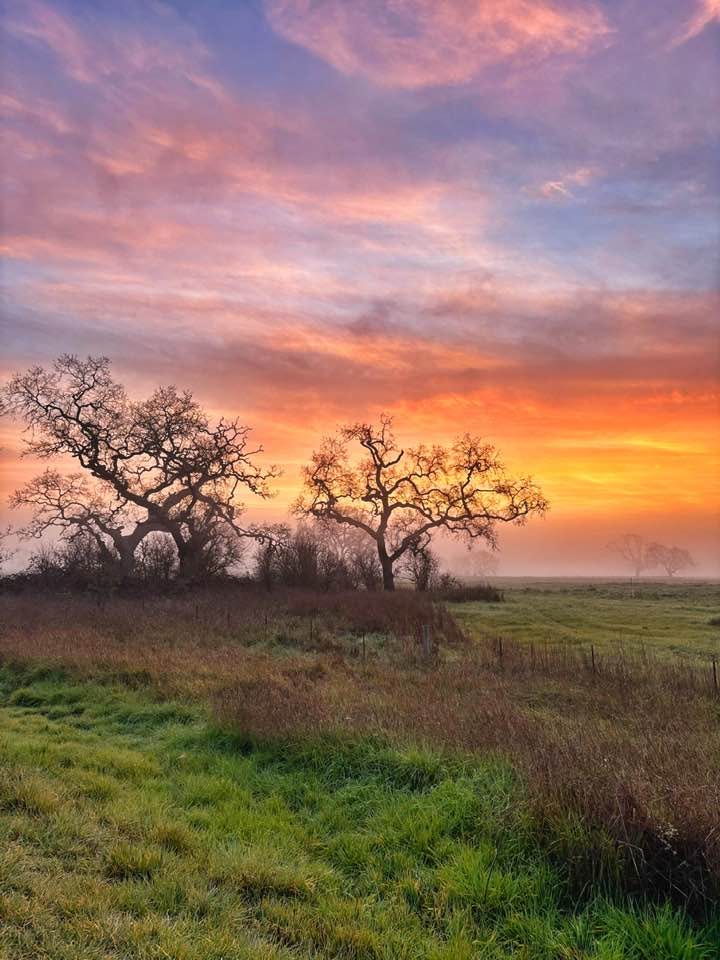
Poet and former Sebastopol City Councilmember Larry Robinson chose this lovely piece, “Safety Net,” as today’s Poem for the Day. He also took the photo below as he walked on the Joe Rodota trail at dawn. If you’d like to sign up for the Poem for the Day email list, write Larry Robinson at Lrobpoet@sonic.net and request to be put on the list. You can also see the Poem for the Day and his laguna photos on his Facebook page.
Safety Net
by Rosemerry Wahtola Trommer
This morning I woke
thinking of all the people I love
and all the people they love
and how big the net
of lovers. It felt so clear,
all those invisible ties
interwoven like silken threads
strong enough to make a mesh
that for thousands of years
has been woven and rewoven
into a net to catch us all.
Sometimes we go on
as if we forget
about the net. Believing only
in the fall. But the net
is just as real. Every day,
with every small kindness,
with every generous act,
we strengthen it. Notice,
even now, how
as the whole world
seems to be falling,
the net is there for us
as we walk the tightrope of the day.
Notice how every tie matters.
What happened to the Sebastopol Police logs?
The Sebastopol Police are producing police logs in a different format than they have in the past, using data from their RIMS system. It provides a much more complete report (12 pages!), and we are working on the best way to present this. Our current thinking is that we will run it as a separate article, perhaps on Monday afternoon. We’ll keep you apprised.


Is Windsor a city in decline, as indicated by having a grocery outlet? Is Sebastopol "better" because it has chain stores like Safeway, Lucky, Rotten Robbies, Starbucks, CVS, but no Grocery Outlet? What an odd concept :) The way I look at it is that Grocery Outlets are local franchises, that offer great shopping, good prices and help prevent food waste. Folks who travel to shop at Grocery Outlet in Windsor, Rohnert Park or Santa Rosa, might travel less far to shop at a Grocery Outlet in Sebastopol, this helping your City of Sebastopol tax base and perhaps reducing greenhouse gas emissions a little. It would be different if you didn't already have Safeway and Lucky and CVS and hotel etc chain businesses in town ... I say get real and support your broader community as well as your little City. Really sad when Sebastopol elites are supporting commercial vacancies and urban blight instead of bringing in local franchise competition to your chain Grocery stores and helping prevent food waste.
Unless a Sebastopol store sources all its product from Sebastopol, only hires city residents, and is 100% city resident owned, some part of their non-tax revenue leaves the city. If such a store exists, it's probably artisan based and contributing modest taxes to the city. There just aren't enough of these kinds of businesses to fully support the diverse needs of our city.
The other end of the scale is a fully corporate owned chain store, selling globally sourced products, extracting a lot of its revenue to outside the city, the county, and often the state.
Everything else is a matter of degree between those options.
It's likely that a majority of Sebastopol city businesses aren't owned and managed by Sebastopol city residents. They come from all over West County and beyond. Ownership $ already leaves the city limits and is spread to a larger area. At what geographical point is that ownership too far for comfort?
Profit sharing has to do with what is left over, after paying expenses such inventory and wages. Really, what we are concerned about in this local debate is whether wages and ownership monies stay and get recycled into our local economy. Employee and Management income are expenses. They get paid to locals prior to there even being a profit.
Profit sharing (like the GO model) is a useful way to have outside-of-the-area-products sold in a way that keeps some of that profit in the local community. The alternative is that all profits leave the area in a fully corporate owned model, or we add an additional layer of local ownership which will be reflected in more expensive products. I can't speak to the specifics of the GO arrangement, but profit sharing is often accompanied by shared services, where local management benefits from bulk purchased centralized systems and administration.
Sebastopol has real needs that can only be addressed by a flourishing and diverse business community. On the surface, GO looks to fill an empty storefront, add to the tax base, hire local workers, and insure significant local ownership and control. From an economic view, it has a lot going for it. Does it fit our collective imagination of our local town character? That's a fair question. That's what this debate is really about.