

Making food from the weeds in your backyard
By Chloe Sanders and Laura Hagar Rush
Sometimes, as a reporter, I cover a lot of night meetings and events, which means I miss a fair number of dinners with my husband. Earlier this week, I felt like I hadn’t seen him for days, but I really wanted to do a story about a class that Nan Koehler was offering at Permaculture Artisans. So I asked one of my housemates, Chloe Sanders, an herbalism student, if she’d take the class and report back to me.
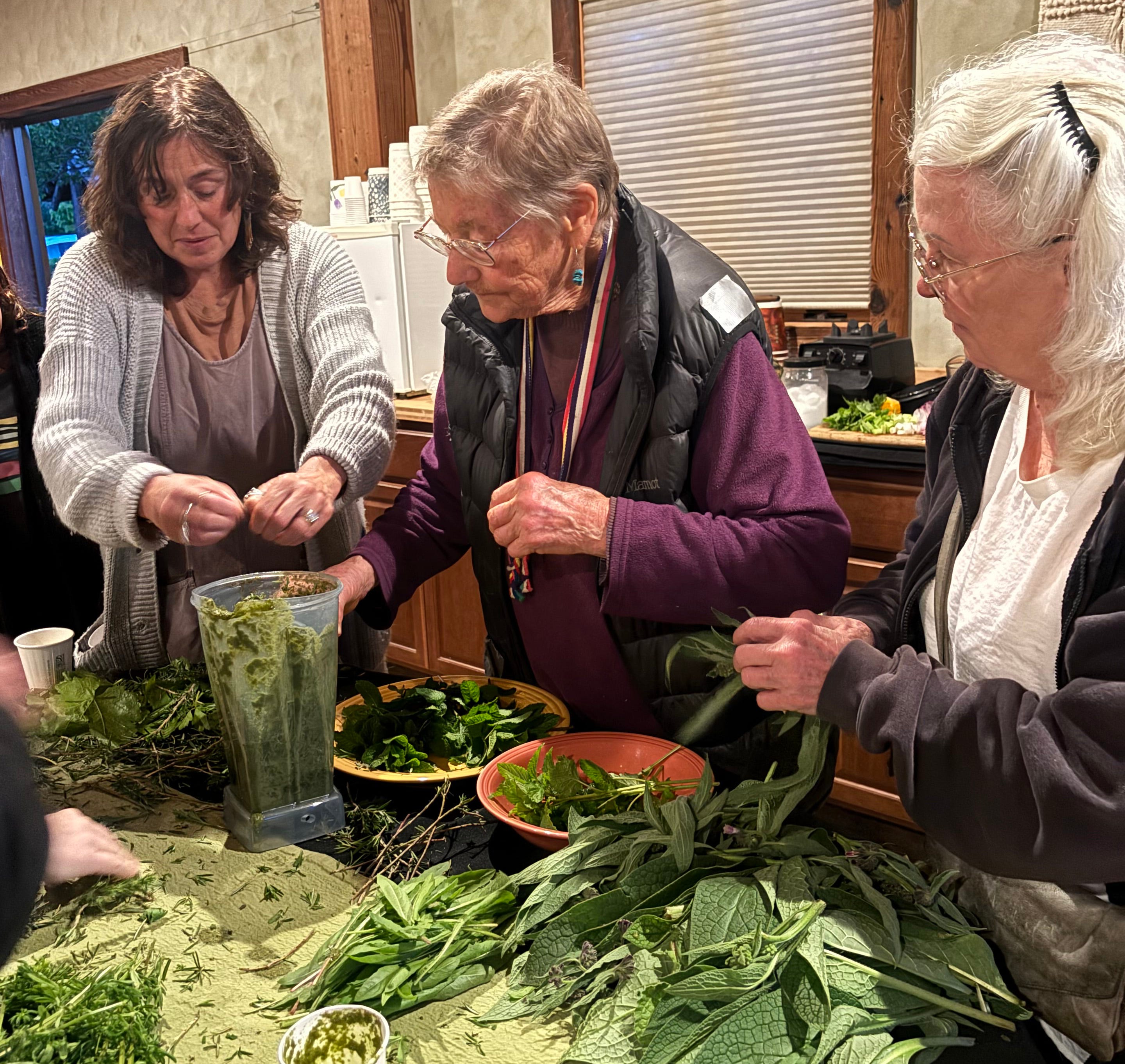
Nan Koehler of Rainbow’s End Farm is a farmer, herbalist, grandmother, and well-known community elder. She gave a class on “Wild Pestos & Green Juice” at Permaculture Artisans this week, teaching an enthusiastic group of folks how to make food from the wild greens growing right in their own backyards—often known simply as “weeds.”
The class began in a circle. Nan held a bundle of herbs in one hand and a rattle in the other. She sang some Native American-inspired songs, and everyone introduced themselves briefly. The group then went outside to forage for some weeds. It was very immersive. She would pass around a plant so everyone could touch, smell and taste the plant. Nan could name almost every green thing that was growing. After a while, the class broke into their own little groups, connecting and ID-ing plants.
Back inside, the group began garbling plants. Garbling is the process of sorting and cleaning herbs to separate the usable parts—leaves and flowers—from stems, woody bits, and impurities.
In the kitchen, students chopped and prepared the herbs under Nan’s direction. Nan doesn’t give exact amounts for her recipes. She suggests you nibble the plants and flowers while you’re prepping and intuit your way into the recipe. “Keep it a little loose; the plants will tell you,”she said.
The group made two recipes: a green juice and a rosemary pesto.
Green Juice recipe
Put in a blender:
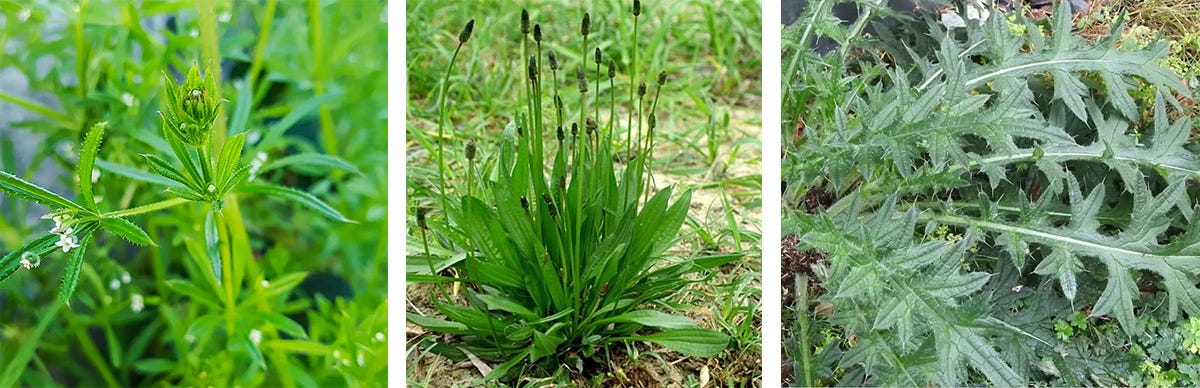
A couple of handfuls each of cleavers (leaves and stems), plantain (leaves), thistle (leaves), and lemon balm (leaves)
1 Meyer lemon with skin
A couple of inches of ginger
Some fresh pineapple (about half a pineapple)
3 celery sticks
Small handful of parsley
1 apple cut into quarters
Water
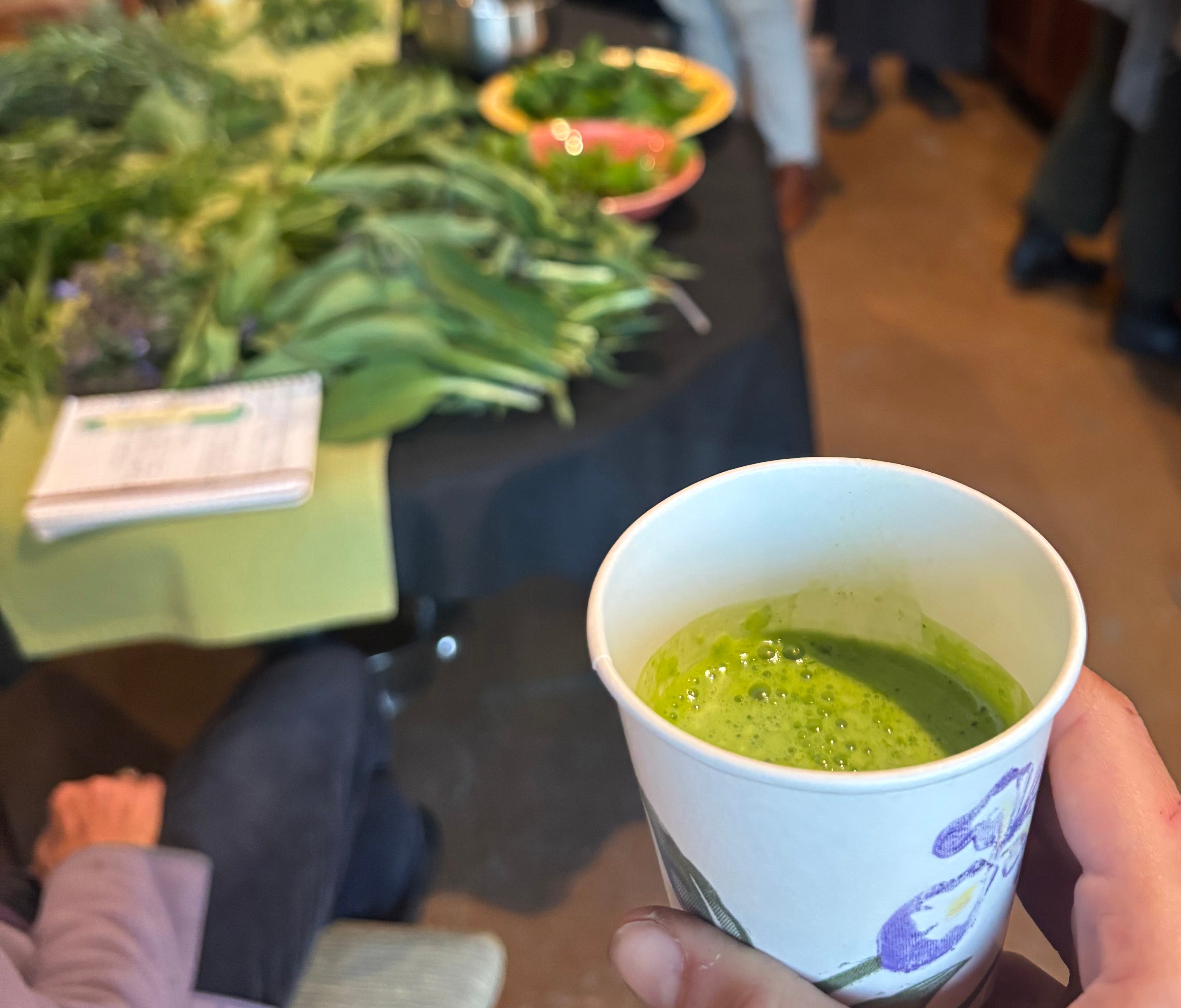
Put all the ingredients in a blender and blend for a very, very long time, adding water as needed to keep it liquid. Strain through a funnel lined with a cloth sieve or cheesecloth. The juice is a frothy bright green.
Rosemary-Clover pesto
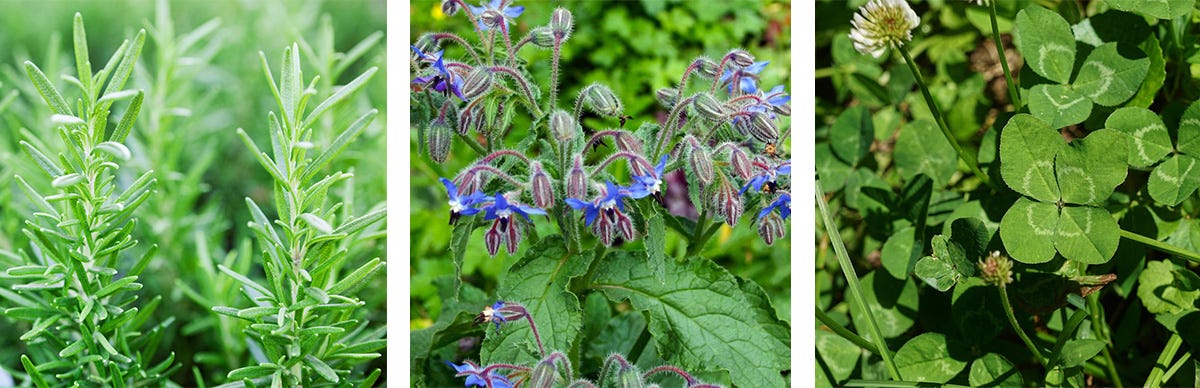
1-2 cups rosemary (soft parts only, no woody parts)
Half of a red onion
1 and 1/2 small lemons (butt removed to reduce bitterness)
A small handful of Borage (flower, leaves, and soft stems)
1 cup clover
French gray salt
A lot of green garlic (can substitute three-cornered leeks (Allium triquetrium) or garlic corms (I think only garlic farmers would have access to the latter as these are small bulbs which grow on the bottom of garlic plants.)
Add to blender and blend to preferred consistency as you would with any pesto.
What’s our take on these recipes? Chloe found the green juice clean and balanced, with distinct herbal notes. She brought some pesto home for me to try. I found it, um, weedy-tasting, but it’s good to know that, in case of a future apocalypse, you can in fact eat the weeds in your yard.
Obligatory warning: Many wild plants, including many weeds, are toxic. Don’t just go grazing. As with mushroom foraging, make sure you can positively identify as safe any plant you’re planning to eat.
Soup’s on!
Remember our article in February about a community building project called SOUP? It’s happening! And organizer Hunter Franks is inviting you to participate.

Join Franks and others for an evening of food, conversation, and community-powered change on Thursday, May 7, from 5:30 pm to 8:30 pm, at the Sebastopol Grange, 6000 Sebastopol Ave. (Hwy. 12), just east of town.
SOUP Sonoma County is a community dinner where your vote funds a local idea. At this gathering, four people from our community will each share a project they believe could make our town better. Each presenter has four minutes to pitch their idea and answer questions from the audience.
After hearing the ideas, we’ll share a simple meal together — soup, salad, and bread — and everyone votes for the project they believe in most. The project with the most votes takes home all of the money collected at the door to bring their idea to life.
Come for the food. Stay for the conversation. Leave knowing you helped shape the future of your community.
RSVP at socosoup.eventbrite.com. Suggested contribution at the door of $5–$50. Please bring cash. No one turned away for lack of funds.
Have an idea or a community project that needs funding? Apply to present your project at SOUP here.
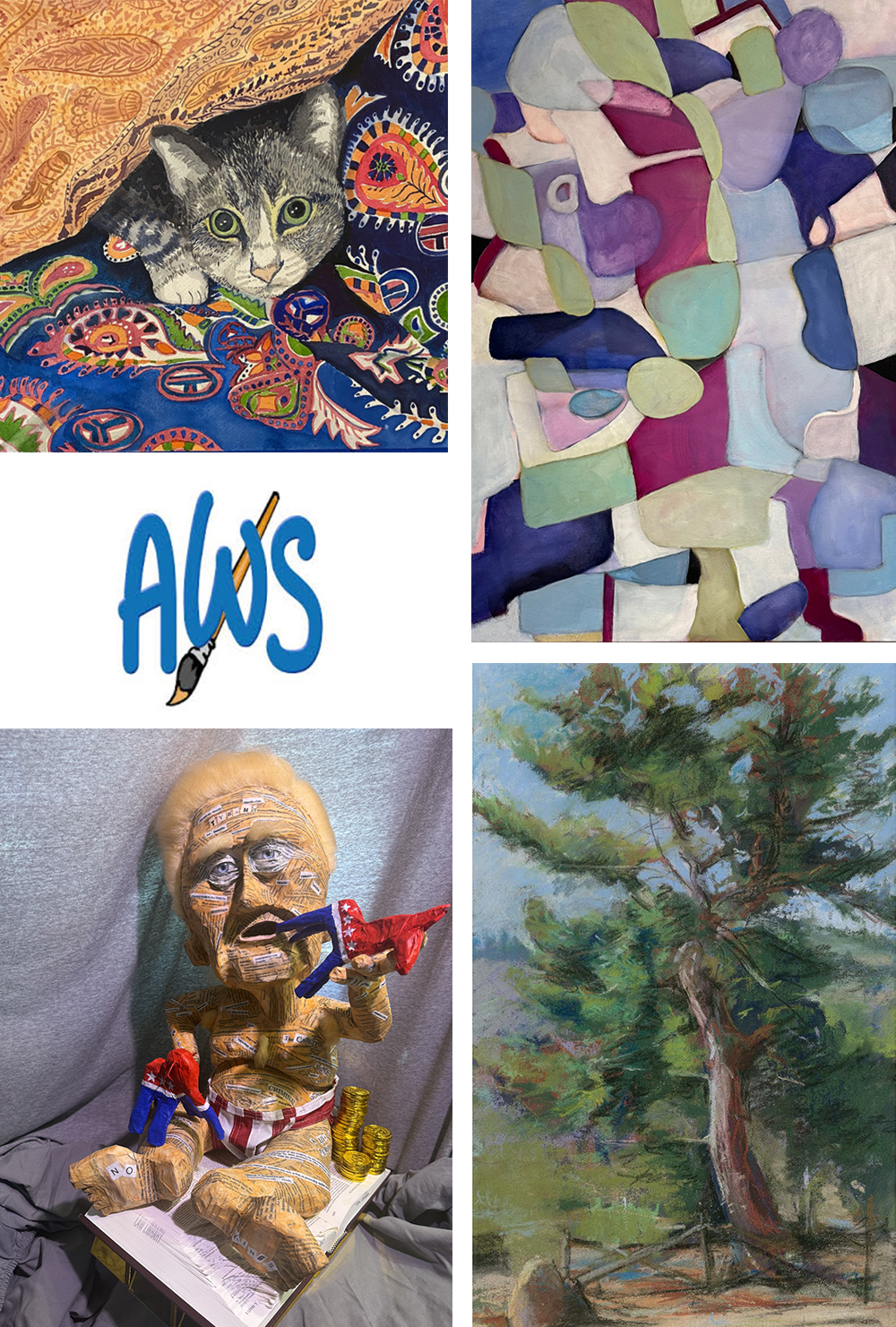
AWS Art Show coming up next weekend at Apple Blossom
AWS, Art Workshop of Western Sonoma County, is a 130-member organization of artists founded in 1965 by six local artists. For more than 50 years, AWS has been the official Apple Blossom Art Show.
The show will open with a reception on Friday, April 24, from 7 to 9 pm at the Sebastopol Center for the Arts, 282 S. High St., Sebastopol. Admission is free, and there will be wine, appetizers and live music from Copley & Radice. This is a non-juried show, and, like Apple Blossom itself, it has a sweet, homespun quality.
AWS artists range from beginners to professionals and include oil, acrylic, watercolor, and pastel artists, as well as photographers, mixed-media artists, sculptors, and jewelry makers. The group is currently capped at 130, and there’s a waiting list to join.
The group has a potluck lunch and meeting on the third Thursday of every month, from 12 pm to 2:45 pm, at Sebastopol Center for the Arts. The meetings include updates on what’s happening in the local art world, demonstrations of particular artistic techniques, and member critiques.
Pamela Nachtigall is a retired CPA and an accomplished artist who is a relatively new member of the club. “Artists, when we’re painting or doing things, tend to be quite solitary in our little spaces, in our own heads. So this is a very nice way for all of us to get out,” she said. “We all relate to one another on the level of creativity and art, and you don’t always have that with other people.”


Like a group of unexpected AND welcome plants coming up, the Sebastopol Times Sunday garden is always a pleasant place to visit and start the day.
See you all at SOUP.