

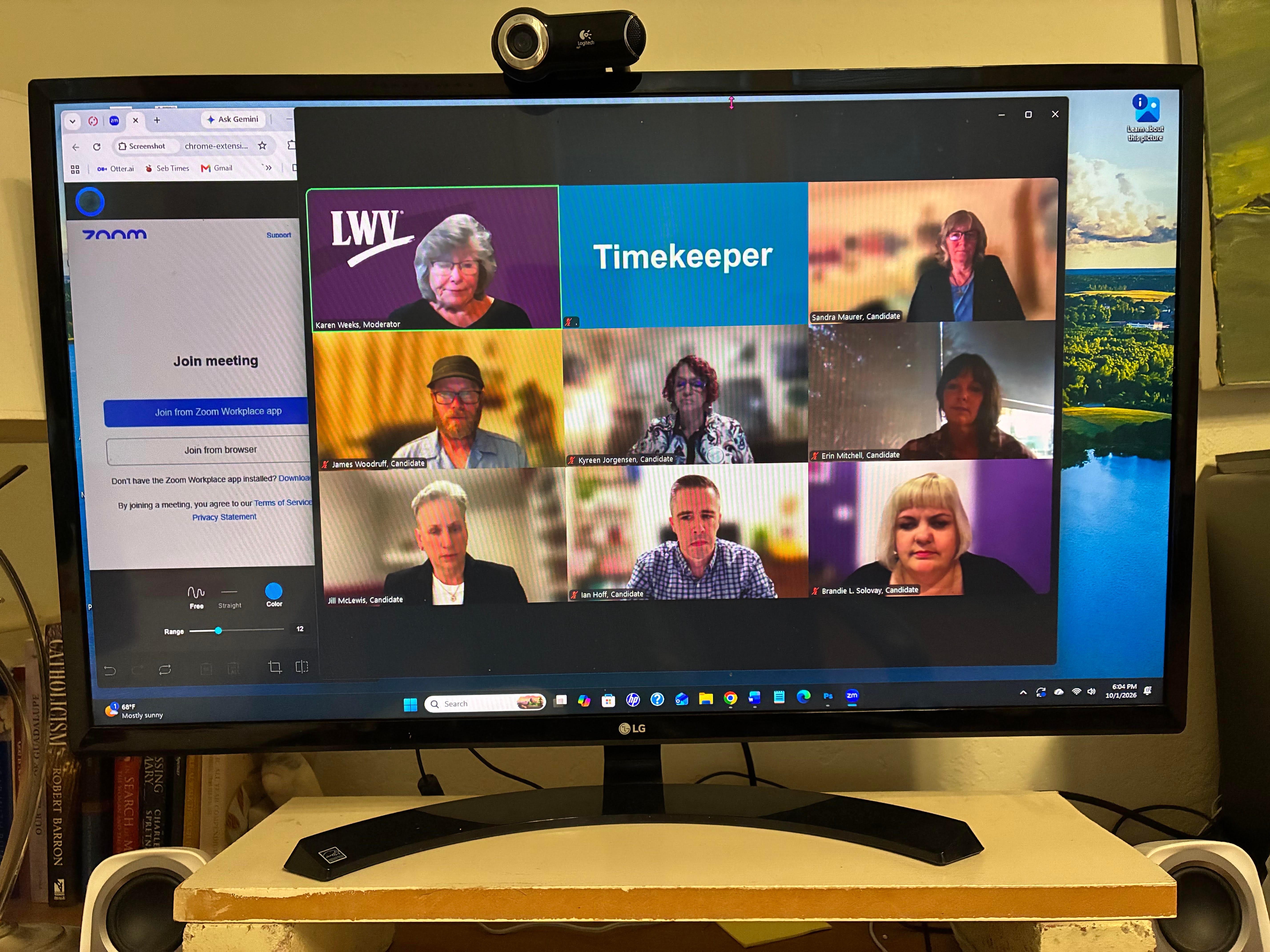
This is Part 2 of a two-part article about last week’s League of Women Voters’ online forum for Sebastopol City Council candidates. (You can find Part 1 here.) In this article, we’ll hear the candidates’ responses to questions about the Sebastopol Commons, traffic, the Grand Jury report on Sebastopol’s water and sewer funds, and what they think the job of a councilperson is really all about.
As a quick refresher, the candidates include:
Kyreen Jorgenson has lived in Sebastopol for 8 years. She has been a deputy clerk for the Board of Supervisors and is currently board clerk for the Smart Train.
James Woodruff is a third-generation Sebastopol resident. A welder who wants to represent working people, he has state certifications in water supply and wastewater treatment.
Ian Hoff has lived in Sebastopol for 8 years. He’s a structural engineer and former Sebastopol volunteer firefighter.
Jill McLewis is a councilmember and current mayor. She has lived in Sebastopol for 12 years. She is the director of a regional food and beverage trade organization and owns a small business, Eye Candy, in Sebastopol.
Brandie Solavay has lived in Sebastopol since 2023. She is a practicing attorney with experience in family, discrimination, disability, immigration and criminal defense law, as well as nonprofit leadership.
Erin Mitchell is a mother and an environmental planning student in her last year at SSU. She was born and raised in Sebastopol. She worked for the state of California for six years in facilities and maintenance.
Sandra Maurer is a councilmember and vice mayor. Before joining the council, she was a non-profit director and environmental activist who helped win the right for utility customers to opt out of smart meters. She has lived in Sebastopol for 38 years.
The city council incumbents — McLewis and Maurer — were at somewhat of a disadvantage in this forum because they’re not allowed to state their position on items that will be coming before the city council. On the other hand, the incumbents naturally had a leg up on some of their opponents because, having worked on the council since 2022, they have a deeper understanding of the issues. Nowhere was this more clear than in some of the answers to a question about the Sebastopol Commons.
What are your thoughts about the Sebastopol Commons Project?
Unfortunately, in last week’s forum, the actual question on this topic, based on a listener-submitted question, was this: “If the Sebastopol Commons Project does not move forward as envisioned, what alternative uses or improvements should the city consider for that site?”
This was a poor question because it sounds like they’re referring to the O’Reilly site, but that’s really not the issue. The question at the heart of the Commons project is, “Should the city create a civic hub, The Sebastopol Commons, somewhere in Sebastopol that includes an expanded Sebastopol Library, a larger City Hall, and a larger Sebastopol Area Senior Center, as well as a handful of other local nonprofits?” A city committee, the Committee to Build the Commons, made the case that the Sebastopol Commons should be created at the O’Reilly complex—or at least, that the city should move forward with due diligence in that direction. At a council meeting in September, councilmembers Jill McLewis, Sandra Maurer and Neysa Hinton pushed back on that. A decision about this has been tentatively pushed off to midyear.
Here are candidates’ thoughts on the Sebastopol Commons:
Brandie Solavay initially came down squarely on the side of keeping the library downtown, “I am a person that thinks it's great for the library to be downtown,” she said. “I think it's helpful for people who are disabled, who live in town, to access it when it's just right downtown versus moving it somewhere else, which is further—if you maybe aren't able to drive. Also, for students that are going to school, if they want to go to the library, I think it's important that it be close.” Then noting that the library building was old and currently unusable, she made the opposite argument, “I know that it really can use some expansion and some more space, and moving it somewhere where it has more space may be great.” She was in the middle of proposing a new idea — “I know that it's really important to the budget that our city be able to make money, and that where it's currently located might be a space that something else could be built that we could actually increase money from, such as stores or a living-and-store combinations” — when the moderator said she was out of time.
The way the Commons question was written also threw Erin Mitchell off base. “I find it kind of sad that this project got stalled … I think it might be a matter of pulling in some funding to make sure that it goes to what it was promised to people that were looking forward to it. If that didn’t happen, would there be a good alternative use?” She then suggested that it—meaning the O’Reilly complex?—might become “a climate resource or research center or somewhere for kids to come and do projects and learn about the environment.” Then she suggested it should be turned into housing because “No city in California is meeting their housing trajectory.” (Editor’s note: Sebastopol is meeting its quota for creating new housing and has been for a couple of years.)
Sandra Maurer tried to get the discussion back on track by laying out a history of the Commons Project and her objections to it. What really irked her was that she felt the Commons Committee problem had gotten ahead of itself. “Without full agreement from the full council, without a decision from the council, they started doing town halls, promoting the idea of … selling the buildings downtown and moving everything to the O'Reilly Building,” a 90,000-square-foot complex at the north end of town, which is currently for sale for $18 million. Maurer said she understood the appeal—it’s a beautiful complex and there’s a lot of parking—but she said the financial plan for the project “didn’t really make sense to me.” Maurer said she proposed instead that the committee investigate expanding the library at its current site—perhaps into the area behind City Hall, where a large cellphone tower is located. As an electromagnetic frequency (EMF) critic, Maurer would like to see this tower removed when its lease runs out in 2031. “The vote was 4 to 1 to bring this [the Commons question] back in December and form an ad hoc to move it forward with both properties,” by which she meant to consider both O’Reilly and a rebuild at the current site, which she felt hadn’t been fully researched.
Kyreen Jorgensen was also in favor of keeping the library downtown. “I really like the library downtown. I think that the accessibility of the library is better served downtown. There are a lot of schools [nearby]. My stepson went to the library after school and did his homework, and it was a safe environment.” The cost of the O’Reilly project also bothered her. “The price tag on The Commons [at O’Reilly] just blew my mind. You know, the council has worked diligently to try to fix the budget and get the budget back to where the budget needs to be, and then to have this big ticket item just doesn't make any sense to me.” She thought there might be a more affordable alternative. “I don't know what those alternatives are right now. I would love to see city hall, the library, the parking lot, that whole area get revamped at probably a fraction of that price tag.”
James Woodruff was equally concerned about the size of the Commons project. “So the Commons project is definitely a large project, and it’s ambitious, to say the least. I've been listening to people in the community, and there are many people I have talked to who do want to keep the library where it is. They do not want to move it to the edge of town. That is very common to hear. And I also do have concerns about the financial tools that might be used to make this project happen. I'm not sure that the financial climate that we are currently in is a great one to take out new loans.” He also liked the idea of expanding the library in its current spot if possible. “Just making sure we keep responsible with our finances is a big deal.”
Ian Hoff saw the appeal of the Commons at O’Reilly, but said, “We might need to look and find other venues. Can we move the city hall and then have the library take over the city hall building and expand that way? Are there other commercial options for the Senior Center, which he said was “bursting at the seams.” He said he’d be interested in using his structural engineering background to look into the alternatives. “I would also say we need to be careful about taking on a project like O'Reilly when we struggle to maintain our own infrastructure. How can we maintain something like that?”
Jill McLewis, who has been leery of the Commons project from the start, said, “The Commons committee was formed to do the work of finding different options. I think that the amount of work that went into proposing the O'Reilly Building, I wish that I had seen equal amount of time spent trying to figure out a solution for downtown … it's a complicated business. Selling city buildings is very complicated. There are a lot of regulations with the state. Renting a building that's owned by the city comes with complications.” She also mentioned the loss of taxes to the city should it purchase what is currently a commercial site. She was just about to state her main objection —the financial impact on the city? — when she ran out of time.
What are your top priorities for improving traffic flow and pedestrian safety on Main Street, Bodega Avenue, and 116?
Erin Mitchell kicked off this discussion by saying, “This is one of my priorities — the traffic is probably the thing that has changed the most in my lifetime in Sebastopol.” She mentioned a recent visit to a small town outside of California where “the speed limit through town is 20 miles per hour, and it was amazing. Everything is slowed down … I live at the top of the 116, and I can barely get out to get my kids to school in the morning. People are flying around that corner, so I like a slow city. I think we should slow it down. I'm in support of us changing traffic patterns in order to make it more slow, friendly, and also to make sure we can get emergency vehicles through, and of course protect our pedestrians and have it be safe.”
Sandra Maurer began by saying, “We all know traffic is one of the biggest problems that Sebastopol has.” She said she had tried to interest her colleagues on the council in creating an ad hoc to study the traffic problem to no avail. She suggested putting up a sign directing southbound traffic on 116 to take Occidental Road into Santa Rosa, rather than driving through town. She also noted the city had added reflectors on signs and poles to make certain crossings and intersections more visible at night.
Kyreen Jorgensen agreed that “Traffic is kind of crazy in Sebastopol. I've only lived here about eight years, and it has increased drastically in those eight years … I love the fact that Sebastopol has prioritized safety, pedestrian and bike lanes, and, quite frankly, I’m at a loss as to what to do.” She supported Maurer’s ideas of diverting some traffic down Occidental and creating a city council ad hoc on traffic. She also suggested collaborating with Caltrans and the county and bringing community members into the discussion.
James Woodruff seemed to have thought quite a lot about this issue and was up-to-date on all the au courant solutions and lingo. “I believe we could definitely start with some traffic-calming measures to slow down the traffic, then work on getting to a complete-streets [mode of transportation] so that things are more bikeable, more walkable — multimodal mobility. Getting people out of their cars as much as possible would definitely help traffic. If you're staying local, you shouldn't have to drive.” He also suggested improving and increasing the bus service, giving a shout-out to the 24 bus, which provides free transportation on its route around Sebastopol. “Then, along with that, we could possibly make a transit hub with better amenities, maybe some bathrooms, and like a digital display with wait times. I think those are great, so that people have an idea of how long they're going to be waiting. If the bus is late, it'll let them know. And then, oh, protected bike lanes. I think those are important. So not just paint on the road, but maybe even some raised areas so that people feel safe biking.”
This was also Ian Hoff’s wheelhouse. “So my background, being a licensed civil engineer, is that I studied transportation engineering in college. As a senior, I took an upper-division elective in traffic engineering. I was the student chapter president of the Institute of Transportation Engineers at school.” Hoff said much of the traffic in town is from people just passing through. “We have two major arterial highways that meet and intersect in the middle of our town. These are people that really have no interest in being in Sebastopol. They’re just trying to get from point A to C, and we happen to be B. They work in Forestville. They live in Petaluma. They want to get over to the beach for the day. So this creates an interesting problem for us. Caltrans, in partnership with the city, has done a good job providing traffic calming measures—highly visible pedestrian crossings, bike lanes. They’ve done a good job doing what they can.” He said he was not a fan of the two-way street proposal. “I know the city is entertaining a plan to switch to two-way traffic. Part of that idea, people have said, is like, ‘Well, it’ll slow people down.’ Well, we can slow people down with speed limits, but we don’t want to slow people down with congestion. When people are in traffic, when there’s congestion, do you think people drive better? Do they drive safer? Talking about Occidental Road, we saw what happened when Occidental Road was closed for construction and what that did to Sebastopol. To go willingly to two lanes would make that a more regular condition.”
Jill McLewis said that people have been complaining to her about traffic since she took office: ‘Whether people are driving too fast or too slow, I’ve heard the whole gamut about how people feel about that.” She noted that, “The city has been instrumental in getting the hawk light safety lights installed at McKinley near downtown, and then also near Burbank already.” She said she also opposed two-way streets: “I voted against switching to two lanes because I agree with the statement that we can slow people down in different ways but it concerns me how congested things are going to become.” She also said it was challenging working with Caltrans, which controls much of the Hwy. 116 and 12 corridors. “I'm just going to say it: when you're a council member, and you start doing these things, you'll realize that nothing happens fast … There’s a lot of bureaucracy involved.”
Brandie Solavay, who has worked in disability law, said, “I tend to look at everything through the lens of access, and I think that when we have lots of traffic and moving vehicles and higher speeds, it makes things dangerous for everyone—not just disabled folks, but for people with strollers, for students, for seniors, for all pedestrians. And so I think we need to try to make things the safest we can. I agree with what folks have said about having speed limits that are slower. I think that's very important.” She also wanted to increase the bus service “if that's possible with the budget.” She also noted, “I can tell you that not all community members even know that we have a bus service that is free. So, making sure people are aware of this would be a good start to having less traffic in town, and just really listening and seeing if other community members have other ideas.”
Do you believe any recent financial decisions involving enterprise funds should be revisited? Why or why not?
Sandra Maurer said, “This is a really important issue. The Grand Jury report stated the city took five and a half million dollars too much from the water and sewer accounts over the last 20 years, and the city staff disputed these findings. However, I believe the city needs to assess the overallocation and reconcile the accounts, even if it takes 20 years to pay it back.” She also said the current council wasn’t to blame for the problem, and she enumerated all the things the council had done to resolve the issue. “We formed the Enterprise Fund Oversight Committee. It's EFOC. We forgave a $1.2 million loan to the sewer account. We froze water rate increases. We eliminated tiered pricing. We switched attorney time to direct billing; we started time tracking for public works employees and admin staff. We refunded $350,000 in attorney fees. We set aside $75,000 for a new water and sewer rate study by the General Fund. We revised the cost allocation plan to be based on actual costs two years prior. We completed a master water plan and a master sewer plan.” By the time she finished with this recitation, she was out of time. What she didn’t say was that many of these maneuvers had basically been forced on the council by constant lobbying (over several years) by EFOC member Kate Haug. On the other hand, Maurer consistently voted to approve these improvements.
Kyreen Jorgensen understood that “mistakes were made,” but she said she was ready to move on. “Quite frankly, I wish I knew a little bit more about this, but this is my understanding: the Grand Jury found some information and gave direction to the council and to city staff to make some adjustments, and that the council came back and, as Sandra was pointing out, made lots and lots and lots of changes.” Jorgensen said she wasn’t sure whether the $5.5 million was an accurate figure. “I would say that after all of the changes that the council has done and that city staff has done, I think we just need to move forward. We don’t need to go backward. We don’t need to have an opinion about what a previous council did or didn’t do, or what staff did or didn’t do. Maybe mistakes may have been made. We just need to move on. We need to not make the mistakes again, to have more accountability, have more oversight, and keep moving forward so that we can have a more sustainable, long-term budget.”
James Woodruff wanted a more exact accounting. “The grand jury report has stated that some of the funds were misallocated … it should all be paid back, and we should come to a conclusion as to whether the grand jury report is accurate. That should be looked at to see what actually does need to get paid back. Even if it does take years, I think that the enterprise funds should be made whole.” He emphasized the need for more transparency going forward. Like Jorgensen, he wasn’t interested in playing the blame game. “I do not want to assign blame because I think it was mostly just mishandled and not anybody doing anything malicious.”
Ian Hoff agreed that “This is not a bright spot in Sebastopol's history, but like everyone says, we'll look forward and we'll move beyond this. There was the grand jury report. Our own Enterprise Funds Oversight Committee corroborated that and supported the findings. As Sandra mentioned, they put together steps to mediate and fix this, and the current council is currently moving through those. I think that's great. We should continue to do that, and we should prioritize that where feasible. I'd like to pivot slightly and say that this is important because our water and sewer infrastructure is in disrepair … we need to address this and make these funds whole and correct, and we need to make sure that we provide and take care of our infrastructure in the future.”
Jill McLewis said she’d been aware of these problems for years. “As a person who came and watched city council meetings for seven years before getting elected, this was a known issue that had been going on, and I started digging into it well before I ever got on the council.” She noted that she opposed the water and sewer rate increases, as well as the studies that undergirded them. She said the city was now doing time tracking, which “would hopefully give us a more accurate reflection of what Sebastopol is actually doing.” In terms of repairing Sebastopol’s water and sewer infrastructure, she said, “I met recently with Adam Schiff's aide with the city manager, and we had discussions around the possibility of them writing a letter of recommendation should we need to apply for a federal loan” to repair Well 4, which is over 75 years old. “We've known that for a long time that it's at the end of its life.”
Erin Mitchell admitted that she wasn’t very informed on this issue, but said, “I do know that we owe it to Sebastopol residents to maintain transparency and honesty and keep our noses clean. Working for the state, deferred maintenance was a huge strain on our overall department. So I think that one of my number one priorities is water and water infrastructure and preparing for the future in that resource.”
Brandi Solavay agreed that “The grand jury findings were definitely worrisome, and I do think that we need to make it right. So I'm happy to hear of some of what the current council is doing, and I also think that we need to look forward and make sure it doesn't happen again. I think we need to be very transparent about what money comes in and what money comes out through reports that are accessible to our community, and we also do need to address our current sewer situation.”
What do you see as the core responsibilities of a Sebastopol City Council member, and how we prioritize them?
This question was actually the opening question of the online forum. We didn’t include it up front because almost everyone said the same thing: that they believed councilmembers were representatives of the public, that they should listen to their constituents—many of whom had great ideas—and represent their often conflicting opinions while finding a way to balance them, all the while keeping an eye on the budget. Here were a few nuggets pulled from what was otherwise a sea of sameness on this particular question:
Kyreen Jorgensen: “I think that one of the main priorities is representation, not individual idealism.”
James Woodruff: “If we're not paying attention and looking at all the details, then things will be missed, and we will end up in a bad place.”
Jill McLewis: “Most importantly, as of late, as of the last few years, is us just digging ourselves out of a hole that was not created by the current council, but just working through the challenges that you were presented when we all took our seat at the dais.”
Brandy Solavay: “It's important to make things accessible. So continuing to have city council meetings online where people can participate or making materials accessible for people to understand. Putting a 500-page budget online is not going to be accessible for everyone to understand. So having things in plain language so that all community members can review it and understand what's going on.”
Erin Mitchell compared being a councilperson to the job of being a mother. “I'm a mom, and I have kids, so I said, "Well, you know, they're all different. They all want different things. Sometimes you have to make a decision that can compromise for everybody to be happy.”
Sandra Maurer was the only candidate whose statement on this question stood out from the rest for its specificity:
“The boss of the council are the residents, and so that makes it difficult sometimes when the residents are divided over an issue. But it’s our job to listen and to not decide how we’re going to vote until we’re on the dais—until we’ve heard from the public, and we’ve done the deep dive —we’ve researched the issue, and we’ve heard from staff, and we’ve heard from our colleagues on the dais. That’s an important responsibility as a council member. We need to follow Brown Act rules, although we can “Brown up” with one other council member to go deeper into the issues to discuss these. I found that that’s been very helpful. So collaboration is very helpful. I think it’s really important to be respectful to residents and respectful to staff, and to be responsive to residents and staff, and try to help get information for residents if they need it … I think it’s important to show up at the council meetings, and I have 100% council record for showing up at all regular meetings and the closed session meetings. I think it’s important to be responsible for the budget and to make wise decisions, listening not only to the public and the staff, but also to our other council members.” She also mentioned that she sends out a City Council Alert—listing what’s coming up at the upcoming council meeting—and a City Council Recap to those who’ve signed up on her email list.
Closing statements
All of the candidates made closing statements in which there was a lot of thanking, which we’re excluding from their remarks for the sake of brevity.
Kyreen Jorgensen: “I just want to say that I am someone who listens, someone who shows up, and I work hard. I have many, many years of experience working in local government. I understand the Brown Act. I understand how agendas are created. I understand staff reports. I understand working relationships. I understand regional relationships. My leadership style: I'm collaborative, steady, focused, and, all that, I believe, helps with my experience with transparency and open government.” Find out more at kyreenforsebastopol.
James Woodruff: “Sebastopol is a wonderful city with a strong sense of community and progressive values, and I want to protect its unique small-town character and preserve it for the generations to come. Our green spaces, parks, and farmland are not only resources, but critical to a resilient and beautiful environment that we can all enjoy, and to a thriving economy that works for all. Since it wasn't possible to cover everything in the limited time of the forum tonight, I want to invite everyone to reach out to me. You can visit my website electjameswoodruff.com, where you can see more about my positions and find my contact info.”
Ian Hoff: Referring to a joke he made earlier about his having been a politician for a whole month and half, he said, “I've really enjoyed the experience. It's been really great getting into the community. You just find that so many people, you know, everyone knows everyone. People wear multiple hats. You meet someone at the senior center, and, oh, they're involved with Kiwanis; oh, well, then they're also on the board of this organization, and that person on the board is also involved in the Chamber of Commerce. That there are a lot of dedicated people, not even within the city, that make things work. It's been enjoyable meeting business owners and residents. Over the next month, I'm going to be doing so much more of that. I've never turned someone down for a cup of coffee. I've had a lot of coffee, and it's been great.” Find out more at ianhoff.com.
Jill McLewis: “Thank you, Sebastopol, for the opportunity to serve on your city council for the past four years. It's truly been an honor, and I hope I can continue. Our most pressing needs are clear: our infrastructure, our water and sewer systems, and the city's financial health. These call for steady, common-sense decisions, and I hope you’ll continue to trust me to make them. I've been representing Sebastopol at the state level as the vice chair of the Cal Cities’ Governance, Transparency, and Labor Relations Policy Committee, consistently weighing in on the issues from a small city perspective. The positions you heard from me tonight aren't ones that I've adopted for this election. They reflect how I've governed. I question spending, and I'll keep doing it. I'll continue to strengthen our financial controls and insist on transparency. Sebastopol deserves a council member who does their homework and asks the hard questions, and I'd be honored to keep doing that work for you.” Find out more at jill4sebastopol.com.
Brandie Solavay: “Tonight, you've heard arguments that the budget is in trouble. I'll pursue every grant that we qualify for, share services where it makes sense, and support our small businesses so they thrive, and challenge insurance denials the way that I fight for my clients. I'll look at every decision through the lens of access: a sidewalk that doesn't work for a wheelchair, a stroller, or a person with low vision isn't doing its job. I'm an advocate by training, and it's my passion. I'll listen. I'll even listen to people that I disagree with, and then I'll deliver. Ballots go out October 5, and I'm asking for one of your three votes. I am looking forward to the ability to work together to keep our city our small, charming city. And if you want to know more about my positions, please visit votebrandie.com.”
Erin Mitchell: “My stance is a sustainable community needs three legs on the table to to hold the table up: you need three balanced legs, and that's environment, community, and economics. And that is something that I promise to address as my reason for being there for the people—balancing and sustainability. I'm kind of running a grassroots campaign. I don't really have a website, but if you see me in my 1967 Volkswagen Bug driving around town, you can stop and say hi and meet me, or send an email at erinforsebastopol@gmail.com.”
Sandra Maurer: Maurer thanked the League of Women Voters, saying, “These resources create more informed voters, and that's important because the city council makes key decisions that shape the future of Sebastopol, and how you vote matters.” She also thanked her endorsers: the Sonoma County Democrats, Sonoma County Conservation Action, Sebastopol Tomorrow, North Bay Association of Realtors, North Coast Builders Exchange and many others. She closed by saying, “It's been an honor to serve on council, and I ask for your support for re-election. You can learn more at www.sandimaurer.com.”
You can watch the entire Sebastopol City Council Candidate Forum on the League of Women Voters’ YouTube page.
And, don’t forget, the Sebastopol Times and the Sebastopol Grange are co-hosting a Sebastopol City Council Candidate Forum on Friday, Oct. 16.
It's wild to see people still pushing for the two-way thing again. It's interesting to talk to the people who've lived here long enough to remember and you can't find anyone in that historical crowd who really liked it at all. Nor do any of them suggest that traffic flowed better. What a waste of civic effort to return to it, as if it's some sort of Shangri-La that will improve the town. I've heard all manor of ideation on it, but the main delusion seems to be that it will somehow "make Sebastopol more walkable." As one of many many daily in-town walkers I'm baffled by the notion that our town ISN'T walkable. I walk everywhere, totally unrestricted, and totally with ease. Yes, there are loud trucks and a lot of cars, and, to some City Council folks' point, a great majority of those cars are, as Ian Hoff suggested, passing through Seb on their way to the River communities up north or on their way to Petaluma, or, heading to the coastal beaches and beach communties to the west and Santa Rosa to the east. This traffic is a CONSTANT. It will not diminish by making our north and south-bound lanes two ways. And there's a politically useful piece of history here: voters narrowly approved the switch in 1984, 931–887. Then, after residents had actually experienced the one-way system, opponents forced another vote in 1987. That time the result was overwhelming: 1,600 voted to keep one-way versus just 387 to return to two-way. That second vote is potentially a much stronger argument than anecdotal “old-timers remember the traffic.” Sebastopol essentially conducted a real-world before/after experiment, then voters chose one-way by about 4-to-1 after living with both systems. This 4 to 1 Nay count is something that should be acknowledged; these were people that lived through the change, saw it before and after and then saw it rolled back to what we have now, after 75% them hated it! (This is all cited in the Sebastopol Times) HISTORY, anyone??? It's a whimsical daydream by a new generation who imagines it's somehow going to "Help walkability" in a town that is already TREMENDOUSLY walkable! What a waste of our town's emotional and civic resources to explore this issue yet again, and the Planning Commission seems to be pushing for it in spite of the "4 to 1 hated it" history that's hidden in plane sight. And that some of them are pushing for a "commons" that isn't even walkable for people that actually LIVE in the downtown area, speaks volumes about this lack of studied discipline that predominates the council and the planning commission.
Great re-cap! Thank you! I hope candidates educate themselves on the Water and Sewer issue as it is one of the biggest and most critical issues facing Sebastopol. Water rates have risen over 200% in the last 15 years while the infrastructure has been neglected to the point of failure. The City is currently looking at how to finance infrastructure. Well 4, which pumps the majority of the City's water, is currently over 30 years (!) past its useable life. The Pleasant Hill loop, which circulates over 50% of the City's water, has been on the CIP since 2005 and is a critical part of redundancy in our water system. If it fails, water pressure would drop and people would not be able to access water (and potentially fire hydrants) in about 50% of Sebastopol. Ratepayers have been paying for infrastructure in constant rate hikes over the last 3 decades without the benefit of the infrastructure being fixed. Interestingly, the City is looking to borrow around $5 million for water repair. The Grand Jury found the City misappropriated funds in the amount of $5,500,000. The EFOC also located several instances of misappropriated funds in a similar range. If the City paid back the $5.5 identified by the Grand Jury, we wouldn't have to take out a loan to fund the Water Infrastructure. Due to prior Council and City Staff's illegal actions and misappropriation, Ratepayers will have to pay for the same infrastructure 3 times. First with the initial rate hikes, second with the loan amount to pay for the infrastructure now and third with interest payments that will roughly double the amount paid. If prior Council/City Manager would have done the infrastructure repairs in 2012 and 2019 (both times when the City raised rates), $5,500,000 would have purchased significantly more infrastructure than the same amount of money today due to inflations and post pandemic pricing. Bringing the City into Prop. 218 and Prop. 26 compliance and restitutions to the Enterprise Funds should be key policy platforms for all candidates. If not, people with Water bills in Sebastopol will be looking at significant rate hikes and more misappropriation by the City. Current Council has been proactive and thoughtful on this issue and steps have been made. Unfortunately, it has been piecemeal and without an overacting plan so significant issues like the current Cost Allocation Plan, time tracking (the City says they are doing it but at a prior meeting Ana Kwong said they couldn't find a software program so it is unclear what method is being used), refunding the Enterprise Funds for vacant positions like the City Manger, the Syserco Loan, and moving all contractors to direct bill are still outstanding. While previous Councils/ City Manger created this problem, current and future candidates will have to solve it. Water and Sewer infrastructure is the most critical service the City provides. It impacts every single business, nonprofit, home, apartment complex, hotel, and school.
The grand jury report is here: https://sonoma.courts.ca.gov/system/files/grand-jury/05-12-2026-sebast-water-posting.pdf
You can find more documents and videos at https://ratepayer.info
Any candidate should be informed on this issue and be ready to address it with a clear sense of the legal burden of the City and why anyone who pays a water bill in Sebastopol will have a stake in this.