


This is Part 2 of a two-part article. Read Part 1 here.
Council defers some but not all fee payments for Gravenstein Commons
Gravenstein Commons, Sebastopol’s second permanent supportive housing complex, opened with fanfare two weeks ago, and last week some of its new residents began moving in. The building is owned by developer St. Vincent de Paul and operated by COTS, a homeless services provider based in Petaluma. Several council members were present for the opening, and they had good things to say about the facility.
Council members were less happy (and some were frankly livid) at St. Vincent de Paul’s initial request to defer the $360,290 in impact fees and pay them back in three annual installments.
In her introduction to this item, City Manager Mary Gourley suggested a counter-proposal that involved the deferral of two of the fees—the Park Improvement Fee and Traffic Impact Fee ($299,596.00)—to be payable in two annual installments of $149,798, starting in July 2027. The city requested that the other fees—General Government, Fire Facilities, and Strong Motion Instrumentation, totalling $60,694 — be paid before issuance of the Certificate of Occupancy.

Councilmembers were even less thrilled when, in public comment, St. Vincent de Paul’s new director Lauren Taylor asked the city to simply waive the roughly $300,000 in Park and Traffic fees altogether
Mayor McLewis and Councilmember Zollman both took this opportunity to rake her over the coals for her temerity in even making this request.
Zollman demanded if she knew she was making this request to a city “under a declaration of fiscal emergency.” He reminded her that her predecessor Jack Tibbets had said the SVDP would sell or leverage one of its other properties if need be to pay for Gravenstein Commons.
“So why aren’t you doing that?” he said. “Why did you take four hours of staff time and then our time having to read it [the SVDP request], and then now you’re asking for something in addition? Why don’t you just leverage and get money from your other properties?”
Taylor gave a feisty response. Noting the county’s failure to come through with roughly $1 million in promised support, she said, “We’ve ended up building most of this on lines of credit that we are taking out and … we are selling some properties as a result.” She also complained of costly errors on the city’s part during the permitting process.
She also noted that “You’re the only city that didn’t adopt a county-wide ordinance for impact fee right-sizing, so it’s not abnormal that an organization would ask for a deferral or just a waiving of certain fees.”
McLewis shot back: “We’re the only city that has two home key projects in a city of 7,500 people so I think the credit should be given where it’s due. Our city is doing much more than most cities—or all cities—in this area.”
In public comment, several people spoke against deferring the fees, including Oliver Dick and Kate Haug, who noted how early in the development process “there were promises and assurances that this would cost the city of Sebastopol nothing.”
Mary Cone said, “This [project] should have been voted down right from the beginning. This is exactly what we were warned about,” she said. She noted of the initial Homekey grant award, “If you read through the whole thing, you get to the end of it, and it says Sebastopol will be on the hook for whatever Saint Vincent de Paul can’t come up with.”
Other councilmembers leavened their criticism with praise for the project itself.
“I’m really appreciative of how Gravenstein Commons has turned out. I think it’s really fabulous housing, and I’m so grateful that we’ve done it,” Councilmember Maurer said.
She also noted that Don Schwartz, the city manager at the time, advised against this project at the very beginning because he thought it didn’t pencil out. (Interestingly, Schwartz had warned specifically against depending on money promised by county officials before an official vote by the Board of Supervisors.) “He said, ‘This is not going to work. This is a problem,’ and it turns out it’s true. It is a problem,” Maurer admitted, but she still said it was worth it.
Councilmember Hinton, who said she’d been supportive of the project all along, also wasn’t willing to waive fees. “Having worked for a nonprofit, I do understand ‘if you don’t ask, you don’t get.’ But I would like to say to the speaker from St. Vincent de Paul, maybe you didn’t realize our pavement condition index is a 54 out of 100, and that is the worst streets in the county. And so, we have to collect impact fees to make our town work. We’re a very small community.”
Having said that, she made a motion for the staff’s recommendation: three fees paid upfront with Traffic and Park fees paid over two years.

The city council narrowly approved this on a 3-to-2 vote, with McLewis and Zollman dissenting.
Council opts for a new cost allocation plan
After last year’s report from the Grand Jury and at the request of the city’s own Enterprise Funds Oversight Committee, the city is having its cost allocation plan redone. (In the case of Sebastopol, the cost allocation plan is primarily used to determine how much money the city’s General Fund will be paid for the city services that the Water and Sewer Departments use.)
The city released a request for proposals and got three responses: Government Consulting Partners, Inc. (GCP); Matrix Consulting Group; and Willdan Financial Services.
The hiring committee consisted of Council members Phill Carter and Sandra Maurer and EFOC members Kate Haug, Oliver Dick and Greg Dabel.
Several of the committee members complained that they had far too little time to adequately review the lengthy applications, which they received the morning of the vote. Regardless, Councilmember Maurer said they based their vote on the applicants’ presentations and voted 4 to 1 to choose GCP.
Unfortunately, the one person who didn’t vote for GCP was Kate Haug, the person who discovered all the problems in the last cost allocation plan, which was prepared by ClearSource.
“GCP is basically ClearSource with another name,” Haug said during public comment. (She was being metaphorical: they are, in fact, separate companies.) “They represent the same type of model and plan as ClearSource did, which is basically cost allocation for government programs. If you remember, Prop 218 and Prop 26 say nothing about cost allocation plans.”
While that may be true, it doesn’t ban them either, and legal decisions based on these two statutes insist merely that the allocation plan be supported by actual services, reasonable cost calculations, and a defensible allocation methodology.
At Haug’s and the Grand Jury’s urging, the city has begun time tracking to get a better sense of how much time various employees spend on water- and sewer-related issues. Consultants, such as the city attorney, are now billing water and sewer directly.
The question then arose, repeated multiple times by Mayor McLewis, of how the time tracking and direct billing will be integrated into the cost allocation model.
“How does all of that mesh?” McLewis asked.
The council went round and round on this point. Finally, Councilmember Hinton, clearly out of patience, made a motion to accept the hiring committee’s recommendation.
Councilmember Zollman said he wasn’t done asking questions. He said several constituents wanted to be repaid—to have individual checks cut to them—for water and sewer overpayments in the past. Zollman wanted GCP’s opinion on this.
Attorney Alex Mog said, “I don’t think that they’re going to opine on that. That’s a legal question.”
Mog noted that while it wasn’t included in the application package, GCP had offered to do a historical review for another $9,750.
“It’s an optional historical allocation review where they will collect the interfund charges and supporting allocation records for the nine fiscal years the Grand Jury reviewed, reproduce the Grand Jury’s calculation, test it against the allocation basis that the records support for each year, and write a memorandum. It will not recommend a repayment schedule or reach a legal conclusion,” Mog said.
Zollman asked if the city could simply ask GCP if personal repayment of this sort had ever happened in their experience. Both Mog and Gourley said yes, they would ask them.
McLewis pressed the question of time-tracking again and whether GCP would use the city’s time-tracking data or their own estimates.
Gourley said, “They’ll be using what we provide to them, not just conversations,” meaning GCP’s interviews with employees, “but they will be reviewing documentation,” meaning the city’s time-tracking data. “I’m assuming they’re going to also make their comments, whether they agree with that time tracking or not, as professional consultants,” Gourley said.
That settled, the council voted unanimously to award the cost allocation contract to GCP.
Amendments to the current year’s water and sewer cost allocation
This next item looked at whether the City’s current cost allocation plan for 2026-27 should be adjusted to reflect new data about the percentage of time that various city employees and elected officials—the city manager, administrative services, and the city council—have spent on water and sewer issues.
Kwong said, “The percentage was informed by the time tracking, council meeting activity, committee participation, operational data, and management experience. They are a reasonable interim estimate, not a permanent percentage.”
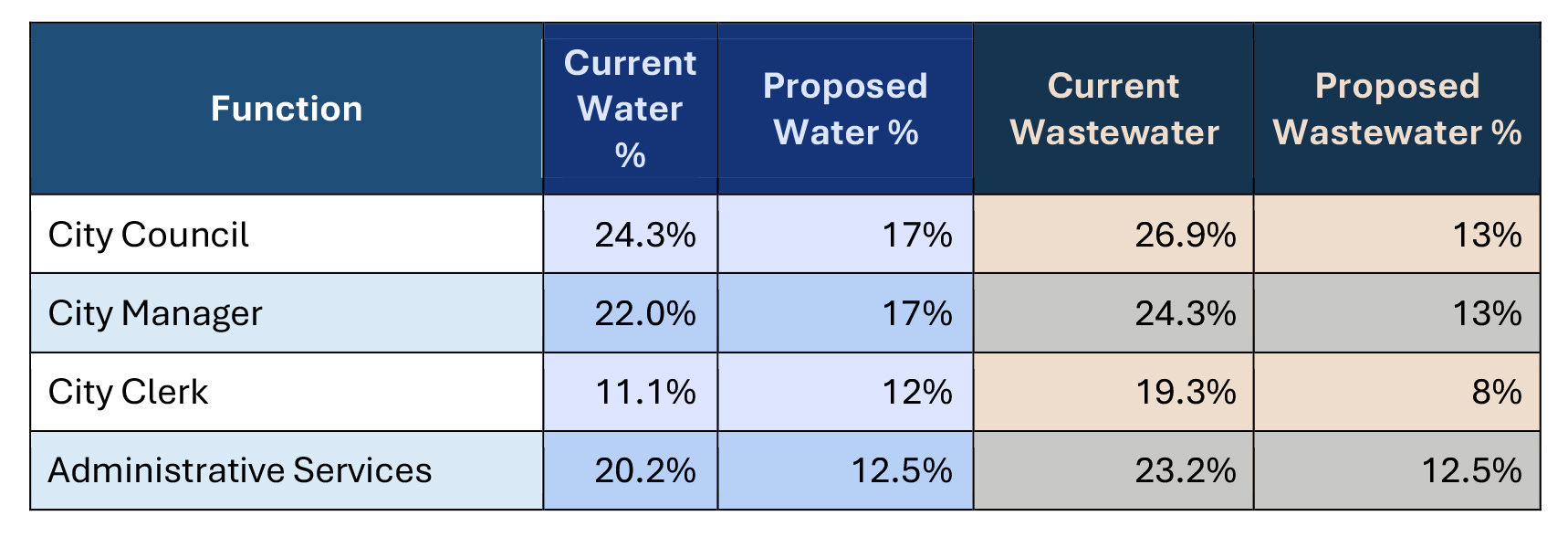
The proposed changes will result in a net reduction in charges to the Enterprise Funds of $467,779.
What Kwong did not say, but which regular readers of the Sebastopol Times may infer, is that relentless pressure from Kate Haug, Lee Mathias and others probably played a big role in the decision to revisit certain features of this year’s cost allocation plan.
Also on the table in this item was the question of whether repayment of the 2021 Syserco loan should be shifted from the Water and Sewer Funds to the General Fund. Haug has frequently mentioned this $5 million loan for smart meters and other water efficiency tools in 2021 in her critique of the council’s actions on water and sewer.
In last week’s meeting, she said, “They did not do their due diligence and meet their obligations to ratepayers when they took out the loan. It exceeds making a bad decision. It was a breach of fundamental duty to ratepayers.”
That said, she thought the downward revision of the percentage of time that the city said it spent on water and sewer was a move in the right direction.
“I would just say the numbers presented on staff time are the most accurate that we’ve seen, as they are based on time tracking,” Haug said. “I would encourage council to move forward with this. $486,000 is a lot of money for the enterprise funds and would help fund our infrastructure.”
The current staff recommendation was that that money be taken from the General Fund and returned to the Water and Sewer Funds in January as a part of the midyear budget review.
There was a long discussion about whether to put off this decision until the new, just-awarded cost allocation plan was completed in February. Mayor McLewis and Councilmember urged their fellow councilmembers not to wait. Both saw this item as a way to prove that the council is attempting to right the wrongs of the past.
“I’m with the mayor, and the fact that all of this work was to send a message directly to the public of the fact that we are trying to make things right as quick as possible,” Zollman said.
In public comment, Kyle Falbo urged the council not to delay, saying, “Kicking the can down the road again is exactly how we got here … You have the opportunity tonight to try to correct things.”
In the end, the council unanimously approved the staff’s recommendation to lower the allocation percentages for the city council, city manager, city clerk and administrative services, and return $467,779 to the Water and Sewer Funds at midyear. As part of this same motion, they agreed to reduce counter hours for utility customers from 8 am to noon. (Weirdly, the staff hadn’t come up with a suggestion and just accepted Kate Haug’s proposal for new hours, seemingly on the fly.) Council also agreed, for the moment, to keep the Syserco loan repayment with the Enterprise Funds.
Sebastopol considers repealing or revising its opt-in to AB1033, the ADU condominiumization law
In January of this year, the City Council amended the city’s Zoning Code to add provisions allowing the separate sale of ADUs as condominiums, as allowed by AB 1033. It was the first city in Sonoma County to do so, and among the first in the state.
At last week’s meeting, the council considered rescinding this opt-in and going back to the baseline of not allowing the sale of ADUs.
The item was put forward by Mayor McLewis, who opposed the opt-in in the first place, and Councilmember Maurer, who had initially supported the opt-in, but was upset when the Valentine housing development, which was made possible by AB1033, ended up removing more than a dozen heritage trees from the site.
In her introduction, Councilmember Sandra Maurer said she wanted to see if the city could add some design guardrails on the opt-in. Councilmember Zollman reiterated that he wanted all infill development kept along the main traffic and transit corridors. Maurer asked if the council could just put a moratorium on the opt-in.
City attorney Alex Mog said no because a moratorium hadn’t been noticed in the staff report, would have to be brought back as a separate item at a future, and anyway, would have to also go through the rather elaborate process required to change the Sebastopol zoning code.
Here are the steps required to do that, as described in the staff report.
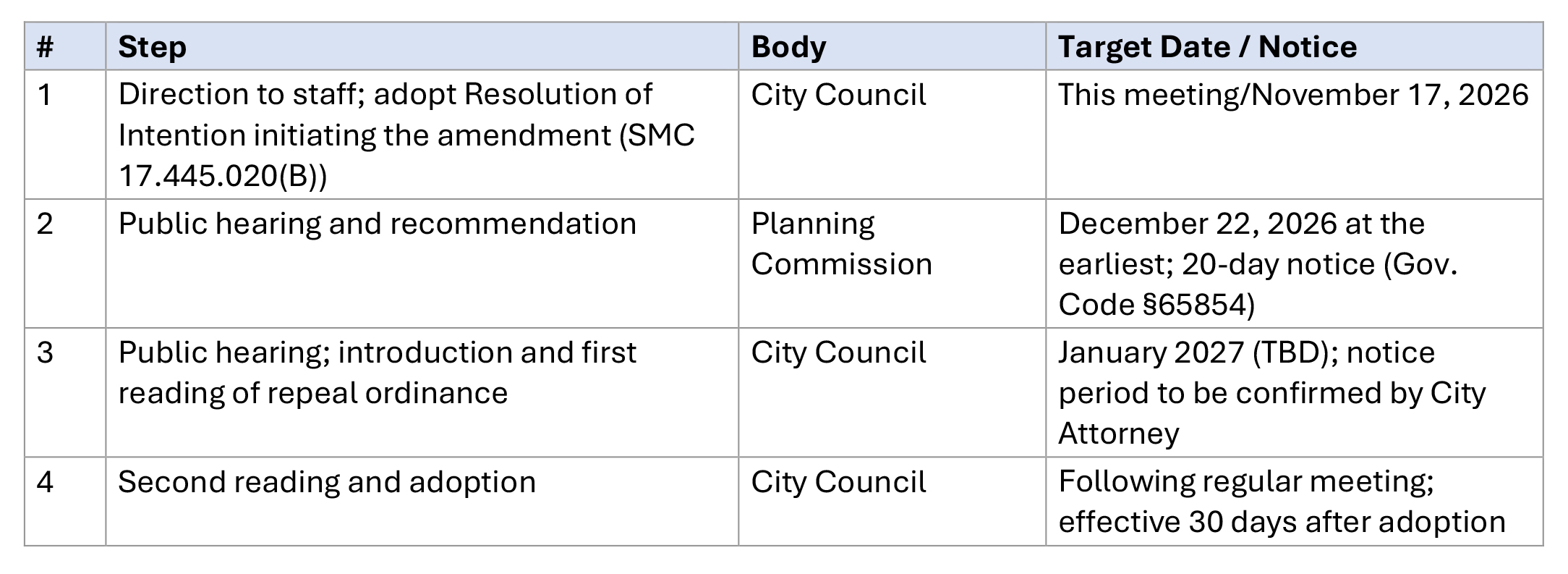
In its effort to repeal the opt-in to AB1033, the council last week was at Step 1: Creating a Resolution of Intention to amend the zoning code.
Despite the lateness of the hour, there were a number of public comments on this issue. Eleven people, including several folks who looked under 35, were opposed to rescinding the opt-in. For them, the ability to purchase an ADU seemed like an affordable way to get into the housing market. Four people (Kate Haug, Oliver Dick, Lee Mathias and Valentine neighbor Janet Lundgren) commented in favor of getting rid of it.
Resident Carly Qualio said, “I was here in December when you all passed this resolution. I was super excited about it, and I’m really disappointed today to hear that we’re even talking about repealing something like this … We desperately need affordable housing in Sebastopol. I moved here three years ago. I’m on the younger side of Sebastopol, but a lot of my friends are leaving because there’s nowhere to live, and we haven’t built any housing.”
Longtime Planning Commission member Paul Fritz was equally appalled. “I don’t know why the council would consider denying people homeownership opportunities,” he said.
Fritz told a story about an ADU project he worked on recently. “I’ve designed a project in Sebastopol, an ADU. The guy who lives there, he’s a landscape contractor. He’s been one for 25 years. He’s never owned a home. The owner of the property is considering selling it to him. He [the landscaper] could become a homeowner at 50 years old,” Fritz said. “I just cannot conceive of why this is a bad thing.”
Ted Luthin also opposed opting out of AB1033. Remembering the years he spent on the city’s Design Review Board, he said, “I think every development faces opposition. Most developments cut down trees. How many trees were cut down to put in that entire Valentine neighborhood? That once looked like Ragle Park. It doesn’t anymore, but now it’s people’s homes. It’s a community. It’s part of Sebastopol. So it’s easy to talk the talk, and it’s harder to walk the talk.”
On the other side, Kate Haug argued, “At this point the council should rescind this and work on some standards. Also develop impact fees and other requirements for ADUs in terms of how they will be sold. Who pays the impact fees?”
Noting how the Valentine project “went sideways,” Oliver Dick argued that “The city doesn’t have the ability … to handle this very green new law, which is being pounced on by very powerful, probably global, developers.”
Affordable housing lobbyists Jen Klose of Generation H and Celeste Goyer of the Casita Coalition were also on hand to speak in favor of AB 1033.
Kyle Falbo wisely noted how this issue pointed out Sebastopol’s desperate need for a permanent planning director. So many of the council’s questions and guardrail suggestions (many of which seemed blatantly illegal under current state housing law) could have been answered by someone who was actually an expert in this field.
In council comment, Phill Carter and Neysa Hinton came out strongly in favor of keeping the opt-in as is. Maurer and Zollman wanted to amend the opt-in to include guardrails around location and design.
Noting that she had lost the last election, Mayor McLewis’s comment on the issue was honest, thought-provoking and a little shocking. Her theme: How dare people ask for affordable housing in Sebastopol?
“I just don’t understand that mentality,” she said. “And I’m just going to say it: I’ve lived here for 12 years, and, like I said, I’ve lived all over this country — and it’s given me a lot of perspective. I would like to live in Tiburon, but I can’t afford it. And I don’t understand the mentality where everybody just feels that they have to live here,” meaning Sebastopol, “and they tell me it’s too expensive. I’m like, I lived in another state—a red state—for nine years so I could save money to buy a home here, and so I understand the sacrifice. I just don’t understand the mentality of ‘I should be able to live here, even though I can’t afford it.’ It just baffles my mind … After living in 25 different states and, like I said, another country, I just never heard anything like that anywhere else. I think it’s the feeling of entitlement.”
The final vote split 3 to 2, with McLewis, Maurer and Zollman voting to adopt the ‘resolution of intention’ to initiate a zoning code amendment regarding the AB 1033 opt-in, and referring the amendment to the Planning Commission for a public hearing. Hinton and Carter opposed this resolution.
An abrupt ending
At the very end of the evening, the council opened one final item — a request for proposals for various contracted services, including human resources, IT services, community outreach services, building official services, as well as a request by Mayor McLewis to hire an in-house Public Information Officer (PIO) rather than a contractor for community outreach. In public comment, Oliver Dick said he supported the PIO position, which he felt was necessary because he said otherwise so many people just read the Sebastopol Times, which he accused of cherry-picking facts (which he gave no examples of) to serve an agenda which he did not define.
By then, it was 10:30 pm, and a clearly frustrated Neysa Hinton called a halt to the proceedings. Sebastopol’s City Council Protocols have a 10:30 pm adjournment deadline. To keep going, there must be a motion to extend the meeting, and if even one councilmember declines, that’s the end.
The question of the RFPs for various contracts—and many of the other items left on the Nov. 17 agenda—will be discussed at an early “catch-up” meeting of the Sebastopol City Council on Dec. 1 at 5 pm. The regular Dec. 1 city council meeting will start at 6 pm. Both meetings will be held at the Sebastopol Youth Annex, 425 Morris St., Sebastopol, and on Zoom. See the agenda and documentation.
You can watch a video of the Nov. 17 Sebastopol City Council meeting here.
Re Mayor McLewis's comments on amending the opt-in to AB1033: AMEN! Plenty of over-35s also worry about continuing to live here, after spending decades working in order to finally afford a home in an area they like, only to have that area turn into something completely different, usually at the discretion of very few people (2 or 3 town council members) and/or monetary influence (greedy developers). I don't live near Valentine Ave., but my heart goes out to those current residents. I would've thought a 10-unit development there would seem excessive, but given the need for housing, perhaps understandable. But 39 units?! That's utterly insane. If amending the opt-in is a way to prohibit any further monstrosities from being constructed, again I say, AMEN!
Thank you Kate Haug and City Council for holding St Vincent accountable and to their word!! Pay their share like everyone else.