

Mayor Jill McLewis, Vice Mayor Sandra Maurer, Councilmember Phill Carter, Councilmember Neysa Hinton, and Councilmember Stephen Zollman were present in chambers for the Sept. 15 Sebastopol City Council meeting.
For the last year, the members of the Building the Commons Committee have thrown their hearts, minds and organizing prowess into the project of moving the library, the senior center, and city hall to more expansive digs somewhere in Sebastopol. Both the Senior Center and the Sebastopol Library (before the mold issue) were bursting at the seams, and, as the months went by, the committee honed in on a preferred option: the beautiful and long-empty O’Reilly buildings at the north end of town. Over the summer, they held three informational meetings for the public — two at O’Reilly and one at St. Stephen’s.
On Tuesday night, the Commons Committee submitted its final report and asked the city council to approve three requests:
to authorize 40 hours of staff time, 10 hours of city attorney time, and $40,000-$50,000 for a fiscal and design review of the O’Reilly site.
to send a formal written request to the Sonoma County Library Director seeking joint capital planning and potential cost participation.
to dissolve the existing Building the Commons Committee and replace it with an advisory Ad Hoc committee that would continue to do the due diligence needed to firm up the concept.
There was a long council discussion and remarks from 20 public commenters who were evenly split pro and con on the O’Reilly site (as were the written public comments for that evening). In the end, the council declined on a 4 to 1 vote to grant any of the committee’s requests, agreeing merely to reconsider creating an ad hoc sometime in December before the midyear budget review. Mayor Jill McLewis, the sole dissenter, declined to agree even to that.
For many on the Commons Committee, it was a crushing blow and a harsh repudiation of the hundreds of volunteer hours they’d expended over the last year.
“The naysayers, on the Council and in the public, prevailed with force,” said former, longtime city councilperson Sarah Glade Gurney, who was a member of the Commons Committee. “To me, the council’s energy, their comments, and their decision, causing significant delay, feel damaging to our local community and to our wider community in the West County, upon which we rely. It was more than disappointing.”
Retired attorney Kent Jenkins, one of the driving forces behind the Commons Committee, wrote to the Sebastopol Times, “Because our committee was convened at the will of the Council, it was their right to accept or not accept our results and recommendations. I understand that’s how the system works … The Council is charged with looking at the whole health of the city, and we spent a year focused only on a part. What’s unacceptable was their deceit in claiming to have read our reports, listened to our presentation, and then to proceed to make points and ask questions which clearly demonstrated they did not have respect for or command of the material.”
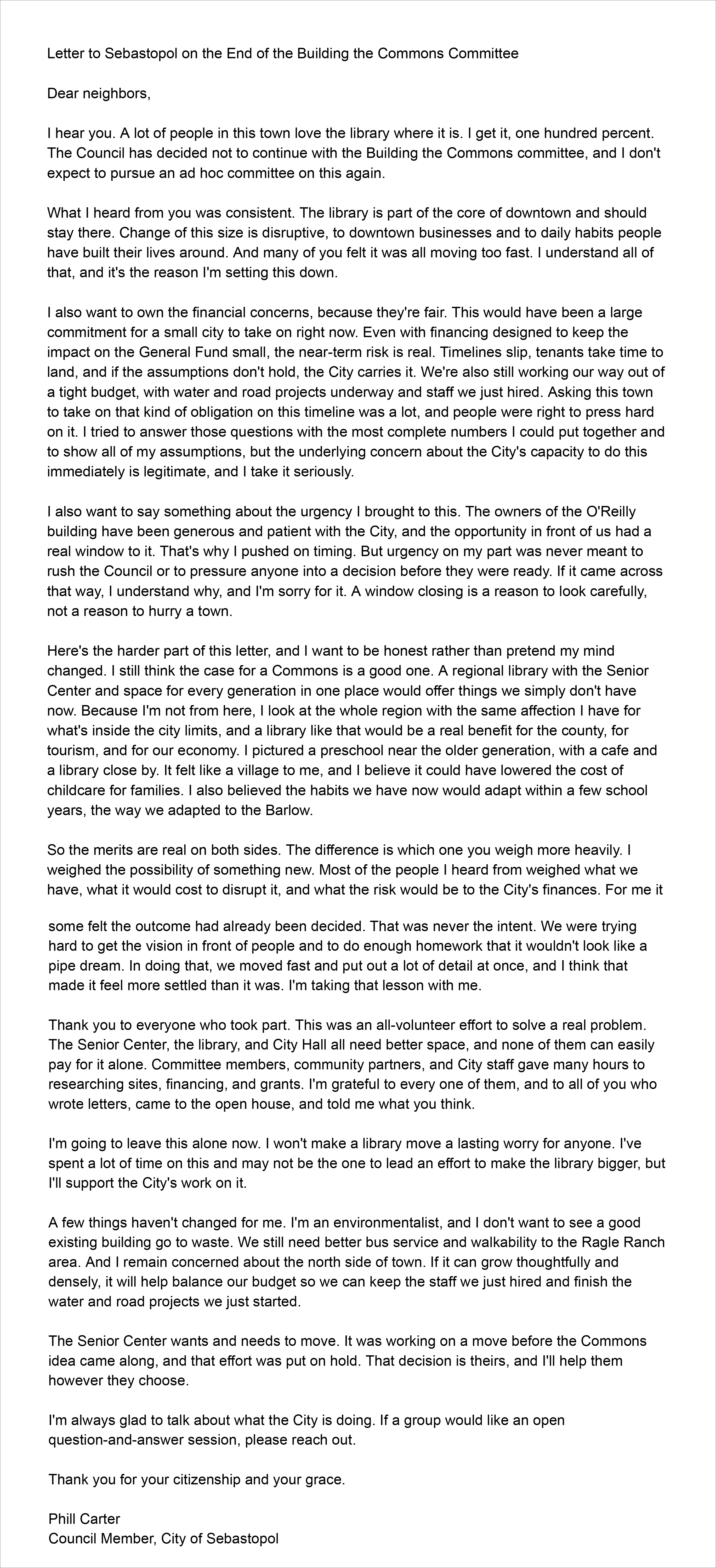
Other Commons Committee members were more philosophical. Councilmember Phill Carter wrote that, though he still believed in the Commons project, he realized that some people in the community felt the committee may have pushed things too fast.
“The merits are real on both sides. The difference is which one you weigh more heavily. I weighed the possibility of something new. Most of the people I heard from weighed what we have, what it would cost to disrupt it, and what the risk would be to the City’s finances. For me it was about 80/20, never a sure thing. When that many neighbors tell me the downtown library is worth protecting, that outweighs my 80. That’s how this should work,” he wrote in an open letter to his fellow citizens. (See his full letter at the end of this article.)
Here’s how the council’s decision unfolded:
A history of the project and a plea to continue
RM Horrell, the CEO of Copperfield’s and the business community representative on the Commons Committee, began by giving a brief history of the project — how a nonprofit library group called LANTERN evolved into a city council committee to expand the library and then evolved again into the Building the Commons Committee, when it became clear that several other Sebastopol institutions, including the senior center, needed more space.
Until the recent mold issue, the Sebastopol Library was one of the busiest in the county. The current building is roughly 10,000 square feet. A 2019 Facilities Master Plan from Sonoma County Library stated, “Given the inadequacies of the existing building, it is strongly recommended that it be replaced with a larger branch of at least 20,000 square feet.” The Senior Center is similarly constrained; the Sebastopol Community Center is at a permanent risk of flooding, and city hall is small and due for a refresh.
As a result, early on in his term, Councilmember Stephen Zollman came up with the idea of a civic hub for all these organizations that ultimately became the Sebastopol Commons. Once it became a city committee, he was joined by Councilmember Phill Carter and a host of others who made up the Committee to Build the Commons: Senior Center representative Kent Jenkins; Sonoma County Library Foundation’s Naomi Hupert; Sebastopol’s representative on the Sonoma County Library Commission, Fred Engbarth; Sarah Glade Gurney, a member of Sonoma County Library’s Measure Y Oversight Committee; branch manager of the Sebastopol Library Deb Hoadley; Gravenstein Health Action Coalition’s Mary Lou Schmidt; and Copperfield’s CEO RM Horrell.
Together, they spent the last year figuring out how the Sebastopol Commons might work. They looked at properties all over the city and ultimately landed on the O’Reilly complex at the north end of town.
In his presentation to the city council on Tuesday, he said, “The way that the O’Reilly Building would solve all of our options is it provides for a library, a senior center, a city hall, a community cultural center, at a capital cost of about $18 million, which can be funded through long-term investments, through EIFD funds, through partnerships, through solicitation of donors throughout West County. And so therefore it is our unanimous agreement as this committee that the City Council perform a due diligence examination.” The project was also reliant on renting commercial space in the building.
He contrasted that $18 million (really $20 million with renovations) for a complex that would house the library, city hall, the senior center and other local nonprofits with the $36 million it would cost to do a total rebuild of the library alone in its current location.
The committee was not asking the council to buy the building but merely to do the kind of due diligence required before a purchase of this sort could be considered.
A skeptical council
Right out of the gate, the questions from several council members, even those that had been previously sympathetic to the project, had a vaguely prickly edge. Councilmember Maurer listed a number of items at O’Reilly that would need repair—ranging from the roof to the carpets. She asked if those repairs were included in that $18 million figure. They were not, Horrell said, though they were mentioned in the report, which added an additional $2 million for renovations, making the total $20 million.
Commenting on the committee plan to help pay for the complex by renting out portions to other businesses and nonprofits, Councilmember Hinton noted that there were rules around renting government-funded buildings to private entities. She turned to City Attorney Alex Mog to elaborate:
“The IRS has rules about how much private activity can be involved,” Mog said. “So generally, you’d think maybe 5 to 10% of the square footage overall.” He also said that if the city wanted to borrow money from a commercial bank for the project, “The city can’t take out any debt that is secured by the general fund without a vote of approval of the voters.”
Hinton also said she believed the hours of staff time involved in supporting this project was higher than reported.
Vice Mayor Maurer seemed to feel that the $36 million number to rebuild the library on its existing site was too high. Maurer asked whether the committee had explored the cost of an addition—perhaps in the area where the large cell tower, next to the library, is currently located. Horrell noted that the figure was based on the average cost of building per square foot and the number of additional square feet suggested by the 2019 Sonoma County Library Report.
McLewis also expressed dismay that the city was talking about selling existing city buildings — even before the issue had come to council — and she asked Mog to explain the requirements involved in that. According to California’s Surplus Land Act, municipal property must be offered first to housing developers, with a stipulation that 15-25% of the units must be affordable, which could affect the appraised value of the property.
Because municipally owned buildings don’t pay taxes, McLewis also noted that the city would lose the taxes the current O’Reilly building owners are paying, which Mog figured at around $26,000. At the same time, the city would be taking on the expense for a large building.
Horrell reminded the council that the reason the committee was asking for $40,000 to $50,000 for consultants was to explore financial and structural questions like these.
A divided public
In public comment, Martin Reed, re-emphasized Horrell’s point: “Tonight has surfaced important questions about building condition, renovation, financing, tax impacts, and community support. These aren’t reasons to reject the idea before examining it. They’re exactly what due diligence is for.”
Several people, including Lisa and Steve Pierce, Paul Fritz, and Jennifer Koelemeijer, objected to moving the library from the center of town, both in terms of walkability and downtown vitality.
“Take those everyday reasons to be here away, and you pull the energy and the people out of the heart of our community,” said Koelemeijer, who is both a Planning Commissioner and the owner of a small business, Gather, on Main Street. “You also make these services harder to reach,” she said, referring the Library and City Hall.
”The O’Reilly site is a place for most of us to get to only by car.”
Others said they simply believed that the town couldn’t afford it, either financially or in terms of staff time. Kate Haug, after mentioning the city’s $5.5 million debt to its water and sewer departments, said, “There is no way the city can handle a project of this magnitude. It simply does not have the resources.” Oliver Dick, echoed this sentiment, carrying a small sign that said, “The County should be paying for this.”
Craig Boblitt asked, “If the building is so cheap, why has it been on the market for so long? I own real estate here in town. I own an office building in town, and office space is difficult to manage, and the city should not be a landlord.”
But the project had an equal number of supporters. Several people from the Senior Center spoke in favor the Commons at the O’Reilly, all of them mentioning how desperate the senior center is for space, including long waitlists for classes and services.
Several speakers, including Craig Litwin and Dena Bliss, said thought it would be a pity to let all the work the committee has done thus far go to waste. “This is a pivotal moment and an opportunity, and I’d hate to see us throw it out at the very end after such hard work,” Litwin said.
Dena Bliss, after expressing her appreciation for the Commons Committee, said, “It seems to me that … they’ve looked at all kinds of opportunities downtown, found that there really weren’t great opportunities downtown. They have found something that might be workable, and I agree with the speakers that have said, “Let’s move forward and check out the last pieces of this to see if we can make this work in our lifetime.’”
Lawrence Jaffe supported exploring O’Reilly further. “What a great night of civic debate!” he began. “Speaking from my side, Henry Ford said, ‘If I’d asked people what they wanted, they would have told me that they want faster horses.’ This is a transformational moment. This is as big as putting the train into Sebastopol and taking the train out. This is as big as adding Ragle Park or adding this whole section where we are now,” meaning the Youth Annex and, by extension, the Barlow. “We are at a transitional moment. We don’t yet have enough information to know yet if the risk is worth the reward.”
Carolyn Jenkins, whose husband Kent was on the Commons Committee, rose toward the end of public comment. “I had a chance to observe some of the methods and how much time and effort the entire committee put in to put this together. So I do wish people who like to be armchair quarterbacks would ask questions with an open mind. It’s really frustrating to see that people already have a decision in their head and they just want to say no to it, and that is very frustrating to watch.”
The council’s not-so-final decision
In the staff report, city staff recommended moving ahead with the O’Reilly project, which included the following:
To direct staff to proceed with formal lease-option negotiations, appraisal, legal review, and financing packages for the 1003–1007 Gravenstein Hwy N campus; direct that a formal request for partnership and consent be transmitted to the Sonoma County Library; authorize community outreach in advance of any final decision; convert the Committee to an advisory ad hoc committee; and appropriate funds for the professional services above — returning to Council within 60 days with scope, cost, and negotiation status, and with a final action plan no later than the date set by Council.
But the staff report also gave the council two additional options:
Receive the committee’s final report and take no additional action.
Receive the committee’s final report and choose instead to pursue a long-term new construction or reconstruction project on the current downtown city-owned block; and form a new standing committee to further develop that project.
In the end, the council chose a mixture of the above—each for their own reasons.
Councilmember Hinton said she thought the financial expectations from the EIFD were overstated and that the county should fund further exploration of this concept, since two of the main tenants—the library and the senior center— also serve West County more broadly. It also irked her to pay for tens of thousands of dollars for consultants for projects that may not work out.
“I want to pump this decision to the midyear review, which is our policy, and have the budget committee review it to see if we have enough money to fund this additional ask. So that’s not saying no, but it’s also not saying ‘right now’.”
Mayor McLewis said the feedback she’d gotten on the O’Reilly proposal had been overwhelmingly negative. Having attended the most recent meeting at O’Reilly, she could see its charms: “It’s beautiful. I mean, who wouldn’t want that?”
But she didn’t think the city should be the only one paying for it. “I grapple with the idea that it’s the responsibility of the city and our taxpayers,” she said. “Where’s the funding from the County? There’s only 7,500 people here in total—3,300 homes paying taxes here—and should the citizens living here within this city be responsible for paying for all the services for people [in the county] who are not actually paying into that? There’s only so much to go around.”
She also said she was concerned about downtown vitality and “the risk of destabilizing our city finances.”
Councilmember Maurer shared many of McLewis’s concerns about finances and the importance of keeping the downtown core strong, and she agreed that a small city of 7,500 couldn’t foot the bill for services for the 50,000 folks who live around it.
“Sebastopol is amazing and wonderful because of the West County,” Maurer said. “We could never have as many restaurants as we do, or as great services, as great of an art center, a senior center, a community center. All these services are great because we have so many people — 50,000 people [in greater West County] — surrounding us that are using them. So I have a lot of appreciation for the West County residents for that reason because they make our town really great. But we have budget constraints right now. We’re looking at an $850,000 deficit for this year. So the idea of saying, okay, well, we’ll give you $50,000 and a bunch more staff time, I just can’t do that.”
She liked Hinton’s suggestion of kicking the concept to midyear and requested that this include consideration of doing an addition to the library—something she felt the Commons Committee had overlooked.
Councilmember Carter began by thanking the Commons Committee members for all their hard work.
“I’m super impressed with the work that everybody’s been doing for the past year, and I’m grateful for the grace that everybody’s had as we’ve come out watching. You know, we were making the sausage. It’s not pretty when it’s getting made. It’s now out of the bag, and now it’s the time for the whole entire city to take a look at this.”
Although he still thought O’Reilly was the best solution, he said he was taking the concerns of its critics seriously—the financial concerns, the county’s contributions, downtown vitality. He agreed with Hinton and Maurer on the idea of possibly creating an ad hoc to review matters in December.
Throughout council comment, Councilmember Stephen Zollman sat still and utterly silent.
Before council moved to the vote, Mayor Lewis couldn’t resist scolding the Commons Committee about its approach. “It felt like a sales job, not an informational type of thing,” she said. “I had several people tell me … they felt like they were in a—what’s it called?— a timeshare thing. That’s what that was the analogy they used.” She also blamed the committee for creating the impression, even before it came to council, that the choice of O’Reilly was a done deal.
Ouch — and surprising, given that committee members repeatedly said during presentations that no decision had been made and nothing was set in stone.
The council voted 4 to 1 (Mayor McLewis dissenting) to direct staff to bring back at the second meeting in December consideration of creation of an ad hoc committee to reconsider both the O’Reilly site and city properties downtown (i.e., the library, city hall, and the parking lot).
A letter from Phill Carter
I was disappointed in this outcome. The committee did a lot of work and presented their findings well. I belong to the Senior Center and classes are full making it difficult to enjoy…