


Sebastopol has been wrestling with some big, tumultuous issues this winter—the possibility of Grocery Outlet, the one-way/two-way street decision, the future of Ives Park—but there was an interesting, if less flashy, discussion on the city budget at the Feb. 3 Sebastopol City Council meeting that’s worth reviewing.
Administrative Services Director Ana Kwong introduced the mid-year budget report with the following summary:
“The city is in a little bit better shape at this stage than it was when the budget was adopted in July of 2025,” she said. “The mid-year adjustment increases the General Fund with a surplus of $466,000, compared to the original adopted budget, with a surplus of $4,000. So the picture is improving a little bit.”
She noted that this change would increase the General Fund reserve level from 25.5% to 29.3%, which far exceeds the 15% minimum and the 20% reserve goal set by the city council.
She clarified that this increase in funds was a one-time occurrence—the result primarily of the large number of unfilled positions in city government.
“I want to make this very clear that this cost saving is a one-time cost saving due to salary vacancy, and this is not to be repeated year after year,” she said.
Money in, money out
Kwong said that revenues to the city increased slightly by roughly $11,000. Although sales taxes declined slightly, this was made up for by an increase in property taxes.
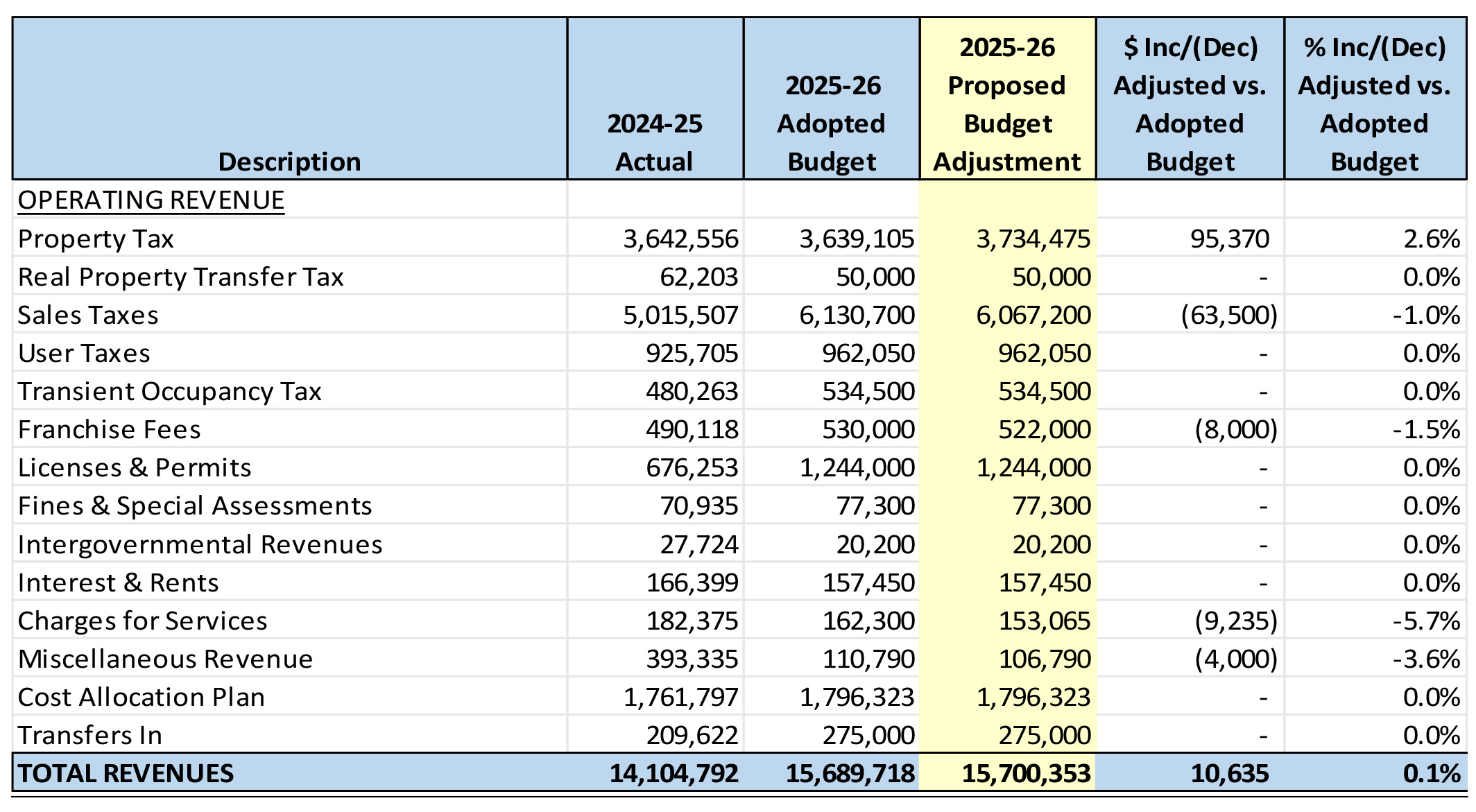
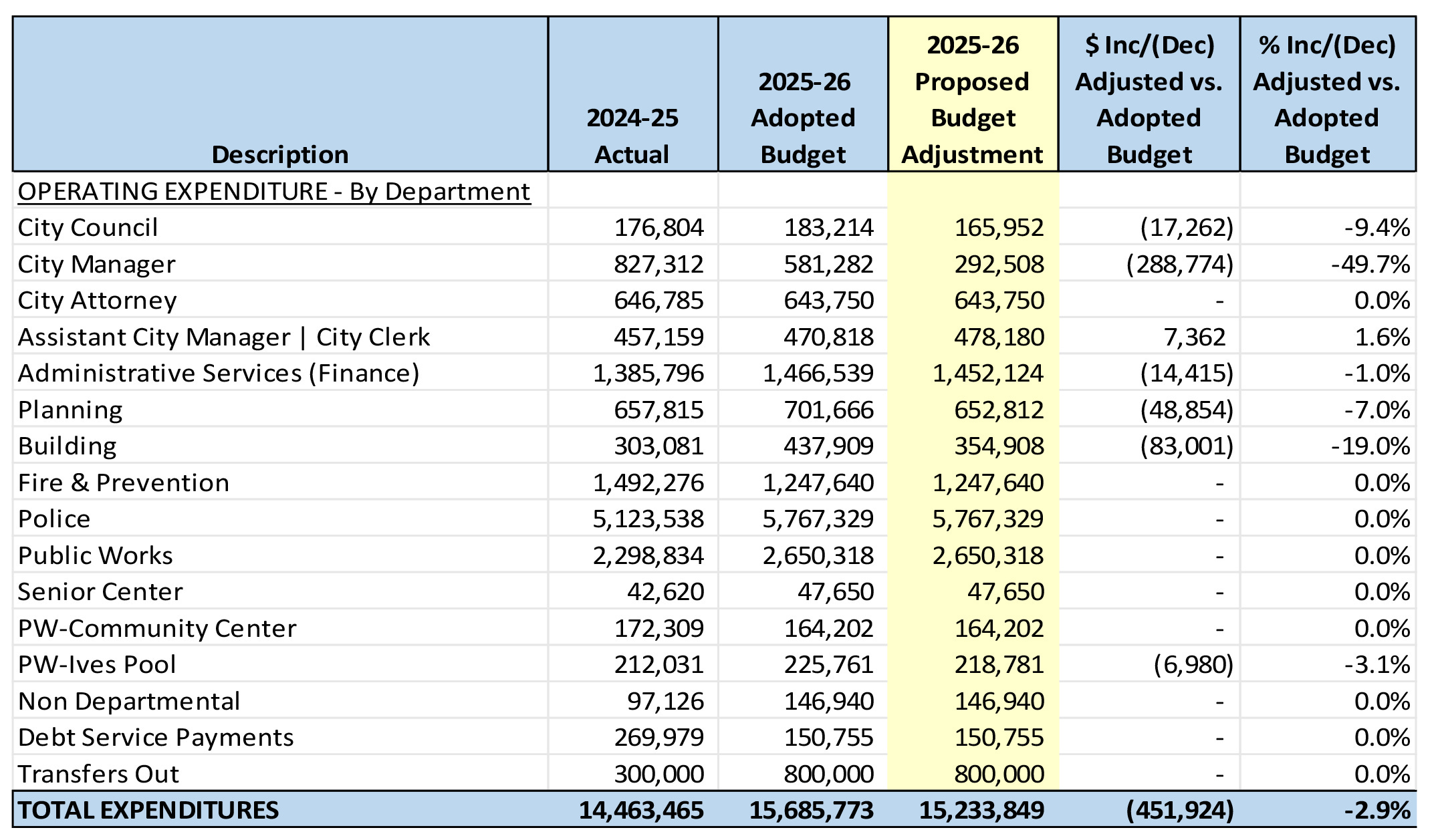
The real savings—$451,924—came on the expenditures side because of the large number of unfilled positions at the top of the city government. Not having an official city manager, for example, saved the city almost $300,000.
In light of these improved numbers, Councilmember Neysa Hinton asked whether it was time for the council to lift its “Declaration of a Fiscal Emergency,” which was put into effect in Nov. 2023. Mayor Jill McLewis said she had the same question.
Interim City Manager Mary Gourley counselled holding off on lifting that declaration. “I just want to caution, as was just stated, that these are one-time funds,” she said. “I would think— when we’re going into the preparation of the new year—that is when we want to look at whether or not we want to rescind that fiscal emergency resolution…Wait until we get to the preparation of the new budget for the upcoming fiscal year to see where we’re at, before we bring that item back.”
Noting that the city was significantly over its reserve target, Councilmember Sandra Maurer asked whether the council could spend some of those new reserves on, say, road repair. “So when do you think we can talk about allocating that surplus? Because 29% is quite far over our reserve policy,” she said.
Kwong again cautioned that this $466,000 savings was one-time money, and that financially, the city was not yet out of danger. She pointed to the two forecasts in her staff report—one that included the Barlow Hotel and one that didn’t.
“As you can see, with no hotel, as forecasted for next year, we’re back to the deficit,” she said.
What’s happening with the Water and Sewer Enterprise Funds?
Kwong also spoke briefly about the Water and Sewer Enterprise Funds, saying they were on track for the year.
Thanks to a rate hike two years ago, both funds are in the black. According to the staff report, “As we enter the second year of rate adjustments, the strengthened position of the enterprise fund reflects our ongoing commitment to financial stability and the continued delivery of essential services. Our intent is not to generate excess funds, but to maintain a sound financial foundation and plan responsibly for the future.”
The purpose behind increasing rates was twofold:
To ensure rates fully capture our operating expenses, including all associated costs.
To create contingency reserves that can address future capital improvements and emergency repairs without jeopardizing service quality or financial stability.
There has been an ongoing discussion about whether the city’s current cost allocation plan moves too much money from the Water and Sewer Enterprise Funds into the General Fund. A city’s cost allocation plan is a method for distributing the costs of shared services—like administration and legal expenses—across different city departments.
Under public pressure, the city council set up an Enterprise Fund Oversight Committee to investigate this and other matters. According to frequent commenter Oliver Dick, who is a member of the Oversight Committee, the committee is just getting on its feet and is working on getting up to speed.
During public comment, a frequent commenter who goes by the name of Robert noted that, “There’s a linkage that’s often overlooked between the General Fund and the Enterprise Funds.” He pointed out that the Enterprise Funds were still being charged for their portion of the city manager’s salary, even though, there is currently no city manager, and that that vacant position accounts for a big chunk (about $288,774) of the new surplus. “The point here is, if you take one down, you need to adjust the other.”
He noted that if this had been correctly calculated, “Your revenues and your surplus is a quarter less. So don’t spend it all.”
Councilmember Maurer asked if it might be possible at the end of the upcoming budget process to “true up” with the Enterprise Funds—not to reduce the rates for the rate payers but to fund badly needed water and wastewater repairs.
Gourley said that might be possible and it was something the Oversight Committee was looking into.
Mayor McLewis asked somewhat impatiently exactly what the Oversight Committee was doing. “What is the goal of that committee, like timeline-wise? Are they getting the information that they need so that they can move forward and when will this happen? When can we [the city council] expect to have some type of information? Is there a goal or a plan?”
Interim City Manager Gourley said, yes, the committee was getting all the information it needed and was digging into “how much has one department been allocated versus how much have we truly spent? So we’re doing one department as an example to see if maybe, for that one department, it would be better to have direct cost rather than this cost allocation plan.” She said city staff expected to bring an agenda item discussing cost allocation in March.
Changing how cost allocations are calculated could have a dramatic effect on city finances. If you look at the General Fund Revenue chart at the top of this article, you’ll notice that the cost allocation plan pours almost $1.8 million a year into the city’s General Fund.
Look at the 5 year budget projection in the same document. Without the Barlow Hotel the city is projecting to be below policy reserve levels in FY27-28 and it will run out of reserves in FY29-30. Even with the hotel reserves are effectively depleted by FY 29-30.
Reserves are critical to ensuring sufficient cash to pay bills when expenses and revenues don't match during the year. Also, they are critical to help the city get through economic downturns or meet an unexpected expense. Once reserves get below a certain level expenditures may have to be delayed until revenues are realized or the city has to borrow money from the "bank". Once they are depleted the city is effectively bankrupt and the county takes over the city.
It is unclear that the council is aware and focused of the problem. The discussion about being out of a financial crisis was alarming. The council was discussing the actual document that shows bankruptcy in the immediate future. They should have been asking questions like what level of reserve is necessary to ensure sufficient cash flow to pay the bills during the year.
Rather than cancelling the financial emergency or accelerating spending of "excess" reserves, the council should be talking about establishing a "Financial Oversight Committee" that includes members of the community that understand finances and can consider new options to strengthen the city's financial future.
Historically, the solution has been to not spend money to fix the streets. The 5-year forecast includes $800,000 per year to fix streets. It is likely that is more than has been spent by the city (without grant money) in the entire last 10 years.
According to a recent MTD report the city's pavement condition index (PCI) of 50 is the worst in Sonoma County. A score of 49 is considered poor. Streets in this condition cost 5 to 10 times more to repair than is cost to maintain fair/good streets.
The 2025 Street study estimated that the city would have to spend minimally $1MM a year to just maintain the current overall pavement score. at $800,000 the PCI will continue to decline.
If the city council follows the pattern of previous councils, expect the $800,000 for street repairs to morph into a priority to fix potholes.
Given budget problems why is the city obsessed with two way streets that are 1/unpopular; only 23% actually want two way streets, and 2/ against the recommendation of expensive consultants. This plan is wasting our money and will destroy the downtown at the behest of a developer (see the Sebastopol Times article reporting on a secret meeting with Chamber of Commerce, developer of a dying flooded outdoor mall including at least one council member) pushing for two way streets. Let's re-route all the northbound traffic from 112 through the Barlow to give it the small town Main Street feel instead!